Not as a verified production-car result. Reports describe a Huawei patent for a sulfide solid-state battery targeting up to 3,000 km (about 1,864 miles) and charging in five minutes. Those are filing-related claims and theoretical targets, not independently demonstrated performance from a retail EV.
What Huawei’s patent is reported to claim
The headline figures come from coverage of a Huawei battery patent reported by CarNewsChina on June 18, 2025, and VnExpress on August 19, 2025. The reported architecture is a sulfide-based solid-state battery with a nitrogen-doped sulfide electrolyte.




As an Amazon Associate I earn from qualifying purchases.
| Claim or feature | What the available reporting says | What is not established |
|---|---|---|
| Range | Up to 3,000 km (about 1,864 miles) | The vehicle, battery-pack size, operating conditions and certification cycle are not stated |
| Charging | Five-minute charging is commonly reported | The exact start and end state of charge differs between reports |
| Energy density | Approximately 400–500 Wh/kg; SlashGear reports 500 Wh/kg as the upper figure | Whether the figure applies to a cell, module or complete pack is not established |
| Development status | Patent-stage design and target or theoretical performance | No independently verified production-EV demonstration |
The range number should not be compared directly with a showroom car’s EPA, WLTP or CLTC rating. No test cycle is identified in the available coverage, and those cycles produce different results.
The Tool Desk
Outbyte PC Repair FREEClear out junk files and repair common Windows errorsFree Scan →Outbyte Driver Updater FREEFix the driver behind crashes, sound loss and screen glitchesFind Drivers →Is Huawei’s 3,000 km battery real?
The patent is real as an intellectual-property filing, but the performance remains a claim. A patent can describe a composition, structure or operating target without proving that a complete battery pack can be manufactured reliably or installed in a road car.
#1 Best Overall
SlashGear’s Brian McHugh made the limitation explicit in its July 1, 2025 article: Of course, for now, it’s just a patent. This battery may never actually come to fruition or get the same performance Huawei is claiming.
That is an assessment of the report, not a Huawei statement.
A verified 3,000-km road range would require, at minimum, an identified vehicle, a defined test procedure, usable pack capacity, mass, environmental conditions and repeatable testing. Those details are not supplied here.
What does “five-minute charging” mean?
The phrase is ambiguous in the reporting and should not be treated as a confirmed zero-to-100% result.
| Source and date | Charging window described | How to read it |
|---|---|---|
| VnExpress, August 19, 2025 | 10% to 80% in under five minutes | A rapid partial charge, not a full battery refill |
| SlashGear, July 1, 2025 | Headline and text present a full-charge claim | The exact test window is not clear from the available summary |
Until the patent’s test conditions and charging window are documented, “five minutes flat” is best treated as headline shorthand. Charging from 10% to 80% is also materially different from charging from empty to full because the battery receives less energy and charging systems commonly reduce power near high state of charge.
How much charger power would five minutes require?
The basic calculation is energy divided by time. Five minutes is one-twelfth of an hour, so the ideal average power is:
Power (kW) = energy delivered (kWh) × 12
The following examples are illustrations, not Huawei specifications. They exclude charging losses and any reduction in power during the session.
Rank #3
| Illustrative pack | Energy delivered | Ideal average for five minutes |
|---|---|---|
| 100 kWh pack, full charge | 100 kWh | 1,200 kW (1.2 MW) |
| 100 kWh pack, 10%–80% | 70 kWh | 840 kW |
| 150 kWh pack, full charge | 150 kWh | 1,800 kW (1.8 MW) |
| 150 kWh pack, 10%–80% | 105 kWh | 1,260 kW |
Real equipment would need more input power than these ideal averages because of charger, cable and battery losses. The site, connector, cooling system and electrical grid would also have to handle megawatt-class demand for a large pack. A patent claim therefore involves an infrastructure question as well as a cell-chemistry question.
Quick wins for a faster PC:
Repair Windows errors before they cause bigger problemsFix Now →Scan for outdated or missing drivers - takes under a minuteDriver Scan →What is the proposed battery chemistry?
Sulfide solid-state electrolyte
Instead of the liquid electrolyte used in conventional lithium-ion cells, the reported design uses a sulfide solid electrolyte. Solid-state architectures are pursued because they may permit different electrode designs and reduce reliance on flammable liquid electrolyte, but the patent coverage does not establish a finished pack’s safety performance.
Nitrogen doping
The electrolyte is described as nitrogen-doped sulfide. The reported purpose is to reduce side reactions at the lithium interface and improve electrochemical stability, safety and cycle life. These are intended benefits of the formulation; the available reports do not provide independent cycle testing or vehicle-level validation.
Rank #4
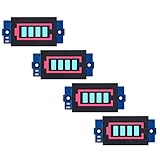
- The 2S battery capacity indicator module can be used to display lithium battery, lead acid battery, and Ni-MH battery.
- Clear and bright display, outline red, display block Blue. The different electricity quantity will illuminate corresponding blocks electricity quantity.
- How to use it: Connect the positive and negative terminals of the display board to the positive and negative terminals of the battery under test. The digital tube displays the real-time battery power.Note : after connecting a few series of lithium batteries in series, it is necessary to connect t-i-n to the corresponding pads.For example if a 2S battery is measured (two 3.7V lithium batteries are connected in series), a short circuit on the pad corresponding to S2 of the board is required.
- Widely applications: Can be widely applied to portable mobile equipment, electro mobile, balance car, cleaning machine, measuring equipment etc. battery capacity indicator.
- Note: The electricity quantity parameter is a reference value, there will be about 2% error range; This model is not waterproof, the electronic components should be used in a dry environment; The number of corresponding battery strings and use them within the corresponding voltage range. Do not exceed a voltage of 4.3*N at most.(for example, if the t-i-n on the pad of S3 is selected, the maximum voltage detected by the module should not exceed 4.3*3=12.9 V).
What does 400–500 Wh/kg imply?
Energy density states how much stored energy weighs one kilogram. The reported 400–500 Wh/kg figure is unusually ambitious, but it cannot by itself establish a vehicle’s range. Aerodynamics, speed, weather, tires, drivetrain efficiency and usable state-of-charge limits all affect distance traveled.
For scale, if the reported number applied to active battery material, a 100 kWh energy store would require an idealized 200 kg at 500 Wh/kg or 250 kg at 400 Wh/kg. A 150 kWh store would be 300–375 kg on the same simplified basis. Those calculations exclude casing, cooling, busbars, safety systems, controls and other pack components; the reporting does not say whether its figure includes them.
What remains unknown before this could be a production EV battery?
- Vehicle demonstration: no independently verified car test is identified.
- Charge profile: the precise state-of-charge window, power curve and charging losses are not published in the available coverage.
- Pack mass and usable capacity: neither is established, so the range claim cannot be converted into an efficiency or pack-size estimate.
- Thermal management: a five-minute session would generate substantial heat and require a validated cooling design.
- Cycle life: the reports describe a goal of improved cycle life but provide no independent endurance result.
- Manufacturing: yield, defect control, scale-up and compatibility with automotive production lines remain open questions.
- Cost: no production cost or vehicle pricing is reported.
- Charging network: megawatt-class charging would require suitable hardware, grid connections and site safety systems.
How does this compare with StoreDot’s five-minute demonstrations?
StoreDot offers a useful reality check, but it is evidence about StoreDot’s technology, not Huawei’s patent. In a November 3, 2021 company release, StoreDot said it had demonstrated five-minute charging in a two-wheeled electric vehicle and a drone. The release did not make that demonstration a validation of Huawei’s chemistry, range claim or automotive pack design.
| Comparison point | Huawei patent reporting | StoreDot release, November 3, 2021 |
|---|---|---|
| Demonstration | No independently verified production-car result identified | Five-minute demonstrations reported in a two-wheeled EV and a drone |
| Charging window | 10%–80% in under five minutes in VnExpress; full charge presented by SlashGear | Exact comparable window not stated here |
| Energy density | 400–500 Wh/kg reported | Not stated in the cited release |
| Vehicle range | Up to 3,000 km claimed | Not stated |
| Production readiness | Patent-stage target | A company demonstration, not evidence that Huawei’s design is production-ready |
StoreDot CEO Dr. Doron Myersdorf wrote that Our development of extreme fast charging batteries is aligned with our commitment to the holistic improvement of the EV battery ecosystem.
The statement describes StoreDot’s program and should not be read as confirmation of Huawei’s filing.
What Huawei’s patent count does—and does not—prove
Huawei’s 2026 intellectual-property page reports more than 165,000 active granted patents worldwide at the end of 2025. That is a company-wide figure covering many technology areas. It demonstrates substantial patent activity, but it does not validate the EV-battery performance described in these reports.
Bottom line: an ambitious target, not a purchasable battery
Huawei’s filing points to an ambitious sulfide solid-state concept with nitrogen-doped electrolyte and reported targets for very high energy density, long range and extreme charging speed. The evidence currently supports describing those numbers as patent claims. It does not support telling buyers that a Huawei-powered EV can already travel 3,000 km or recharge fully in five minutes.
Quick Recap
Product prices and availability are accurate as of the date/time indicated and are subject to change. Any price and availability information displayed on Amazon at the time of purchase will apply.




