A new alternator that is not charging does not automatically mean the alternator is bad. A weak battery, slipping belt, poor connection, blown fuse or fusible link, or missing vehicle-control signal can produce the same symptom. Start with the battery and installation, then test charging voltage and circuit voltage drop before removing the alternator again. Use the service manual for your exact year, make, model, and engine for test limits and wiring details.
Before testing: confirm the symptom and protect the battery
Note whether the battery warning light stays on, whether the battery is discharged, and whether the problem began immediately after the alternator was replaced. Also find out whether the vehicle uses smart or variable charging: its voltage may change with operating conditions, so a single reading may not establish a fault.
Use a fully charged, serviceable battery for meaningful charging-system checks. DENSO recommends checking battery condition and cables before diagnosing the charging system. Follow the vehicle maker’s safety procedure, especially before disconnecting any battery cable.
Never disconnect the battery while the engine is running as a charging test. DENSO warns that doing so can damage alternator diodes. It also warns against reversing polarity: “NEVER apply reverse polarity to the alternator because it can cause the diode(s) to explode, melt or be perforated by high current flow and fail.” See DENSO’s alternator troubleshooting guidance.
#1 Best Overall

- Versatile Digital Multimeter - Accurately measures AC/DC Current, AC/DC Voltage, Capacitance, Frequency, Duty Cycle, Resistance, Diode, Continuity and Temperature.
- Thoughtful Design - Support Data Hold, Large LCD Backlit Screen, Auto Shut-off and Kickstand make the process of measurements easier. Professional level is reflected in some features include Auto-Ranging capability, and True RMS for measuring both AC Current and Voltage.
- Suitable For Many Occasions - This Multimeter is a golden partner to help to troubleshoot a variety of automotive and household electrical problems safely and accurately.
- Ensure Safety - Double ceramic fuse is anti-burn and protects from overloading,and it will be more secure and reliable; F400mA/600V and F10A/600V explosion-proof ceramic fuse tubes can protect the multimeter effectively.
- Additional Tips - Please take off the cap before using the test leads. Check the manual for more usage information.
Inspect the installation and belt drive with the engine off
Before starting electrical tests, check the parts most likely to be disturbed during replacement. Keep hands and tools clear of moving parts, and inspect with the engine off.
- Confirm the alternator is seated and mounted correctly, with fasteners secure.
- Check that the belt follows the correct routing, has the specified tension, and is not cracked, glazed, or damaged. Confirm the pulley is aligned; a loose or misaligned belt can cause irregular or absent charging.
- Verify the alternator’s B+ output cable and electrical connector are on the correct terminals, secure, clean, and free of heat damage. Do not assume terminal locations or connector functions from another vehicle.
- Inspect battery terminals, the engine-to-chassis grounds, and any ground strap for looseness, corrosion, or damage.
- Look for a disconnected, pinched, or damaged wire near the alternator and along the accessible charging circuit.
Loose or resistive connections can reduce the charge reaching the battery even when the alternator produces output. Follow the vehicle procedure before disconnecting battery cables.
Measure charging voltage at the alternator and battery
A digital multimeter can help compare voltage at the alternator and battery. Use the service manual’s test conditions and specifications for your vehicle, including engine speed, battery state, and whether electrical loads should be on.
Rank #2
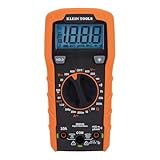
- VERSATILE FUNCTIONALITY: Measures AC/DC voltage up to 600V, 10A DC current, 2MΩ resistance; additional features include continuity, diode test and battery test
- LEAD-ALERT PROTECTION: LEDs on the meter illuminate to indicate proper test lead placement, enhancing accuracy and safety during measurements
- BACKLIT DISPLAY: LCD shows clear readings in low-light conditions for enhanced visibility
- BATTERY TEST: Battery test mode can be used for checking if batteries are working
- CONVENIENT FEATURES: Test lead holders on the back of the meter, kickstand and optional magnetic hanger (Cat. Nos. 69445 or 69417) for hands-free operation
As a general reference, DENSO Auto Parts describes checking at approximately 2,000 rpm and repeating the check with electrical loads on. Its 2022 guidance gives 13–15 V as a general running-voltage range, but explicitly puts vehicle service specifications first. This is not a universal pass/fail target: smart charging, temperature, battery condition, engine speed, and vehicle design can all affect the reading. Follow DENSO’s test guidance and the manual for the specific vehicle.
Quick wins for a faster PC:
Repair Windows errors before they cause bigger problemsFix Now →Scan for outdated or missing drivers - takes under a minuteDriver Scan →Clear out junk files and repair common Windows errorsFree Scan →If the reading is outside the vehicle’s specification, or voltage differs between the alternator and battery, continue with circuit checks rather than assuming the replacement unit is faulty. A loaded voltage-drop test can reveal resistance that a visual inspection misses.
Test voltage drop on both sides of the charging circuit
Voltage drop measures voltage lost across a cable and its connections while current is flowing. A circuit can look clean and still have enough resistance to impair charging. Follow the vehicle’s procedure for safely applying electrical loads and placing the meter leads.
Rank #3
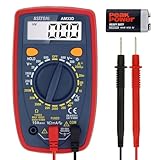
- Additional Tips - The following incorrect operations may cause the multimeter not to show results: Firstly, the plugs of test leads are not fully inserted or not inserted into the correct sockets. Secondly, the manual rotary switch is not placed in the correct position. In addition, this meter can not test all AC Current and below 100mV AC Voltage. Please check the user manual carefully before measurement.
- Versatile Digital Multimeter - Accurately measures AC/DC Voltage, DC Current, Resistance, and Diode. This Multimeter is a really useful tool for solving industrial and household electrical issues. Suitable for Household Outlets, Fuses, Batteries (including Vehicles), Automotive Circuit Troubleshooting, Charging Systems, Testing electronics in Cars etc.
- Troubleshooting with Accuracy - This Multimeter has a sampling speed of 2 times per second; Built-in a backlight LCD display with 3 ½ digits (1999 count) 0.6”, and high polarity including negative and positive readings.
- Ensures Safety - Double fuse is anti-burn and protects from overloading. The silicone cover can protect the multimeter from failing damage and prevent electric shocks. And low battery indication will be displayed when battery power is low.
- Ease of Use - Support Data Hold and Continuity Buzzer. Includes Convenient feature like LCD Backlit Screen makes it easy to use in dimly light areas. Batteries/Set of Test Leads/User Manual are Included.
Positive side
With the engine running and electrical loads applied as specified, measure between alternator B+ and battery positive. DENSO gives no more than 0.2 V as a general reference for the positive side. A higher reading points to resistance in the output cable, terminals, or connections; inspect the circuit and repair or test the suspect section according to the service manual.
Ground side
Under the same specified loaded conditions, measure between the alternator case or ground strap and battery negative. DENSO’s general reference is no more than 0.2 V for the ground side. A higher reading suggests resistance in the ground path, such as a poor strap, connection, or ground contact.
Crashes, No Sound, or Screen Glitches?
Random freezes, missing sound and display glitches usually trace back to one bad driver. Find and replace yours safely.Free scan · under a minutePC Slower Than It Used to Be?
A free scan shows the junk files, broken settings and background clutter dragging Windows down - then fixes them in one click.Free scan · Windows 10 & 11These are diagnostic references, not substitutes for the vehicle’s limits or test setup. For example, the procedure for a 2010 Hyundai Elantra calls for the headlights and blower to be on and uses 0.2 V as its positive-side standard; it directs inspection of wiring from B+ through the fusible link when the reading is higher. That is a vehicle-specific example, not a specification for other cars. See the 2010 Hyundai Elantra service-manual example.
Rank #4

- CAT III 600V Safety Rating: Ensuring your safety when working on electrical systems in common residential, commercial, and industrial settings.
- AC/DC Voltage and Current Measurements up to 1000V and 10A: Allowing you to get accurate readings for a variety of electrical applications.
- Resistance, Continuity, Capacitance: Essential measurement functions for troubleshooting electrical issues in a wide range of systems, allowing you to quickly diagnose and repair problems.
- Diode Test: Allows you to quickly and accurately identify faulty diodes, saving you time and money on repairs.
- Temperature measurement: Provides easy monitoring of heating and cooling systems up to 400C with included type K thermocouple.
Check fuses, fusible links, and alternator control wiring
An open high-current fuse or fusible link can interrupt the alternator’s output path. Some alternators also depend on ignition, sense, warning-lamp, or computer-control signals. A missing supply or control signal can stop charging even if the alternator itself is serviceable.
Use the wiring diagram and diagnostic procedure for your exact vehicle to identify fuses, links, connector terminals, and expected signals. Terminal names and logic vary. The cited 2010 Elantra procedure, for example, checks an S(L) terminal and directs inspection of the circuit or fusible link if expected voltage is absent; that terminal and test should not be assumed to apply to another vehicle.
Inspect the relevant fuse or link using the maker’s prescribed method. If you find an open part, determine why it opened before replacing it; a replacement fuse or link that fails again needs further diagnosis. Do not guess at a fuse location, terminal pinout, or expected voltage.
The Tool Desk
Outbyte PC Repair FREERepair Windows errors before they cause bigger problemsFix Now →Outbyte Driver Updater FREEFix the driver behind crashes, sound loss and screen glitchesFind Drivers →Best Value

- CAT III 600V Safety Rating: Ensuring your safety when working on electrical systems in common residential and commercial settings
- AC/DC Voltage Measurement up to 1000V: Quickly and accurately measure both AC and DC voltage in a wide range of applications, from automotive systems to electrical panels to commercial equipment.
- AC/DC Current Measurement up to 10A: Accurately measure AC and DC current for diagnosing electrical problems such as overloading, short circuits, and faulty wiring.
- Voltage, Resistance, Continuity, Capacitance: Essential measurement functions for troubleshooting electrical issues in a wide range of systems, allowing you to quickly diagnose and repair problems.
- Input Terminal for AC/DC Current Measurements to 10A: Allowing you to get accurate readings for a variety of electrical applications.
Test the alternator after checking the rest of the system
If the battery is serviceable, the belt drive and connections are correct, voltage drops meet the vehicle’s specification, and fuses, links, and control inputs check out, test alternator output using an appropriate shop tester or the manufacturer’s procedure. Delco Remy’s May 12, 2026 troubleshooting tip likewise places service-manual diagnosis after the initial checks when the alternator works correctly: Delco Remy’s troubleshooting tip.
If the alternator fails the proper output test, contact the seller or rebuilder about warranty or return options before buying another unit. If it passes, continue with vehicle-specific diagnosis outside the alternator. A replacement should only be selected after fitment is verified, including output capacity, regulator and control compatibility, pulley dimensions and belt rib count, connector, mounting dimensions, and warranty terms.
When to stop and get professional help
Use a qualified repair shop if testing requires access to uncertain wiring, the correct procedure or specifications are unavailable, the vehicle has computer-controlled charging that you cannot diagnose, or you are not comfortable performing live electrical measurements. Stop if a cable or terminal is hot, visibly damaged, or sparking; avoid running the engine with exposed or loose connections. A shop can test the battery, charging circuit, and alternator together and help distinguish a defective replacement from an installation or vehicle-side fault.
Quick Recap
Product prices and availability are accurate as of the date/time indicated and are subject to change. Any price and availability information displayed on Amazon at the time of purchase will apply.




