Do these 3 things before closing this tab:
1Repair Windows errors before they cause bigger problems2Scan for outdated or missing drivers - takes under a minute3Clear out junk files and repair common Windows errorsChoose your first car for Bangalore by starting with the parking space and the routes you actually drive, then compare the complete on-road price and recurring costs of the specific variants that fit. No single body style, fuel type, or transmission is right for every buyer: your access, commute, passengers, budget, and service options determine what makes sense.
Start with the decisions that can rule a car out
It is easy to begin with a shortlist of models and then try to make your parking, commute, or budget work around it. Reverse that order. A car that does not fit the parking approach, feels tiring on your regular route, or pushes the total cost beyond your limit is not a good first car just because its headline price looks attractive.
As an Amazon Associate I earn from qualifying purchases.
- Check the parking space and approach. Measure the bay and the route into it, including the gate or opening, ramp, pillars, bends, and turning room. Consider where the car must go after it clears the entrance; a vehicle may fit inside the bay but still be awkward to manoeuvre into it.
- Test your normal commute. Evaluate a representative route at a realistic time, if possible. Notice low-speed control, visibility, stop-start comfort, cabin comfort, and parking at both ends.
- Set a complete purchase budget. Ask for an itemized Bangalore on-road quotation for the exact variant. Separate tax, registration, insurance, accessories, financing charges, and anything optional.
- Estimate costs from your own use. Begin with your monthly kilometres and realistic city fuel consumption, then add insurance, scheduled service, tyres, parking, financing, and a repair reserve.
- Check that it works for the household. Assess seating, access, rear comfort, air conditioning, luggage space, safety equipment, and local authorized service support for each remaining option.
This order helps you eliminate poor fits before you invest time comparing features. It also prevents a common mistake: treating ex-showroom price, a citywide traffic statistic, or another buyer’s fuel bill as a reliable answer for your own car and route.
The Tool Desk
Outbyte PC Repair FREERepair Windows errors before they cause bigger problemsFix Now →Outbyte Driver Updater FREEFix the driver behind crashes, sound loss and screen glitchesFind Drivers →Will it fit my parking space?
Assess the whole parking manoeuvre, not just the marked bay. The space may be tight because of an entrance, a steep or narrow ramp, a pillar, a bend, another parked vehicle, or limited room to turn. Those constraints affect day-to-day ease even if the car’s listed length and width appear manageable.
#1 Best Overall

- When the product is working, the sensor emits ultrasonic waves. When encountering an obstacle, the ultrasonic waves are reflected. The sensor receives the reflected signal and transmits it to the control box. Through calculation, the control box obtains the distance between the vehicle and the obstacle, and reminds the driver to pay attention through the display and sound, etc., to avoid danger. It is a good helper for us to drive the car!
- 1: When reversing, activate the rear 4 sensors and the front 2 sensors to detect and alarm. During normal driving, when braking, the 4 sensors in front of the car are activated to assist the driver to safely pass through narrow passages. When you release the brake, the parking sensor will work for about 15 seconds before stopping.
- 2: The product alerts the driver through sound, numbers, and light bars at the same time.
- 3: Probe behind the car to prevent collision, probe in front of the car to prevent rubbing.
- 4: On the display, there are 8 light bars representing each sensor, allowing the driver to distinguish the orientation of obstacles.
Measure the space you actually have
- Measure the bay’s length and width, plus the entrance or gate at its narrowest point.
- Check the width and shape of the approach, including turns, pillars, ramp edges, and any point where you must straighten the car.
- Account for how much room you need to open the doors and get regular passengers in and out.
- Consider where the car will be parked at the other end of your commute. Home parking is only half the test.
Compare your measurements with the dimensions of the exact variants you are considering. Dimensions alone do not tell you how easy a car will be to place: visibility, turning, seating position, and parking aids matter too. Ask the dealer which parking sensors or camera are included on the variant, rather than assuming a feature from a model name is standard across the range.
Try the manoeuvre before deciding
On a test drive, check how well you can judge the car’s front corners and rear edge from the driver’s seat. If possible, practise reversing and turning in a space similar to your own. Test the display or camera in the conditions in which you normally park and find out what the sensors can and cannot detect. Treat these aids as assistance, not as a replacement for checking the space or learning the car’s dimensions.
If a car lacks suitable factory parking aids, an aftermarket sensor may be an option, but it is not automatically equivalent to factory equipment. Confirm compatibility with the exact vehicle and ask the manufacturer or dealer whether installation could affect warranty coverage. Do not let the possibility of adding a sensor persuade you to buy a car that is fundamentally awkward to park.
Bengaluru’s climate-action plan includes actions relating to parking management and enforcement. Those are measures described in a planning document, not evidence that a particular car size or proof of parking is currently required citywide. The Bruhat Bengaluru Mahanagara Palike’s Bengaluru Climate Action and Resilience Plan (BCAP), Sector Actions (2024) should not be read as proof that proposed congestion charges or car-restricted zones are already in force.
How should I test the commute?
A car that is comfortable on a quiet dealer test-drive route may feel different in the conditions you face each week. If possible, drive a representative stretch at a realistic time. Include slow sections, stops, turns, and the places where you normally park. A citywide average cannot predict the delay, road conditions, or stress on your particular route.
Rank #2
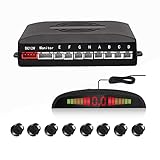
- 【High Quality Parking Radar】This Car Parking Radar System consists of 8 Ultrasonic sensors, digital control box, and LED display, making the job of parking any vehicle much easier.
- 【Intuitive Display】This parking radar not only makes beep sound warning, but aslo shows you distance data. Beep sound warning will be more frequent when distance is getting closer. Prevent future dangerous and costly collisions.
- 【Easy to Install】Easy to install, with full detailed English manual. Perfectly fit your car with universal hole saw. With a drill head, convenient to drill hole on the bumper of the car. The sensors cable length: Front sensors cable: 6m/20ft; Reversing sensors cable: 2.3m/7.5ft.
- 【Multi Color to Select】Multi Color to Select (Black/Red/Grey/White/Fiat Red/Champagne Gold/Blue/Silver). 8 Weather Proof Sensors + LED Distance Display.
- 【Warranty Period】High Quality and 3 Year Warranty
Mobility for Development’s 2025 summary report estimates an average one-way trip of around 63 minutes for 19 km, peak-hour speeds of about 18 km/h, and annual time loss of an estimated 132 hours per commuter. These are report estimates, not a forecast for every Bengaluru commuter or a substitute for trying your own route.
What to notice while driving
- Low-speed control: Is it easy to move smoothly, creep forward, and judge the car’s response in slow traffic?
- Visibility: Can you see enough around the car to judge gaps, turns, and nearby vehicles? Check whether the driving position works for you.
- Stop-start comfort: Are the controls and seating comfortable for repeated stops and short movements? If more than one person will drive the car, each should try it.
- Parking at both ends: Can you enter and leave the spaces you regularly use without an awkward multi-point manoeuvre?
- Cabin and passenger comfort: Have the regular occupants sit in their usual places. Check rear-seat comfort, access, air conditioning, and the space needed for luggage or other household items.
Do not select a car based on a claimed citywide fuel-economy figure alone. Your route, driving, load, and the exact powertrain affect actual consumption. When estimating fuel costs, use a realistic figure for the particular variant and urban use rather than treating a quoted or advertised figure as a guarantee.
Is an automatic easier in Bangalore traffic?
Traffic makes low-speed control and repeated stops worth testing, but the available evidence does not establish a universally better choice between automatic and manual transmissions. The answer depends on your comfort, the route, who will drive, the matched variants’ prices, and your ownership budget.
Drive the transmission you are considering in representative conditions. Ask whether it feels predictable when moving off, slowing down, and manoeuvring into parking. If several household members will use the car, make sure their preferences and ability to operate it are part of the decision. Compare the exact variants rather than assuming a transmission choice has the same equipment or price consequences across different models.
Use the same approach for petrol, CNG, hybrid, and electric options. The evidence available here does not establish a best fuel or drivetrain for all Bengaluru buyers. Compare matched variants, their current quotations, and the way you expect to use the car over the period you plan to own it. Fuel choice should follow the actual route, annual use, budget, and access that matter to you—not a general claim that one option suits every city driver.
Rank #3

- [Auto Tow Bar Recognition]:58 KHz OE quality sensor with full detection coverage,ensures accurate detection,even with a tow-bar or rear protrusions installed,eliminating false alerts
- [Adjustable Alarm Volume]:Customise the alarm volume to your preference (low,medium,high),ensure that you have a clear understanding of the distance to nearby obstacles every time you reverse
- [Extended Detection Range]:The system can extend its detection range by 20 cm or 40 cm to accommodate rear protrusions,such as spare tyres,providing comprehensive coverage
- [Self Test Function for Faulty Sensors]:Identifies and alerts you to any sensor issues to prevent accidental collisions and keep you safe on the road
- [58KHz OE Standard Sensor]:At the heart of the PS-02 lies Promata 58KHz OE-quality ultrasonic sensor,providing superior coverage and accuracy compared to traditional 40KHz sensors.With its enhanced capabilities,this rear parking sensor kit ensures reliable detection of obstacles,even in the tightest spaces
How much will it cost on-road in Bangalore?
Compare the amount you would actually pay to register and take delivery of the exact variant, not just its ex-showroom label. Request an itemized quotation from the dealer and check every line. The total can include road tax, cess, registration, insurance, accessories, loan-related charges, and optional products or services. Ask which items are compulsory for the transaction and which you can decline.
Recommended Free Tools
VariantWise’s Karnataka road-tax explainer, whose figures it says were last checked on 7 August 2026, reports the following slabs. It describes these as rates tied to vehicle price and fuel category. Because this is a secondary explainer referring to state law and department material, treat it as orientation and verify the current applicable law, fuel classification, and calculation for your exact transaction.
| Vehicle category in the explainer | Reported price slab | Reported road-tax rate |
|---|---|---|
| Petrol, diesel, CNG, and hybrid | Through ₹5 lakh | 13% |
| Petrol, diesel, CNG, and hybrid | Above ₹5 lakh through ₹10 lakh | 14% |
| Petrol, diesel, CNG, and hybrid | Above ₹10 lakh through ₹20 lakh | 17% |
| Petrol, diesel, CNG, and hybrid | Above ₹20 lakh | 18% |
| Electric vehicles | Through ₹10 lakh | 5% |
| Electric vehicles | Above ₹10 lakh through ₹25 lakh | 8% |
| Electric vehicles | Above ₹25 lakh | 10% |
The same explainer reports an 11% cess on vehicle tax. Do not mistake that figure for an additional 11% of the vehicle’s full price: the source identifies it as a cess on the vehicle tax. Confirm how the tax and cess apply to the specific vehicle and transaction with the current official requirements and the dealer’s itemized calculation.
Read the quotation line by line
- Vehicle and variant: Confirm the exact variant, fuel type, transmission, and quoted ex-showroom price. A quotation for a different variant is not a like-for-like comparison.
- Tax and registration: Check the road-tax basis, cess, registration charges, and any other statutory charges separately. Ask for a revised calculation if an amount is unexplained.
- Insurance: Identify the policy and cover being quoted, its premium, and the insurer. Comprehensive own-damage cover is priced by insurers and varies by insurer and cover.
- Accessories and add-ons: Ask whether each item is optional, what it costs, and whether you want it. Do not allow an unexplained bundle to obscure the car’s actual price.
- Financing: Include loan-related charges in the purchase comparison. Compare the borrowing cost and repayment obligations that apply to your own offer.
VariantWise’s illustrative on-road example excludes comprehensive own-damage insurance because its price varies by insurer and cover. Its example is not a promise of what any buyer in Bengaluru will pay. The actual quotation depends on the variant and transaction, and insurance needs a current quote of its own.
What will I spend each month?
No comparable Bengaluru-specific fuel price, annual mileage, maintenance average, or insurance premium is established here, so there is no reliable single monthly or annual ownership total to apply to every buyer. Build your estimate from your usage and current local quotes. Keep one-time purchase costs separate from recurring costs so you can see both whether you can buy the car and whether you can comfortably keep it.
PC Slower Than It Used to Be?
A free scan shows the junk files, broken settings and background clutter dragging Windows down - then fixes them in one click.Free scan · Windows 10 & 11Outdated Drivers Are Slowing You Down
One free scan finds every outdated or missing driver and matches the right update for your exact hardware.Free scan · exact hardware matchRank #4

- Automatically detects obstacles behind the car when reversing, automatically turns on and on.
Estimate fuel from your own kilometres
Start with the distance you expect to drive in a month and a realistic city-consumption figure for the exact variant. Multiply monthly kilometres by fuel consumed per kilometre and by the current local price for that fuel. If you use a fuel-efficiency figure expressed as kilometres per litre, first divide monthly kilometres by that figure to estimate monthly litres; then multiply the estimated litres by the current local price per litre. For another fuel unit or a different powertrain, use the appropriate consumption unit and current price.
This calculation is an estimate, not a guaranteed bill. Make your assumptions visible: monthly distance, the consumption figure used, and the fuel price and date checked. If you do not know your likely mileage, make separate estimates for plausible use patterns rather than presenting one unsupported number as certain.
Add the costs that fuel alone misses
- Insurance renewal: Get a quote for the policy and cover you expect to renew, and do not assume the purchase-time premium will be identical in later years.
- Scheduled servicing: Ask an authorized workshop for the service schedule and a maintenance estimate for the exact variant. Use the schedule and quotations rather than a generic average.
- Tyres and repairs: Allow for tyre replacement and unexpected repairs in your budget. The amount depends on the car and your use; obtain relevant quotes where available.
- Parking: Include any regular parking payment that applies to your home, workplace, or routine destinations.
- Financing: If borrowing, account for interest and charges over the loan period, not just the monthly payment shown in isolation.
- Repair reserve: Set aside an amount you can afford for repairs outside the scheduled service plan. This is a personal budget allowance, not a claim about a standard repair bill.
Compare options over the same ownership period and with the same assumptions for annual distance, financing, cover, and parking. If your estimates depend on unknowns, keep them visible as unknowns until a dealer, insurer, or workshop supplies a quote. A precise-looking total built from guessed inputs is less useful than a transparent range based on figures you can verify.
Independent reader supportYour contribution helps us test, update, and keep practical guides available for everyone.How do I compare the cars that remain?
Once a car passes the parking and commute tests, compare exact variants on the dimensions that affect your household and the full ownership cost. Avoid ranking cars on an isolated feature or a headline price that leaves out tax, insurance, or regular expenses.
What’s actually slowing this PC down?
Pick the symptom - the matching free tool is one click away.
| What to compare | Questions to answer for each exact variant |
|---|---|
| Fit and parking | Does it fit the bay and approach? Can you see the corners? How easy is it to turn and manoeuvre? Which factory parking aids are included? |
| Commute | How does it feel on a representative route? Are low-speed control, visibility, and stop-start comfort acceptable to the drivers? |
| Household use | Can regular passengers enter and sit comfortably? Is the rear seat suitable for your occupants? Do the air conditioning and boot meet your actual needs? |
| Cost | What is the itemized on-road amount? What are the expected fuel, insurance, service, tyre, parking, financing, and repair costs over your planned ownership period? |
| Support | Where is the nearest authorized workshop? What service schedule, warranty conditions, and maintenance quotations apply? What delivery timing is being offered? |
| Fuel and drivetrain | How do matched variants and current quotations compare for your expected use, route, and access? What costs or practical requirements matter for the option you are considering? |
Use comparable evidence wherever possible: quotations for the same transaction, service estimates for the exact variant, and test drives by the people who will actually use the car. If a cost, feature, or delivery estimate is not confirmed, mark it as unknown and find out before treating the cars as equivalent.
Best Value

- When the product is working, the sensor emits ultrasonic waves. When encountering an obstacle, the ultrasonic waves are reflected. The sensor receives the reflected signal and transmits it to the control box. Through calculation, the control box obtains the distance between the vehicle and the obstacle, and reminds the driver to pay attention through the display and sound, etc., to avoid danger. It is a good helper for us to drive the car!
- 1: When reversing, activate the rear 4 sensors and the front 2 sensors to detect and alarm. During normal driving, when braking, the 4 sensors in front of the car are activated to assist the driver to safely pass through narrow passages. When you release the brake, the parking sensor will work for about 15 seconds before stopping.
- 2: The product alerts the driver through sound, numbers, and light bars at the same time.
- 3: Probe behind the car to prevent collision, probe in front of the car to prevent rubbing.
- 4: On the display, there are 8 light bars representing each sensor, allowing the driver to distinguish the orientation of obstacles.
What should I check about safety, comfort, and service?
First-car suitability is not just about fitting a car into a space or affording its purchase price. Check the equipment and day-to-day use that matter to the people who will travel in it. A 2026 post in Reddit’s r/CarsIndia describes one household looking for an automatic petrol five-seater, with safety, good air conditioning, rear comfort, parking aids, a decent boot, reliability, and local after-sales support among its priorities. That is an individual example, not evidence that every Bangalore buyer needs the same configuration, but it illustrates useful questions to ask of your own household.
- Safety: Identify the safety equipment included on the exact variant and verify it from the manufacturer’s specifications or dealer documentation. Do not assume a feature is standard across all trims.
- Passenger comfort: Have regular passengers try the rear seat and check access, seating comfort, and air conditioning under conditions relevant to them.
- Luggage: Consider the luggage you routinely carry and whether it fits alongside the passengers who will usually travel.
- Parking assistance: Confirm which sensors or camera are included and test how they work on the car you are considering.
- Authorized support: Find the nearest authorized workshop that is practical for you to reach. Ask about scheduled service, warranty conditions, maintenance quotations, parts and repair support, and delivery timing.
Reliability is important, but do not treat a general reputation or another owner’s experience as a guarantee for a particular car. Check the warranty terms, service access, and the support you can verify locally. If after-sales convenience matters greatly to you, include travel to the workshop and realistic appointment access in your comparison rather than looking at the showroom location alone.
A practical first-car decision checklist
Before paying a deposit, use this checklist for every finalist. It keeps the decision tied to evidence you can check rather than assumptions that may change when the car arrives or the first bills are due.
Free tools Windows power users keep installed
One-click scans. No signup required.
- Have I measured the parking bay, entrance, ramp, turns, and usable door-opening space?
- Have I tried parking and driving the exact car or a closely matching variant in representative conditions?
- Have the regular drivers tested its low-speed control, visibility, and transmission?
- Have the passengers who matter checked rear comfort, access, air conditioning, and luggage needs?
- Do I know which safety and parking features are fitted to this exact variant?
- Do I have an itemized current on-road quote that separates taxes, cess, registration, insurance, accessories, and financing charges?
- Have I checked that the tax calculation and classification apply to this vehicle and transaction?
- Have I estimated fuel from my own monthly kilometres, a realistic city-consumption figure, and a current local fuel price?
- Have I obtained or requested the insurance and scheduled-service figures I need, and allowed for tyres, parking, financing, and a repair reserve?
- Have I checked authorized service access, warranty conditions, maintenance quotations, and delivery timing?
Choose the option that clears the practical constraints and fits the household’s verified budget. If an essential answer is still missing—especially parking fit, the full quotation, or the costs that recur—resolve it before deciding rather than relying on an attractive feature list or an assumed monthly total.
Quick Recap
Product prices and availability are accurate as of the date/time indicated and are subject to change. Any price and availability information displayed on Amazon at the time of purchase will apply.




