Quick wins for a faster PC:
Clear out junk files and repair common Windows errorsFree Scan →Scan for outdated or missing drivers - takes under a minuteDriver Scan →Repair Windows errors before they cause bigger problemsFix Now →A practical U.S. starting point is about $100 a month for car maintenance and repairs. AAA’s current budgeting guidance puts the figure at about $103 monthly, rounded to $100. Treat it as a starting benchmark—not a prediction for your car. Set aside more if you drive more than average or have an older vehicle, and use your owner’s manual and estimates for your actual car to refine the amount.
What the $100-a-month estimate includes
AAA’s budgeting article, published November 11, 2024 and updated in April 2026, translates an average driving estimate into about $103 per month. That makes roughly $100 a convenient broad budget for U.S. drivers. At exactly $100 per month, you would put aside $1,200 over a year, assuming you can make each monthly contribution.



As an Amazon Associate I earn from qualifying purchases.
The underlying figure comes from AAA’s Your Driving Costs 2025 fact sheet: 11.04 cents per mile for maintenance, repairs, and tires. AAA’s study framework considers a new vehicle over five years and 75,000 miles. Its category includes manufacturer-specified routine maintenance, a comprehensive extended warranty, repairs to wear-and-tear items requiring service during five years of operation, and one set of replacement tires.
The Tool Desk
Outbyte Driver Updater FREEScan for outdated or missing drivers - takes under a minuteDriver Scan →Outbyte PC Repair FREEClear out junk files and repair common Windows errorsFree Scan →That distinction matters: 11.04 cents per mile is not a repair-only rate or a quote for a particular car. It combines several ownership costs, including scheduled maintenance and tires, with repairs. Nor does a five-year new-car estimate promise what an older, high-mileage, unusually used, or poorly maintained vehicle will cost. AAA’s $103 monthly translation is a useful planning reference, not a guarantee or a universal amount.
Build a budget around your car, not just a national average
A workable reserve has two parts: money for foreseeable services and replacements, and a cushion for failures whose timing is uncertain. Keeping the two categories visible makes it easier to plan known costs without mistaking them for protection against every surprise. The right total depends on your vehicle, driving, location, condition, and household cash flow; the available AAA figures do not establish one correct personalized amount.
1. Use $100 a month as a first estimate
If you need a simple starting figure and live in the United States, begin with about $100 per month. AAA specifically advises budgeting more if you drive more than average or own an older vehicle. A car used heavily, or one with years of wear, may not match the assumptions behind a new-car ownership estimate. If the starting amount feels unrealistic for your situation, use the steps below to make a more grounded plan rather than treating the benchmark as a required minimum.
2. List the maintenance your manual calls for
Check the owner’s manual for the schedule applicable to your car’s make, model, and year. Write down the services and replacement items due at the mileage or time intervals that apply to you. Then estimate the annual total and divide it by 12 to see what amount to reserve each month for scheduled costs. A general average can help orient you, but it cannot replace a schedule written for the vehicle you own.
Do these 3 things before closing this tab:
1Scan for outdated or missing drivers - takes under a minute2Clear out junk files and repair common Windows errors3Fix the driver behind crashes, sound loss and screen glitchesKeep the calculation tied to the manual’s intervals and your expected use. If a service is not due every year, include it in the year when it is expected rather than assuming it happens monthly. The purpose is to make intermittent expenses visible in your budget before they arrive. AAA recommends following the vehicle’s maintenance schedule; it does not endorse a particular record-keeping product.
3. Add a separate allowance for uncertain repairs
After accounting for scheduled work, decide what additional cushion makes sense for unpredictable repairs. Consider the car’s age, condition, how it is used, and what your household can afford to set aside. The evidence here does not support a fixed dollar target for this second category. A newer car and an older car may face different risks, but no national monthly average can tell you exactly when a component will fail or what a particular repair will cost.
Do not count the same expected expense twice. If a known service is already in your scheduled-maintenance total, keep it there rather than also treating it as an unforeseen repair. Conversely, do not assume that setting aside the scheduled-service amount will cover an unrelated breakdown. Separating the categories is a budgeting choice that clarifies what the money is intended to cover; it does not predict the timing or size of a repair bill.
4. Price a repair you already know is coming
For a specific upcoming job, seek an estimate for that repair instead of relying on a national per-mile figure. AAA’s Car Repair Cost Estimator is described as providing parts and labor breakdowns. AAA notes that estimates depend on location and the job, so the result is more relevant to a repair decision than a broad ownership average, but it is still an estimate rather than a promise of the final bill.
Free tools Windows power users keep installed
One-click scans. No signup required.
Once you have an estimate and a due date, subtract any amount you have already saved for that job from the estimated total. Divide what remains by the number of months until payment to find a monthly saving pace. For example, if a hypothetical repair is expected to cost $600 in six months and you have set aside nothing for it, the arithmetic is $600 divided by six, or $100 per month. That is only an illustration of the calculation, not a typical repair price or an AAA estimate.
5. Track spending and revise the plan
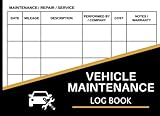
Record mileage, scheduled services, repairs, and amounts paid in a spreadsheet, notes app, or maintenance logbook. A physical logbook is optional; a digital record can serve the same organizational purpose. A record helps you compare what you planned with what your own car actually required, and gives you a clearer starting point when budgeting for upcoming scheduled items. It does not reduce repair costs by itself.
Rank #4

- Made in USA - Proudly produced in Ohio by a Veteran-owned business
- This book will help you remember your last oil change /last service appointment. You can easily track all services, mileage and maintenance for multiple automobiles - great for business or personal use.
- The yearly expense summary is a very important part of this book. The yearly summary page is a perfect tool for your tax prep and your budget. After every month you should log your total business miles and personal miles in the “Annual Mileage Summary” page.
- This book comes in two convenient sizes, 8.5” x 11” - perfect to fit into any binder or clipboard that you may use for business and 5” x 7” which is the perfect size to fit into your glove compartment!
- Our unique cover is a semi-rigid transparent cover that leads to a sturdy book that resists stains and wrinkles. Reorder SKU: LOG-100-57CW-PP(Auto-Maintenance)
When the car’s condition, driving pattern, or known service needs change, revisit the monthly amount. Keep the reasoning transparent: list the expected scheduled costs, add whatever separate cushion your circumstances allow, and note any large upcoming repair estimate. That makes it possible to adjust the plan without confusing AAA’s broad benchmark with a vehicle-specific forecast.
Choosing a budgeting method
The methods below answer slightly different questions. A national benchmark is quick, a maintenance schedule helps anticipate routine spending, and an estimate is useful for a defined job. A separate repair cushion addresses uncertainty, while available emergency savings may offer flexibility if a bill arrives before a dedicated car reserve has grown. These are planning distinctions, not a claim that one approach fits every household.
| Method | Best use | Personalization | Main limitation |
|---|---|---|---|
| About $100 per month | A quick U.S. starting budget for combined maintenance and repairs | Broad average, not tailored to a specific vehicle | AAA’s estimate is not repair-only and may not reflect an older car or above-average driving |
| Owner’s-manual schedule, totaled and divided by 12 | Planning for services and replacement items expected on your vehicle | Uses the make, model, year, and applicable schedule | Does not forecast the timing or cost of unexpected failures |
| Repair estimate for a known job | Saving toward a specific upcoming repair | Can reflect the job and location; AAA describes parts and labor breakdowns | An estimate is job- and location-dependent, not a forecast of all future repairs |
| Separate repair cushion or emergency savings | Managing the cash-flow risk of an unplanned bill | Set according to the car’s age, condition, use, and household capacity | No fixed target is established by the cited figures |
Why a repair reserve can matter for cash flow
AAA’s April 4, 2017 release reported that 64 million American drivers said they would be unable to pay for an unexpected vehicle repair without going into debt. The same release described an average repair bill of $500–$600 and advised saving at least $50 monthly for unforeseen costs. These figures are historical: the survey, repair-bill range, and advice are from 2017, not current measures of how many drivers face that problem or what repairs cost now.
Best Value
The historical numbers help explain why a reserve can be useful, but they do not establish how much any reader needs today. In that 2017 release, AAA quoted Greg Brannon, whose role was then director of Automotive Engineering: “To avoid a surprise down the road, drivers should budget for monthly payments, insurance premiums, fuel costs and the inevitable expenses of routine maintenance and repair.” The quotation is dated to that release; it should not be read as a statement about Brannon’s current role.
How to interpret the numbers if you live outside the United States
The recommendation of about $100 per month is a U.S. budgeting benchmark. AAA’s cited materials do not establish a corresponding universal amount for other countries. Repair labor, parts, taxes, vehicle availability, and driving patterns can differ by place, so using the dollar amount elsewhere without local estimates may mislead. For a non-U.S. budget, use the same planning method—identify scheduled work, price known repairs locally, and allow for uncertain costs—but base the amounts on costs where the vehicle is maintained.
Common budgeting mistakes to avoid
- Treating 11.04 cents per mile as a repair quote. AAA’s 2025 value is for maintenance, repairs, and tires together, under a new-vehicle, five-year/75,000-mile study framework.
- Assuming every car should cost about $100 a month. The monthly figure is a starting point; AAA says to budget more for above-average driving or an older vehicle.
- Using an old bill range as today’s average. AAA’s $500–$600 average repair bill was reported in 2017 and is historical context only.
- Ignoring the manual. A broad average cannot identify which services apply to a particular make, model, and year.
- Counting scheduled spending as the whole reserve. Planned service costs and uncertain failures are different budgeting problems; make clear which one each portion of your savings is meant to address.
- Treating an estimate as a guaranteed final charge. A repair estimate depends on the job and location. Use it to plan and ask for an updated estimate if the work or circumstances change.
Putting the plan together
- Start at roughly $100 monthly if a broad U.S. benchmark is useful.
- Check the owner’s manual and list the scheduled services and replacement items relevant to your vehicle.
- Estimate those known costs across the year and divide the total by 12.
- Add a distinct, affordable cushion for unpredictable repairs, informed by your car’s age, condition, and use.
- For a known repair, get a job- and location-specific estimate, subtract money already saved, and divide the remaining amount by the months until it is due.
- Track mileage, work, and spending, then adjust the plan when your driving or vehicle needs change.
This approach keeps the broad benchmark in perspective: it is a useful place to begin, while your manual, actual repair estimates, and capacity to save determine a more suitable amount for your own car.
Quick Recap
Product prices and availability are accurate as of the date/time indicated and are subject to change. Any price and availability information displayed on Amazon at the time of purchase will apply.




