Powerful, low-cost LiDAR will probably not come from one universal design. The companies pursuing it are attacking different parts of the cost problem: expensive lasers and detectors, large scanning mechanisms, optical alignment, packaging, calibration, processing, manufacturing yield, and the cost of integrating a sensor into a vehicle.
Aeva, Baraja, Cepton, Hesai, Innoviz, Luminar, Lumotive, MicroVision, Ouster, and RoboSense represent the main strategies now being developed. Some are replacing mechanical scanners with semiconductor or optical alternatives. Others are shrinking proven architectures, adding custom chips, integrating perception software, or spreading one hardware platform across several vehicle and robotics applications.
As an Amazon Associate I earn from qualifying purchases.
Important context: “Leading” here means technologically and commercially relevant, not a definitive ranking by revenue, market share, or production volume. The range figures and cost claims discussed below come from company materials or announced targets identified in the research. They are not independent, apples-to-apples test results. Most companies do not disclose comparable production prices.
Why powerful LiDAR has been expensive
LiDAR measures distance by sending light toward an object and analyzing the returned signal. A useful automotive unit must do much more than produce a distance number. It may need to detect dark, distant, or partially obscured objects; operate in sunlight, rain, dust, and temperature extremes; scan a wide field of view; produce enough points for perception software; and survive years of vibration and vehicle use.
#1 Best Overall
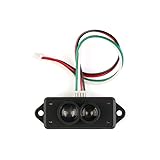
- TFmini-S is a single-point ranging radar based on TFmini upgrade. The blind area is reduced to 10cm, the outdoor ranging performance is further improved, and the ranging accuracy of different reflectivity is optimized, which can realize stable, accurate, highly sensitive and high-speed distance measurement.
- Small size, light weight, low power consumption, high frame rate (up to 1000Hz output frequency)
- Measurement range: 0.1m ~ 12m @ 90% reflectivity, Frame rate: 1-1000Hz, Light source: VCSEL, Power supply voltage: 5V ± 0.1V
- Built-in a variety of adaptation algorithms, a variety of adjustable configurations and parameters, in complex environments with excellent ranging performance, to meet the needs of customers in complex application scenarios.
- Suitable for smart home, pedestrian detection, vehicle detection, barrier anti-smashing, altimeter, intelligent robot
The cost is therefore distributed across an entire system:
- Laser and detector: The light source, receiver, photodetectors, and supporting optical components.
- Beam steering: A rotating assembly, oscillating mirror, MEMS mirror, prism, metasurface, or another method for directing light across the scene.
- Optics: Lenses, mirrors, micro-optics, filters, apertures, and alignment.
- Electronics: Timing circuits, analog front ends, signal processing, memory, communications, and custom ASICs.
- Thermal and mechanical packaging: Enclosures, heaters, cooling, vibration resistance, weather sealing, and a design that fits the vehicle.
- Calibration and software: Factory calibration, point-cloud processing, object detection, tracking, diagnostics, and updates.
- Manufacturing: Component sourcing, automated assembly, optical alignment, testing, yield, and quality control.
- Vehicle integration: Brackets, wiring, cleaning systems, windshield or grille placement, compute hardware, and validation.
A sensor can become cheaper at the component level while remaining expensive as a vehicle-ready system. Conversely, a somewhat more expensive LiDAR module may reduce total vehicle cost if it replaces several other sensors or requires less downstream computing.
“Solid-state” does not mean one thing
LiDAR marketing often uses solid-state as shorthand for a sensor with no large rotating assembly. That description covers several different approaches. A MEMS LiDAR still moves a microscopic mirror. A prism steers light through wavelength-dependent refraction. A metasurface changes the direction of light electronically. A mirrorless design may use a non-rotating optical mechanism. Other systems use semiconductor arrays and software-defined scan patterns.
What’s actually slowing this PC down?
Pick the symptom - the matching free tool is one click away.
Removing a large motor or rotating platform can reduce size, wear points, and assembly complexity. It does not automatically make the entire sensor inexpensive. Laser efficiency, detector sensitivity, optical packaging, calibration, thermal management, reliability testing, and production yield remain difficult problems.
The 10 approaches at a glance
| Company | Main approach | Primary cost or scale lever |
|---|---|---|
| Aeva | FMCW LiDAR-on-chip | Silicon photonics, integration, automated assembly, and direct velocity measurement |
| Baraja | Spectrum-Scan prism steering | Fewer complex moving parts and a roadmap toward greater optical integration |
| Cepton | Mirrorless MMT and MagnoSteer | Compact optics, custom ASICs, power efficiency, and vehicle-specific product tiers |
| Hesai | Compact 1D scanning plus solid-state short-range products | Industrialized architecture, module integration, silicon, and production scale |
| Innoviz | 905-nanometer solid-state scanning | Automotive integration, configurable scanning, and perception at the sensor |
| Luminar | 1550-nanometer long-range sensing | Vertical integration of photonics and electronics, with cost recovery through volume |
| Lumotive | Semiconductor metasurface beam steering | Silicon manufacturing and software-defined scanning |
| MicroVision | MEMS laser beam scanning | Small moving mirrors, custom ASICs, software, and sensor-fusion savings |
| Ouster | VCSEL arrays, SPAD receivers, and digital processing | Semiconductor scaling, common hardware, manufacturing, and software reuse |
| RoboSense | Automotive solid-state product families | Platform reuse across forward, side, blind-spot, and robotics applications |
1. Aeva: FMCW LiDAR-on-chip and integrated processing
Aeva uses frequency-modulated continuous-wave, or FMCW, LiDAR rather than conventional pulsed time-of-flight sensing. In a pulsed ToF system, the sensor estimates distance from the travel time of a light pulse. Aeva’s stated FMCW differentiator is that it measures range and instantaneous velocity for each point at the same time.
That velocity measurement could help distinguish a moving object from a stationary background and reduce some of the ambiguity that perception software must otherwise resolve. It is a performance and architecture distinction, not by itself proof of lower cost.
Aeva says its CoreVision architecture integrates the transmitter, detector, and optical-processing functions into a silicon-photonics module. Its X1 processor combines data acquisition, point-cloud processing, scanning control, and application software. The company’s cost thesis is that integration can eliminate fiber optics, reduce the number of discrete optical components, simplify alignment, lower power consumption, and make automated assembly more practical.
Aeva’s Atlas product page lists up to 250 meters at 10% reflectivity, a 120-degree by 30-degree field of view, passive cooling, and a package 70% smaller than Aeries II. Those are manufacturer-published specifications under stated conditions, not an independent comparison with every competing sensor.
The trade-off: FMCW is technically demanding. The laser, frequency control, optical processing, and manufacturing process must all work reliably at scale. Aeva therefore represents a scaling thesis: FMCW could become cost-effective through deep integration and automated manufacturing, but the architecture should not be assumed to be cheaper than every pulsed ToF product today.
2. Baraja: steering light with a Spectrum-Scan prism
Baraja takes a different optical route. Its Spectrum-Scan platform sends different wavelengths through a prism to steer the beam. Rather than using a conventional rotating assembly or oscillating mirror, the system uses the relationship between wavelength and refraction to direct light across the scene.
The potential cost and reliability benefit is a reduction in complex moving components while retaining a scanning architecture intended for long-range automotive sensing. Fewer large mechanical parts can simplify packaging and reduce some failure modes, although the prism, laser, optics, control electronics, calibration, and enclosure still have to be manufactured precisely.
The Tool Desk
Outbyte PC Repair FREEClear out junk files and repair common Windows errorsFree Scan →Outbyte Driver Updater FREEScan for outdated or missing drivers - takes under a minuteDriver Scan →Baraja emphasizes long-range precision, reliability, automotive integration, and a roadmap toward a single-chip design manufactured at scale. That roadmap matters: a stated future path toward more integration is not the same as a demonstrated commodity sensor already being produced at that cost.
The trade-off: Baraja should not be grouped casually with every “solid-state” LiDAR company. Its prism-based Spectrum-Scan approach is a distinct optical method. The attraction is reduced mechanical complexity; the unresolved commercial question is how efficiently the complete optical system can be produced, aligned, calibrated, and integrated into vehicles.
3. Cepton: mirrorless MMT, MagnoSteer, and multiple cost tiers
Cepton’s Micro Motion Technology, or MMT, uses a non-rotational, mirrorless, frictionless scanning method. The company positions MMT as compact, power-efficient, scalable, and suitable for automotive production. Its Vista family also supports software-definable fields of view and dynamic regions of interest, allowing the sensor to devote scanning resources to areas that matter most for a particular driving situation.
Rank #2

- How to work with pixhawk : https://discuss(dot)ardupilot(dot)org/t/avoidance-experiments-with-the-poc-and-benewake-tfmini/25277;How to use with raspberry pi/arduino: https://github(dot)com/TFmini
- Communication interface : UART/I2C, Default: UART. If you need I2C, pls send configuration commands to set (After connection enter: 5A 05 0A MODE SU where MODE = 0 (UART) or 1 (IIC) and SU stands for checksum. Important: After sending the parameter configuration command, be sure to send the "Save Configuration (5A 04 11 6F)" command, otherwise the parameters will be reset when the product is connected again.)
- Operating Range : 0.1-12m at 90% reflectivity, Frequency: 100Hz(1-1000Hz adjustable), Light source:VCSEL, Applicable voltage range: 4.5-6V
- Applications: Traffic Monitoring, Obstacle detection, Obstacle detection, Level measurement, Smart device, Security and obstacle avoidance etc.
- What you will get: 1PCS TFmini-S and 2PCS Cable
Cepton lists Vista Ultra at up to 300 meters at 10% reflectivity and up to a 120-degree by 25-degree field of view. Again, the important qualifiers are the target reflectivity and the manufacturer’s measurement conditions. A maximum range figure does not tell a vehicle engineer how many useful points remain available in rain, glare, or at a selected frame rate.
Quick wins for a faster PC:
Clear out junk files and repair common Windows errorsFree Scan →Scan for outdated or missing drivers - takes under a minuteDriver Scan →Repair Windows errors before they cause bigger problemsFix Now →The cost strategy combines optical efficiency, compact packaging, custom ASICs, and manufacturing-oriented design. Cepton previously announced that its Nova near-range sensor could cost less than $100 in high automotive volumes. That was a volume target for a particular short-range configuration, not a general selling price for a long-range forward-facing LiDAR.
The broader lesson: “Low-cost LiDAR” describes different product tiers. A short-range blind-spot, parking, or side-coverage sensor has a very different range, point-density, optical-power, and validation requirement from a 200-to-300-meter highway sensor. Cepton’s portfolio helps make that distinction clear.
4. Hesai: industrializing a proven scanning architecture
Hesai’s ATX illustrates a pragmatic route to lower cost: improve and industrialize a one-dimensional scanning architecture instead of relying entirely on a radically new beam-steering principle.
Hesai says ATX uses a market-validated 1D scanning design, greater module integration, and a simplified core optical scanning structure. Its published specifications include a 230-meter range at 10% reflectivity, a 120-degree horizontal field of view, 8 watts of power consumption, and a 100-by-100-by-30-millimeter package. Hesai describes ATX as 60% smaller by volume and almost half the weight of its AT128.
Recommended Free Tools
The company also develops fully solid-state products for short-range coverage. Its company history identifies FT120 as a mass-produced fully solid-state LiDAR, while company filings describe FTX as a next-generation solid-state design with a very wide field of view.
Hesai’s cost strategy is therefore layered: use a validated scanning architecture, integrate more functions into a smaller module, develop proprietary controller silicon and point-cloud processing, simplify the supply chain, and build manufacturing volume. In a 2025 filing, Hesai described AT128 as a high-performance, low-cost architecture and reported ATX design wins with multiple automakers as of February 2025.
The trade-off: Incremental industrialization may be less dramatic than a new optical principle, but it can be just as important. Packaging, automated assembly, component sourcing, yield, and production experience often determine the actual price of a vehicle sensor.
5. Innoviz: 905-nanometer solid-state scanning plus perception
InnovizTwo is marketed as an automotive-grade solid-state LiDAR with a detection range of up to 300 meters, configurable operation at 10 to 20 frames per second, and a wide field of view. Innoviz describes a 905-nanometer laser platform and integrates perception capabilities through its InnovizAPP software.
Free tools Windows power users keep installed
One-click scans. No signup required.
The 905-nanometer wavelength is common in cost-focused automotive LiDAR designs because its lasers and related components can benefit from established semiconductor and optoelectronic supply chains. Innoviz presents the platform as a lower-cost path to hardware for Level 2-plus driving functions and higher automation levels.
Configurable regions of interest can also influence system economics. If the sensor can direct more resolution or processing toward a relevant area without requiring a much larger hardware platform, vehicle developers may have more flexibility in balancing coverage, compute, and power.
Innoviz has extended the platform into InnovizSMART for security, defense, mobility, robotics, and traffic applications. Selling related technology into more than one market could spread development and manufacturing costs across a larger product base. It does not, however, automatically prove lower unit economics: different markets have different qualification, support, volume, and performance requirements.
The trade-off: Innoviz’s approach depends on making a 905-nanometer solid-state platform sufficiently capable for automotive use while using integrated perception to reduce the burden on the rest of the vehicle system. The right comparison is total system cost and capability, not just the price of the optical module.
Do these 3 things before closing this tab:
1Scan for outdated or missing drivers - takes under a minute2Repair Windows errors before they cause bigger problems3Fix the driver behind crashes, sound loss and screen glitches6. Luminar: higher-cost 1550-nanometer components, integrated at scale
Luminar represents a different strategy from companies that begin with the least expensive laser wavelength. Its Iris platform uses a 1550-nanometer laser and combines the transmitter, receiver, vertically integrated detector and receiver ASIC solutions, and a high-range scanning architecture.
Rank #3

- Upgraded LiDAR Module: TFmini-s is an upgraded single-point micro ranging module based on TFmini. The dead zone is shortened to 10 cm, and the outdoor performance and accuracy of different reflectances are improved
- Tiny Body Yet Big Wisdom: low-cost, small-size and low power consumption. Distance Resolution is 1cm, frame rate is 100Hz, ambient light immunity is 70Klux and central wavelength is 850nm
- Tiny Yet Powerful: It is based on ToF (Time of Flight) principle and integrated with unique optical and electrical designs, so as to achieve stable, precise, high sensitivity and high-speed distance detection
- Main Application Scenario: Pedestrian detection, vehicle detection, intelligent barrier gate and altimeter
- Note: TFmini-s version is UART by default. If you need I2C, please switch by yourself. It is compatible with Raspberry Pi and Arduino
Luminar’s filings describe Iris as designed around automotive requirements for size, weight, cost, power, reliability, and series production. The company has published detection figures of up to 600 meters and a 120-degree horizontal field of view under its stated specifications.
There is an important cost nuance. A 1550-nanometer system can offer greater eye-safety margins and support higher optical power than many 905-nanometer systems. But the longer wavelength generally requires more expensive photonic components, including specialized detector technology such as indium-gallium-arsenide. Wavelength alone does not make a LiDAR inexpensive.
Luminar’s cost thesis is instead to vertically integrate critical photonics and electronics, design the product for vehicle production, and recover the higher component cost through scale, reliability, and long-range capability. If the system enables earlier detection or reduces the need for other sensors, the relevant calculation is again vehicle-level economics rather than bill of materials alone.
Status caution: Luminar’s corporate and product situation has been volatile, so business, production, and program claims should be checked against the latest company filings before being treated as current commercial facts. The architecture remains useful in this comparison because it shows the “spend more on the source and detector, then reduce total cost through integration and volume” path.
7. Lumotive: semiconductor metasurface beam steering
Lumotive’s Light Control Metasurface chips steer light electronically without conventional moving parts. The company’s LM10 is described as a production offering with software-defined scan patterns, a wide field of view, compatibility with VCSEL and edge-emitting lasers, and an active aperture measuring 11 by 9 millimeters.
Lumotive also offers reference designs such as M30 and TX10 to help partners create customized sensors. This makes Lumotive more than a traditional finished-sensor supplier: its component platform could reduce cost for other LiDAR brands that incorporate the beam-steering technology into their own products.
The cost thesis is semiconductor manufacturing. A metasurface can replace a mechanical steering subsystem with an all-semiconductor optical component made using scalable silicon-manufacturing techniques. Software can then define scan patterns and regions of interest instead of requiring a different mechanical design for every application.
Lumotive says this approach reduces complexity, size, and cost while improving reliability. Those are company claims, and the full commercial result depends on the laser, receiver, optics, electronics, packaging, calibration, and production yield of the finished sensor.
The trade-off: A compact steering chip can be a powerful enabler, but it does not eliminate the rest of the LiDAR cost stack. Lumotive’s importance may ultimately be measured by how many sensor makers can use the component platform and how much it lowers the cost of complete products.
8. MicroVision: MEMS scanning, custom ASICs, and sensor fusion
MicroVision’s MAVIN uses MEMS mirrors for high-speed laser beam scanning, while its MOVIA products target shorter-range applications. MEMS is not completely motionless: a microscopic mirror moves. But it avoids the large rotating macro-components found in some older LiDAR designs and can potentially be packaged more compactly.
MicroVision’s 2025 MAVIN product sheet specifies a 220-meter range, a maximum 60-degree by 22-degree field of view, and 905-nanometer laser operation. It emphasizes micro-scale MEMS mirrors and custom ASICs intended to reduce power and cost.
Outdated Drivers Are Slowing You Down
One free scan finds every outdated or missing driver and matches the right update for your exact hardware.Free scan · exact hardware matchPC Slower Than It Used to Be?
A free scan shows the junk files, broken settings and background clutter dragging Windows down - then fixes them in one click.Free scan · Windows 10 & 11The company also promotes perception software and sensor fusion. Its filings argue that fused output could reduce the number of sensors or the amount of downstream processing required in a vehicle. This is a system-level cost argument, not proof that the LiDAR module itself has the lowest bill of materials.
The trade-off: MEMS sits between conventional mechanical scanning and fully solid-state approaches. It retains a moving element, which introduces its own reliability and control requirements, but the moving part is small and may be easier to integrate than a motorized rotating assembly. The practical question is whether the complete MEMS package meets automotive reliability, range, field-of-view, and production requirements at the intended volume.
9. Ouster: digital LiDAR built around VCSELs and SPADs
Ouster’s digital LiDAR architecture uses vertical-cavity surface-emitting laser arrays, or VCSELs, custom CMOS receiver system-on-chips with single-photon avalanche diode, or SPAD, detectors, micro-optics, and digital signal processing.
Rank #4

- Main Application Scenario Pedestrian detection Vehicle detection Intelligent barrier gate Altimeter
- Product Performance Operating Range: 0.1 ~12 m @ 90% Reflectivity Accuracy: ±6 cm @ (0.1-6 m) [Accuracy was calculated based on a standard whiteboard with reflectivity 90% in indoor condition] / ±1% @ (6-12 m) Distance resolution: 1 cm Frame rate: 100 Hz Ambient light immunity: 70 Klux Operating Temperature: 0 ~ 60 °C
- Optical parameters Light source: VCSEL Central wavelength: 850 nm Photobiological safety: Class1 (EN60825) FOV: 2°2
- Electrical parameters Supply voltage: 5 V ±0.1 V Average current: ≤140 mA Power consumption: ≤0.7 W Peak current: 200 mA Communication level: LVTTL (3.3 V) Communication interface: UART/IIC
- Miscellaneous Housing: PC/ABS Storage temperature: -20 ~ 75 °C Weight: 5 g ±0.3 g Cable length: 10 cm
This resembles a camera-sensor strategy: move more of the emitter, detector, and processing function onto semiconductor components that can benefit from electronics manufacturing and repeated design reuse. Ouster says the architecture improves light efficiency and supports software-defined products that share a common hardware platform.
Recommended Free Tools
The cost thesis includes several elements:
- VCSEL arrays and SPAD receivers can increase semiconductor content.
- Custom CMOS receiver chips can combine detection and processing functions.
- A common architecture can serve different product variants.
- Software can tailor scan patterns and capabilities without redesigning every optical subsystem.
- Scaled or outsourced manufacturing can simplify supply and increase production volume.
Ouster’s filings describe digital LiDAR as a route to improved manufacturing cost, supply-chain simplicity, production yield, and economies of scale. But optical packaging and calibration remain challenging even when the emitter and receiver are semiconductor-based. A LiDAR is not as simple to manufacture as a bare imaging chip.
The trade-off: Ouster is one of the clearest examples of a company trying to make LiDAR more like a digital electronics product. That could reduce marginal cost over time, but the benefits depend on volume, reliable packaging, and the ability to reuse the platform across enough applications.
10. RoboSense: product-family reuse across the vehicle
RoboSense’s strategy is centered on automotive product families rather than one single architecture. Its offerings include the E1 and E1R solid-state family and E2, which the company describes as a second-generation fully solid-state LiDAR. Company materials also identify the RS-LiDAR-M1 as an automotive-grade product and describe low-cost solid-state blind-spot LiDAR demonstrations.
This portfolio approach matters because vehicles may need different types of coverage. A forward sensor needs long range and broad situational awareness. A side or blind-spot sensor may need less range but a compact package and a wide viewing angle. A parking or robotics product may have another balance of cost, range, resolution, and environmental performance.
RoboSense can potentially reuse manufacturing, software, calibration tools, and engineering knowledge across those products. Its robotics and automotive activities may also allow common technologies to serve multiple markets.
The trade-off: Portfolio scale does not automatically mean every product is cheap, and the public materials identified for this comparison do not provide a universally comparable unit-price disclosure. RoboSense represents the idea that a supplier can lower costs through standardized families covering front, side, blind-spot, and robotic applications rather than waiting for one perfect sensor to solve every job.
Independent reader supportYour contribution helps us test, update, and keep practical guides available for everyone.How the strategies compare
FMCW versus pulsed time of flight
FMCW, represented here by Aeva, can measure range and velocity simultaneously for each point. That may provide useful information to the perception stack and potentially reduce ambiguity. Its challenge is the complexity of producing and controlling the required optical system economically.
Pulsed ToF systems send light pulses and calculate distance from return timing. They benefit from a broad ecosystem of components and designs, but velocity is generally inferred over time rather than measured directly for each return in the same way. Neither approach is automatically cheaper in every application.
Mechanical, MEMS, mirrorless, prism, and metasurface steering
Large rotating mechanisms can provide broad scanning but add motors, bearings, moving mass, packaging, and reliability concerns. MEMS reduces the moving structure to a microscopic mirror. Cepton’s MMT removes rotational scanning from its stated architecture. Baraja uses prism-based wavelength steering. Lumotive uses a semiconductor metasurface. These designs all seek to reduce mechanical complexity, but they have different optical, control, calibration, and manufacturing requirements.
The relevant question is not simply “Does it move?” It is whether the complete sensor can meet the required range, field of view, point density, frame rate, eye-safety rules, reliability, and production yield at a vehicle-compatible cost.
905 nanometers versus 1550 nanometers
Innoviz and MicroVision are examples of 905-nanometer systems, while Luminar uses 1550-nanometer technology. A 905-nanometer platform can benefit from established component ecosystems and a cost-oriented design path. A 1550-nanometer platform can offer higher eye-safety margins and support more optical power, but its detector and laser components are generally more expensive.
That is a trade-off, not a universal ranking. A longer-range sensor may justify higher component costs if it improves vehicle safety, reduces the number of sensors, or avoids expensive downstream systems. A shorter-range sensor may prioritize low unit cost and compact integration.
On-sensor processing and software
A LiDAR that outputs a compact, processed representation rather than an enormous raw data stream can reduce bandwidth, latency, and downstream compute. Aeva’s X1, InnovizAPP, MicroVision’s perception software, and Ouster’s digital processing all illustrate this direction.
Best Value

- 【UPGRADED PERFORMANCE】 Based on the advanced TFmini platform, the TFmini-S LiDAR module features a reduced blind zone of only 10cm, improved outdoor performance, and enhanced accuracy across different surface reflectivities for stable, precise, and high-speed ranging.
- 【HIGH SPEED & HIGH PRECISION】 Achieves a remarkable frame rate of up to 1000Hz (configurable) for real-time detection. Offers high accuracy of ±6cm (0.1-6m) and ±1% (6m-12m), with a fine resolution of 1cm, ensuring reliable data for demanding applications.
- 【FLEXIBLE & DUAL OUTPUT】 Supports both UART (TTL 3.3V) and I2C communication interfaces, easily configurable via command. Provides flexible integration with various microcontrollers like Raspberry Pi, and industrial PCs.
- 【COMPACT & ROBUST DESIGN】 Miniaturized size (42x15x16mm) and lightweight (5g) design with a wide operating temperature range (0°C to 60°C). Features a Class 1 eye-safe laser (850nm VCSEL) and strong ambient light immunity (70Klux), suitable for indoor and outdoor use.
- 【WIDE APPLICATIONS】 Ideal for a multitude of projects including pedestrian/vehicle detection, intelligent barrier gates, altitude hold for drones, robotics navigation, industrial automation, volume measurement, and more. A versatile sensor for makers, engineers, and innovators.
Software can also make one hardware platform serve several applications. Lumotive emphasizes software-defined scanning, while Cepton and Ouster describe configurable or software-defined product capabilities. This can reduce the need for separate hardware designs, although it does not remove the need to validate every supported operating mode.
What all 10 companies have in common
- They are reducing large mechanical assemblies. MEMS, mirrorless scanning, prisms, metasurfaces, and semiconductor arrays all aim to reduce size, wear points, assembly burden, or failure modes.
- They are increasing semiconductor content. VCSEL arrays, SPAD receivers, silicon photonics, custom ASICs, and integrated control chips shift more of the system toward repeatable electronics manufacturing.
- They are moving processing closer to the sensor. Local acquisition, point-cloud processing, scanning control, and perception can reduce data movement and vehicle compute requirements.
- They are designing around vehicle packaging. Smaller modules can fit behind windshields, in grilles, headlights, bumpers, or rooflines and may lower the cost of brackets, wiring, and integration.
- They are reusing platforms. Common hardware, software-defined scan patterns, and short-, mid-, and long-range variants allow engineering and manufacturing costs to be distributed across more products.
What readers should not conclude from the claims
There is no reliable public apples-to-apples price list for these ten companies. “Low cost,” “affordable,” and “mass production” can refer to a target, a component, a specific product configuration, or an expected price at very high volume.
Range figures are also easy to misread. The result depends on target reflectivity, ambient light, weather, field of view, frame rate, point density, eye-safety limits, signal-processing settings, and whether the number describes a maximum detection distance or a production operating condition. A sensor that can detect a favorable target at a stated maximum range is not necessarily equivalent to a sensor that consistently produces useful automotive perception data at that distance.
What’s actually slowing this PC down?
Pick the symptom - the matching free tool is one click away.
A 12-meter single-point development module is not a substitute for a 200-to-300-meter forward-facing automotive sensor. A short-range blind-spot unit can be low-cost because it solves a narrower problem; that does not make it a cheaper version of a highway LiDAR.
A practical way to experiment with LiDAR
Readers who want to understand basic LiDAR ranging can start with a maker-oriented module, but should keep the scope clear. The TFmini-S LiDAR sensor module is a short-range, single-point time-of-flight development sensor designed for distance measurement rather than automotive perception. Benewake’s published specifications describe an approximate 0.1-to-12-meter range depending on reflectivity, UART and I2C interfaces, VCSEL illumination, low power consumption, and compatibility with platforms including Raspberry Pi, Arduino, ESP32, and Pixhawk.
That makes it useful for a simple robotics or electronics experiment:
- Choose the host platform. A Raspberry Pi, Arduino, ESP32, or Pixhawk can be used depending on whether the project needs Linux, a microcontroller, or an autopilot ecosystem.
- Confirm electrical requirements. Check the current module documentation, pinout, voltage levels, connector, and interface mode before applying power. UART and I2C are not interchangeable wiring arrangements.
- Start with a fixed target. Measure a wall or board at several known distances and compare the reported values with a tape measure.
- Test different surfaces. Light, dark, shiny, angled, and textured targets can return different results because reflectivity and geometry affect the measurement.
- Move the sensor. Mount it on a small robot or pan-tilt mechanism to see the difference between a single-point range measurement and a scanned point cloud.
- Record conditions. Log distance, target material, angle, lighting, interface, and update rate. This prevents a favorable indoor result from being mistaken for automotive-grade performance.
Accessories such as a UART-to-USB adapter, jumper wiring, and a compatible development board may be useful, but the exact parts depend on the chosen platform and wiring scheme. The module is a hands-on introduction to ranging—not evidence that a low-cost maker sensor can perform the work of any of the automotive systems above.
Crashes, No Sound, or Screen Glitches?
Random freezes, missing sound and display glitches usually trace back to one bad driver. Find and replace yours safely.Free scan · under a minuteWindows Errors? Fix Them Before They Spread
Repair common Windows errors and clear accumulated junk for a smoother, more stable PC - no reinstall needed.Free scan · no reinstallWhat will actually determine whether LiDAR gets cheaper?
The most credible long-term answer is a combination of improvements rather than a single winning architecture:
- Semiconductor integration: More capable emitters, detectors, processors, and beam-steering components made with repeatable wafer-level processes.
- Automated optical assembly: Less manual fiber alignment, lens adjustment, and calibration.
- Higher production yield: Fewer rejected units and more predictable factory output.
- Standardized platforms: The same hardware, chips, optics, and software serving several vehicle positions and markets.
- Smarter perception: Less raw data and less external compute required for useful results.
- Vehicle-level integration: Packaging that avoids expensive redesigns, cleaning systems, brackets, wiring, and redundant sensors.
- Volume: Enough automotive and non-automotive demand to spread research, tooling, qualification, and support costs across many units.
There are also meaningful trade-offs. A longer-range system may need more optical power and more expensive detectors. A wide field of view may reduce point density or range if the aperture and power remain fixed. A compact package can create thermal challenges. Software-defined flexibility can reduce hardware variants while increasing validation and software-support requirements.
For automakers, the most useful future comparison will not be the advertised maximum range or whether a sensor is labeled solid-state. It will be the complete cost of delivering reliable perception: sensor price, compute, wiring, packaging, cleaning, calibration, warranty exposure, validation, and the number of other sensors the LiDAR can replace or supplement.
Frequently Asked Questions
Which of the 10 companies is making the cheapest LiDAR?
The public information does not support a reliable apples-to-apples ranking. Most companies do not disclose comparable production prices, and “low cost” may refer to a target price, a particular short-range product, or pricing expected only at high volume. Cepton’s previously announced sub-$100 figure applied to a specific near-range Nova configuration at high automotive volumes, not to long-range LiDAR generally.
Do these 3 things before closing this tab:
1Scan for outdated or missing drivers - takes under a minute2Repair Windows errors before they cause bigger problems3Fix the driver behind crashes, sound loss and screen glitchesIs solid-state LiDAR always cheaper than mechanical LiDAR?
No. Solid-state designs can remove large motors and rotating assemblies, but the complete system still requires lasers, detectors, optics, electronics, calibration, packaging, thermal management, testing, and software. A solid-state label describes part of the architecture, not a guaranteed production price.
What is the difference between 905-nanometer and 1550-nanometer LiDAR?
905-nanometer systems can benefit from established semiconductor and optoelectronic components and are often positioned as a cost-effective path. 1550-nanometer systems can provide higher eye-safety margins and support more optical power, but their lasers and detectors are generally more expensive. The best choice depends on range, safety, performance, volume, and total vehicle cost.
Can a TFmini-S replace automotive LiDAR?
No. The TFmini-S is a short-range, single-point development module with an approximately 0.1-to-12-meter range depending on reflectivity. It is suitable for basic ranging experiments and robotics prototypes, not for the wide field of view, long range, point-cloud density, environmental robustness, and automotive validation expected from a vehicle sensor.
Why can two LiDAR products with similar range claims have very different costs?
Range depends on target reflectivity, ambient light, weather, field of view, frame rate, point density, eye-safety limits, and processing assumptions. Two sensors may report a similar maximum distance while differing substantially in useful detection performance, coverage, packaging, reliability, compute requirements, and production yield.
Quick wins for a faster PC:
Repair Windows errors before they cause bigger problemsFix Now →Scan for outdated or missing drivers - takes under a minuteDriver Scan →The Bottom Line
The low-cost LiDAR race is not a contest between one “correct” technology and nine obsolete ones. Aeva is integrating FMCW photonics and processing; Baraja is using prism-based wavelength steering; Cepton is pursuing mirrorless scanning and differentiated product tiers; Hesai is industrializing a compact scanning architecture; Innoviz and MicroVision are developing 905-nanometer platforms; Luminar is vertically integrating a higher-cost 1550-nanometer approach; Lumotive is turning beam steering into a semiconductor component; Ouster is applying VCSEL, SPAD, and digital electronics economics; and RoboSense is reusing technology across a broad product family.
Powerful LiDAR becomes genuinely affordable only when the whole system improves: semiconductor content, automated assembly, packaging, calibration, software, yield, vehicle integration, and volume. Until companies publish comparable production economics and independent testing becomes more consistent, readers should treat “low cost” as a strategy or target—not as a verified price claim.
Quick Recap
Product prices and availability are accurate as of the date/time indicated and are subject to change. Any price and availability information displayed on Amazon at the time of purchase will apply.




