The Tool Desk
Outbyte Driver Updater FREEScan for outdated or missing drivers - takes under a minuteDriver Scan →Outbyte PC Repair FREERepair Windows errors before they cause bigger problemsFix Now →Honda has earned the right to be taken seriously in reusable-rocketry research—but it has not suddenly become an orbital launch provider. On June 17, 2025, Honda R&D successfully flew an experimental rocket at its test facility in Taiki, Hokkaido. The vehicle climbed 271.4 meters, remained airborne for 56.6 seconds, and landed just 37 centimeters from its target.
That is an impressive control-and-landing demonstration, especially from a company better known for cars, motorcycles, engines, robotics, and aircraft. It is also still a short hop. Honda has demonstrated a reusable rocket hopper, not orbital insertion, payload delivery, rapid reuse, or a commercial launch business.
As an Amazon Associate I earn from qualifying purchases.
What Honda actually demonstrated
Honda’s flight was the company’s first launch-and-landing test of a rocket. The experimental vehicle was developed independently by Honda R&D and was built to validate the fundamentals of a future reusable launch system: stable ascent, controlled descent, attitude management, and precision landing.
Outdated Drivers Are Slowing You Down
One free scan finds every outdated or missing driver and matches the right update for your exact hardware.Free scan · exact hardware matchPC Slower Than It Used to Be?
A free scan shows the junk files, broken settings and background clutter dragging Windows down - then fixes them in one click.Free scan · Windows 10 & 11Honda’s official figures are unusually specific:
| Specification or result | Honda’s reported figure |
|---|---|
| Flight date | June 17, 2025 |
| Test location | Honda’s test facility in Taiki, Hokkaido, Japan |
| Maximum altitude | 271.4 meters, or approximately 890 feet |
| Flight duration | 56.6 seconds |
| Landing accuracy | Within 37 centimeters of the intended target |
| Vehicle length | 6.3 meters |
| Vehicle diameter | 85 centimeters |
| Dry mass | 900 kilograms |
| Wet mass | 1,312 kilograms |
The vehicle is often described as a hopper because it performed a short vertical flight rather than an orbital mission. That is a useful technical description, although Honda’s official announcement refers to it as an experimental reusable rocket rather than giving it a consumer-facing product name.
#1 Best Overall

- BEGINNER MODEL-ROCKET LAUNCH SET: The Tandem-X rocket-model launch set offers adults and kids ages 10+ hours of fun during the holidays as they complete and launch our Amazon and Crossfire ISX rocket models. This set includes the easy-to-assemble Amazon model parts, the Crossfire ISX model parts, parachutes, and the launch pad system. It requires rocket engines, Starters, Recovery Wadding, and 4 high-quality 1.5-volt AA alkaline batteries for launch use (sold separately).
- 2 SOARING ALTITUDE HEIGHTS: Our Tandem X set offers a high-performing power duo with our giant 30-inch Amazon model (600-foot projected altitude with a C6-5 rocket engine) and our streamlined 15.6-inch Crossfire ISX model (1,150-foot projected altitude with a C6-7 rocket engine). Other compatible Estes model-rocket engines for Amazon model: B4-2, B4-4, B6-2, B6-4, C5-3, and C6-3. Other compatible engines for Crossfire ISX: A8-3, B4-4, B6-4, and C6-5. All engines sold separately.
- READY TO ASSEMBLE: Our beginner model-rocket launch set comes with 2 build options. The precolored Amazon model features plastic fins and self-stick graphics and can be built in an hour. The Crossfire ISX model comes with laser-cut wood fins, self-stick decals, and aerodynamic parts. Pair the rockets with the included Porta Pad II Launch Pad and Electron Beam Launch Controller for a hands-on educational activity or a unique Christmas gift for a budding scientist or a space aficionado.
- SAFETY FIRST, FUN ALWAYS: Our rockets and rocket launch accessories are designed to be used with the NAR (National Association of Rocketry) model-rocket safety code. Always ensure you have an appropriate launch site, stand back at least 15 ft., insert the safety key, issue a countdown, and then you can let your rocket fly!
- WE IGNITE IMAGINATIONS: Since 1958, Estes has created educational rocket kits and displays designed for an unforgettable aerospace experience. As a family-owned company, we have grown to offer exciting STEM products that engage aspiring rocketeers and the future minds of aerospace.
Why a 271-meter hop matters
Altitude alone is not the important number here. The difficult part was controlling the vehicle throughout the flight and bringing it back to a narrowly defined landing area.
According to Ars Technica’s review of Honda’s test footage and technical information, the vehicle lifted off on four landing legs, retracted those legs during ascent, deployed aerodynamic control surfaces in flight, and redeployed the legs shortly before touchdown. That sequence indicates a more meaningful test than a simple tethered hover or an uncontrolled vertical jump. Honda exercised multiple systems in one flight:
- Ascent control: keeping a tall, relatively slender vehicle stable as it left the launch area.
- Attitude management: controlling the vehicle’s orientation during ascent and descent.
- Configuration changes: retracting and redeploying landing hardware at the appropriate stages of flight.
- Descent and position control: guiding the vehicle back toward a selected point.
- Landing execution: absorbing touchdown on four legs with an error of only 37 centimeters.
A reusable rocket must eventually do all of this after traveling much faster, much higher, and through a far more demanding flight environment. But these are foundational functions. A company cannot skip them on the way to a recoverable orbital vehicle.
Recommended Free Tools
Honda’s automotive expertise helps—but it does not solve rocketry
Honda’s appeal as a potential space-technology entrant comes from the overlap between its existing capabilities and the needs of a reusable vehicle. The company has decades of experience with combustion, fluid systems, electronic controls, manufacturing, robotics, autonomous systems, testing, and high-performance engineering. Its motorsports and aircraft work also give it experience with systems that must perform reliably under demanding conditions.
That experience is relevant to rockets, but the transfer is not automatic. A launch vehicle’s propulsion, thermal environment, guidance requirements, structural loads, flight software, safety systems, and regulatory obligations are substantially different from those of a road car or motorcycle. Honda’s advantage is better described as an industrial and engineering foundation—not as proof that it already possesses a complete launch-vehicle architecture.
Honda itself has framed the program as an effort to apply core technologies from combustion, control, robotics, connected mobility, satellite data, and renewable-energy research to space transportation. The company has also said that younger engineers proposed the small reusable-rocket project as part of Honda’s expansion into new fields. That background helps explain why the project exists, but it does not establish a final customer, payload class, launch site, or business model.
Honda has not confirmed the rocket’s propulsion system
One important detail remains undisclosed: Honda’s official materials do not identify the propellant combination, engine cycle, thrust level, or engine architecture used by the demonstrator.
Ars Technica noted that the vehicle’s plume and behavior could suggest a cryogenic liquid-propulsion system, potentially involving methane and liquid oxygen. That is an external observation, not a specification confirmed by Honda. It would therefore be inaccurate to call the vehicle a methane-fueled or methalox rocket as though that were established fact.
Rank #2

- BEGINNER MODEL ROCKET LAUNCH SET: The Estes Alpha III launch set lets kids ages 10+ and hobbyists easily build and launch this iconic model rocket. The model rocket kit includes rocket parts, engine mount, decals, a parachute, a launch pad system, and instructions. For blastoff, you’ll need Estes rocket engines, Starters, Recovery Wadding, and 4 high-quality 1.5-volt AA alkaline batteries (not included).
- SOARS UP TO 1,150 FT.: Our Alpha III model rocket is designed for first-time STEM kit builders and climbs up to a projected altitude of 1,150 ft. (351 m). It’s compatible with 1/2A6-2, A8-3, A8-5, B4-4, B6-4, B6-6, C6-5, or C6-7 Estes rocket engines (sold separately).
- READY TO ASSEMBLE: Rocket building sparks creativity and a love for science and outer space! This beginner Alpha III model kit is easily put together with 1 hour of preparation and includes decals. It comes with a Porta-Pad II Launch Pad and Electron Beam Launch Controller for an unforgettable blastoff for first-time rocketeers.
- SAFETY FIRST, FUN ALWAYS: Our rockets are designed to be used with the NAR (National Association of Rocketry) model-rocket safety code. Always ensure you have an appropriate launch site, stand back at least 15 ft., insert the safety key, issue a countdown, and then you can let your rocket fly!
- ESTES EDUCATION: Since 1958, Estes has created educational rocket kits designed for an unforgettable launch experience. As a family-owned, US-based company, we offer exciting and engaging STEM products for all interests, skills, and power levels.
The distinction matters because propulsion choices affect nearly every later question: storage, ground infrastructure, engine complexity, reusability, environmental performance, cost, and the vehicle’s eventual payload capability. Until Honda publishes those details, the correct description is simply an experimental reusable rocket demonstrator with an undisclosed propulsion configuration.
The 2029 target is suborbital, not orbital
Honda introduced research into a small reusable rocket in 2021. In its June 2025 announcement, the company said the program remained in the fundamental-research phase and that no decision had been made about commercialization. Honda nevertheless set a technology-development goal of achieving the capability for a suborbital launch by 2029.
That wording is important. A suborbital vehicle can travel into space or near-space and then return without completing a sustained orbit around Earth. An orbital launch requires enough velocity and energy to keep a payload—or a vehicle stage—circling Earth. It is a much more demanding objective involving substantially greater propulsion, guidance, thermal, structural, and operational requirements.
Quick wins for a faster PC:
Clear out junk files and repair common Windows errorsFree Scan →Fix the driver behind crashes, sound loss and screen glitchesFind Drivers →Honda’s stated 2029 goal should therefore not be reported as a plan to begin commercial orbital launches. At this point, it is a technology-development milestone. Honda has not announced an operational launcher, a commercial launch schedule, a payload capacity, a launch cadence, or a price per flight.
How Honda’s test compares with the rocket industry
Honda’s landing was not the first reusable-rocket landing in the world. SpaceX and Blue Origin have already demonstrated and operated vertical-landing rocket systems, and other companies and government programs are developing reusable prototypes.
Honda’s significance is different: it has joined a relatively small group of organizations that have independently demonstrated controlled rocket ascent and landing while pursuing a future spaceflight objective. For a large Japanese industrial company that was not previously a conventional launch provider, that is a meaningful technical threshold.
Japan’s space sector already includes Mitsubishi Heavy Industries as an established launch-vehicle builder and JAXA as the national space agency. Toyota has also invested in Interstellar Technologies, a Japanese startup working toward orbital-class rockets and larger-scale production. Honda therefore does not currently differentiate itself through launch capability. Its differentiator is the combination of a major industrial parent, in-house mobility and control expertise, and a successful reusable demonstrator.
The most accurate description today is that Honda is a credible entrant in reusable-rocket research. It is not yet an established competitor to SpaceX, Blue Origin, Mitsubishi Heavy Industries, Rocket Lab, or other companies with operational or near-operational launch systems.
Rank #3
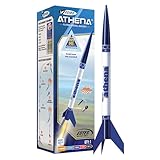
- BEGINNER MODEL ROCKET SET: The Estes Athena model rocket gives kids ages 10+ and beginners an easy way to experience real rocket launches with no building required! This ready-to-fly model rocket kit includes a fully prepared rocket with a parachute. This rocket requires Estes rocket engines, a launch pad system, Starters, Recovery Wadding, and 4 high-quality 1.5-volt AA alkaline batteries (sold separately) for launch use.
- SOARS UP TO 1,125 FT.: Our high-flying Athena rocket features a bright 12-inch parachute for safe recovery and soars up to a projected altitude of 1,125 ft. (343 m) with a C6-7 engine (sold separately). It is also compatible with the A8-3, B4-4, B6-4, and C6-5 rocket engines.
- READY TO FLY: Rocket-building kits are creative, educational gift ideas for Christmas or special-occasion surprises! This beginner-friendly Athena rocket comes fully assembled and just takes 15 minutes of preparation time. This model pairs with the Porta Pad II Launch Pad and Electron Beam Launch Controller (sold separately) for blastoff.SAFETY FIRST, FUN ALWAYS: Our rockets are designed to be used with the NAR (National Association of Rocketry) model-rocket safety code. Always ensure you have an appropriate launch site, stand back at least 15 ft., insert the safety key, issue a countdown, and then you can let your rocket fly!
- SAFETY FIRST, FUN ALWAYS: Our rockets are designed to be used with the NAR (National Association of Rocketry) model-rocket safety code. Always ensure you have an appropriate launch site, stand back at least 15 ft., insert the safety key, issue a countdown, and then you can let your rocket fly!
- ESTES EDUCATION: Since 1958, Estes has created educational rocket kits designed for an unforgettable launch experience. As a family-owned, US-based company, we offer exciting and engaging STEM products for all interests, skills, and power levels.
Honda’s rocket is part of a broader space strategy
The hopper should not be viewed as Honda’s only space-related project. Honda and Astroscale have announced work on a refueling-port connecting system for satellites, with a demonstration target around 2029. That project points toward in-orbit servicing infrastructure rather than launch vehicles.
Honda’s research materials also connect space work with satellite data, connected mobility, robotics, autonomous control, and renewable-energy systems. Taken together, those efforts suggest a portfolio approach: Honda is exploring where its technologies might fit across space transportation, satellite servicing, energy, and robotics.
That strategy could eventually give Honda more than one way to participate in the space economy. It also means the rocket should not automatically be interpreted as the beginning of a conventional Honda-branded launch company. The company may ultimately commercialize the technology, partner with another organization, or keep parts of the work at the research stage. Honda has not committed publicly to one of those outcomes.
What the successful test does—and does not—prove
| The test demonstrates | The test does not demonstrate |
|---|---|
| Controlled vertical ascent and descent | Orbital insertion |
| Precision landing on four legs | Useful payload delivery |
| Operation of flight-control and landing systems | Recovery after an orbital mission |
| A credible experimental foundation for reuse | Rapid turnaround or low-cost operations |
| Honda’s ability to build and fly a rocket demonstrator | A production vehicle or commercial launch service |
| Meaningful progress toward Honda’s suborbital research goal | A confirmed 2029 commercial launch date |
The next milestones will be more revealing than the first hop. Honda will need to show repeatable flights, increasingly demanding trajectories, reliable propulsion, accurate guidance, durable landing hardware, and a path toward safe operations. It will also have to address manufacturing scale, supply chains, testing infrastructure, launch licensing, range safety, maintenance, and customer demand.
Reusable hardware only improves economics if it can be recovered, inspected, refurbished, and reflown without replacing most of the vehicle after every mission. Honda has not yet published the data needed to judge those economics.
Independent reader supportYour contribution helps us test, update, and keep practical guides available for everyone.Why this matters to car enthusiasts
For automotive readers, Honda’s test is interesting because it shows a familiar kind of industrial logic being applied in an unfamiliar environment. Honda is not starting from zero in controls, combustion research, lightweight structures, automated testing, or high-volume manufacturing discipline. Those capabilities can reduce some barriers to entry.
At the same time, rocketry is a useful reminder that engineering expertise does not transfer as a complete package. A car company can bring strong component knowledge and systems engineering to the table while still needing years of specialized work in launch operations, propulsion qualification, orbital mechanics, flight safety, and regulatory compliance.
What’s actually slowing this PC down?
Pick the symptom - the matching free tool is one click away.
The 271.4-meter flight is therefore best understood as a credible proof of capability, not a finished product reveal. It shows that Honda can design, build, control, and land a rocket-sized vehicle. The harder question is whether it can turn that demonstration into a reliable and economically useful space system.
Rank #4

- BUILD IT. COUNT DOWN. LAUNCH IT 10 FEET: Kids build their own realistic rocket and durable launcher from precision-cut wooden parts — then press the red launch button and watch it blast up to 10 feet into the air. No batteries, no electricity — pure mechanical action. Winner of the 2025 Parents Choice Award. Designed for kids ages 6 to 12.
- REAL ROCKET SCIENCE — SERIOUSLY: Every launch teaches Newton's Third Law of Motion — action and reaction — in the most tangible way possible. Kids also discover how rocket propulsion works, what forces keep a rocket on course, and why aerodynamic design matters. These are the same principles behind actual space missions, learned through building and launching.
- SAFE FOR INDOOR LAUNCHING: The rocket's soft foam tip makes it safe to launch indoors — no need for a backyard or outdoor space. Kids can blast off in the living room, bedroom, or classroom without any risk to people or furniture. The launcher is stable, the rocket is lightweight, and the thrill is completely real.
- STEM SKILLS BUILT INTO EVERY STEP: Assembling the rocket and launcher teaches structural engineering, spatial reasoning, and mechanical thinking before a single launch takes place. Kids follow illustrated step-by-step instructions to complete the build independently — developing patience, precision, and confidence in their own ability to make things work.
- RELAUNCHABLE, REPLAYABLE, ENDLESSLY FUN: This isn't a one-shot toy. Kids reload, relaunch, and experiment — adjusting angle, force, and technique to see how high and how far the rocket goes each time. Every launch is a new experiment. Every tweak teaches something new about physics, force, and flight.
What to watch next
- More flight tests: Repetition will show whether the landing was a one-off success or the start of a dependable test program.
- Higher and more demanding flights: A future vehicle must handle greater speed, altitude, aerodynamic forces, and navigation challenges.
- Propulsion disclosure: Honda’s engine and propellant decisions will clarify the program’s technical direction.
- A defined mission: Honda will eventually need to identify whether the system is intended for research, tourism, satellite work, transportation, or another use.
- Commercial commitment: A launch service requires customers, licenses, infrastructure, production plans, and economics—not just a successful landing.
Honda’s 2026 R&D materials show that the program remains active. The reusable-rocket demonstration received the Prime Minister’s Award at Japan’s 7th Space Development and Utilization Awards and the FY2025 Space Frontier Award from the Japan Society of Mechanical Engineers. Those honors recognize the technical importance of the test, but they do not change Honda’s stated research-stage and non-commercial status.
Source note: The quantitative specifications and program status discussed here come from Honda’s official announcements and R&D materials. Flight-sequence details and competitive context are additionally informed by Ars Technica’s examination of Honda’s test footage and technical information.
Frequently Asked Questions
Is Honda’s rocket an orbital rocket?
No. Honda demonstrated a short vertical reusable-rocket flight to 271.4 meters. The company’s stated development goal is suborbital capability by 2029, which is materially different from placing a payload into sustained orbit.
How accurately did Honda’s rocket land?
Honda reported that the vehicle landed within 37 centimeters of its intended target after a 56.6-second flight.
What type of fuel does Honda’s rocket use?
Honda has not publicly confirmed the demonstrator’s propellant combination, engine cycle, thrust, or engine architecture. Suggestions that it may use methane and liquid oxygen remain external speculation, not confirmed Honda specifications.
Free tools Windows power users keep installed
One-click scans. No signup required.
Will Honda start selling commercial rocket launches in 2029?
There is no such announcement. Honda has described 2029 as a technology-development target for suborbital capability and has said the program remains in the fundamental-research phase, with no commercialization decision made.
The Bottom Line
Honda is now a serious contender in reusable-rocket research, not yet a serious launch-industry competitor. Its 271.4-meter hopper flight proved that Honda can control and land a rocket-sized vehicle with remarkable precision. The real test begins next: repeating the achievement, scaling the technology, and demonstrating that it can support a safe, reliable, and commercially useful space system.
Quick Recap
Product prices and availability are accurate as of the date/time indicated and are subject to change. Any price and availability information displayed on Amazon at the time of purchase will apply.




