The SB>1 Defiant was a real flying helicopter, but it was never a production aircraft or the U.S. Army’s Black Hawk replacement. Sikorsky and Boeing built it to test whether rigid coaxial rotors, a rear pusher propeller, fly-by-wire controls, and composite construction could deliver much higher speed without giving up helicopter-like vertical-lift operations.
The SB>1 Defiant was a real flying helicopter, but it was never a production aircraft or the U.S. Army’s Black Hawk replacement. Built by Sikorsky and Boeing, it was a high-risk technology demonstrator designed to test whether a helicopter could combine helicopter-like vertical-lift handling with much higher forward speed.
As an Amazon Associate I earn from qualifying purchases.
Its unusual formula combined two rigid, counter-rotating coaxial main rotors, a rear-mounted pusher propeller, fly-by-wire controls, and a composite fuselage. The aircraft first flew in March 2019 and reached an Army-reported test milestone of 265 mph in 2021. Those figures describe a flight-test achievement—not a certified operational top speed or a promise that a production Defiant would perform identically.
Do these 3 things before closing this tab:
1Clear out junk files and repair common Windows errors2Fix the driver behind crashes, sound loss and screen glitches3Repair Windows errors before they cause bigger problemsWhat was the SB>1 Defiant?
The SB>1 Defiant was Sikorsky and Boeing’s Joint Multi-Role Technology Demonstrator, or JMR-TD. The Army created the JMR effort to mature technologies for its broader Future Vertical Lift program. The demonstrator’s job was to generate flight data and expose the engineering challenges of a fast compound rotorcraft; it was not intended to enter service as a normally procured Army fleet aircraft.
#1 Best Overall
![ACA12127 1:35 Academy USMC AH-1Z Cobra 'Shark Mouth' [Model Building KIT]](https://m.media-amazon.com/images/I/51n+69EWuVL._SL160_.jpg)
- This is a plastic model kit. Assembly and painting is required.
- Paint and glue is NOT included.
- Contains parts to build one of each model.
The name is easy to confuse with two later or related programs:
- SB>1 Defiant: the flown Sikorsky-Boeing technology demonstrator.
- Defiant X: the Sikorsky-Boeing production-oriented proposal submitted for the Army’s Future Long-Range Assault Aircraft competition. It built on technology demonstrated by the SB>1 but was not the same aircraft.
- MV-75 FLRAA: the Bell-derived aircraft selected by the Army for the production program. Its prototype designation is YMV-75A.
That distinction matters. The SB>1 did not replace the UH-60 Black Hawk, did not enter Army service, and did not win the FLRAA competition.
Why does the Defiant have two main rotors?
The Defiant uses a rigid coaxial rotor arrangement. Two main rotors sit on the same axis and rotate in opposite directions. In a conventional single-main-rotor helicopter, the engine’s torque tends to spin the fuselage in the opposite direction from the rotor. A tail rotor counters that torque and also helps control yaw.
Recommended Free Tools
Because the Defiant’s two main rotors turn against each other, their torque effects largely cancel. The aircraft therefore does not need a conventional tail rotor. More importantly, the coaxial arrangement allows both rotors to contribute lift while occupying a relatively compact footprint.
“Dual-rotor helicopter” is a useful description for a general audience, but rigid coaxial compound rotorcraft is more precise. The Defiant was not merely a conventional helicopter with an extra rotor. Its rotor system was paired with a separate propulsor, creating a compound aircraft in which the rotors and propeller were intended to divide the work of flight.
What does the rear pusher propeller do?
At low speed and in hovering flight, the main rotors provide the lift and much of the control authority expected from a helicopter. At high forward speeds, the rear-mounted pusher propeller supplies additional thrust. That arrangement is intended to reduce the need for the main rotors to provide all of the aircraft’s forward propulsion.
Rank #2

- Create this cornerstone of American military with this 139-piece model kit
- Kit features choice of outboard mini guns or rockets, two flight crew figures, separate doors, extensive detail, and two sets of decals
- Model scale 1:32
- Recommended for ages 12 years and older
- Paint and glue are sold separately
This is the central aerodynamic idea behind the Defiant: preserve the vertical-takeoff and confined-area access associated with a helicopter, while using a separate propulsor to make faster forward flight practical. A conventional helicopter’s rotor must simultaneously produce lift, control the aircraft, and provide forward thrust. The Defiant attempted to separate those tasks more effectively.
What’s actually slowing this PC down?
Pick the symptom - the matching free tool is one click away.
The arrangement also illustrates the trade-off. A second rigid rotor, a compound transmission, a pusher propeller, control software, and vibration-management requirements make the aircraft more complicated than a familiar single-rotor helicopter. Public information establishes the architecture and the technology work, but it does not support precise claims about the Defiant’s lifecycle cost, reliability, maintenance burden, or combat survivability.
Rigid rotors, fly-by-wire, and composite construction
The Defiant’s rotors were rigid rather than relying on the same type of flapping and lead-lag motion associated with many conventional helicopter rotor systems. That rigidity was part of the X2-derived approach used by Sikorsky, intended to support high-speed flight and precise control. It also created demanding structural, vibration, transmission, and control-system problems that had to be addressed through testing.
Fly-by-wire controls were another important part of the demonstrator. Instead of connecting every pilot input directly to mechanical flight-control hardware, computers interpret the pilot’s commands and command the aircraft’s actuators. This can help coordinate a complex rotorcraft and manage the transition between low-speed helicopter flight and high-speed compound flight, although it also adds software, sensor, redundancy, and certification requirements.
The aircraft also used a composite fuselage. Sikorsky and Boeing described the Defiant as having a footprint comparable to that of a Black Hawk. That is a useful indication of the design’s intended compactness, not proof that the two aircraft had identical payload, range, cabin volume, or operational roles.
How fast did the SB>1 Defiant fly?
The most widely reported Army test milestone was 265 mph, reached by June 2021. Earlier official reporting described the expanding flight envelope through milestones of approximately 140 knots and 250 mph.
Rank #3
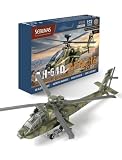
- [Newly designed assembly model]]The AH-64 helicopter model kit assembly model is based on the real AH-64 helicopter, and the classic features of the AH-64 helicopter are carefully restored from the appearance, such as the unique helicopter shape, exquisite spraying details, movable wheels and propellers, etc. The model perfectly demonstrates the modern technology of the military helicopter. And the texture is very good, making the AH-64 helicopter model look more refined.
- [Easy-to-use assembly experience]The AH-64 helicopter model kit parts are carefully designed and made with good compatibility and fit, and can be assembled without special tools. It comes with an assembly step-by-step diagram, so even beginners can easily get started. At the same time, the assembled model is also movable, the propeller can rotate 360 degrees freely, and the helicopter wheels can also move, giving you a more vivid display effect.
- [Product size and painting]The AH-64 military helicopter kit is restored according to the prototype ratio of 1:72, with a specific size of 23*23*7.5 and a weight of 0.146 pounds. The helicopter model assembly model is made of high-quality plastic material, which is not only sturdy and durable, but also not easy to oxidize and fade. The material is exquisite and lightweight, it has no sharp edges, and can effectively prevent the model from being damaged during assembly and play, which is safer.
- [Unique decoration and gift]The assembled AH-64 military helicopter model kit is not only a beautiful handicraft, but also can be used as a decoration and collection. It is very suitable for military enthusiasts to collect or give as a gift. For teenagers and children, the assembly process of this 1/72 AH-64 helicopter model can exercise hands-on ability. Whether you collect it yourself or share it with like-minded people, this AH-64 helicopter model can bring you endless fun and satisfaction.
- [Worry-free Purchase]The product contains tiny parts, be careful not to let children swallow them by mistake. The AH-64 helicopter model kit uses a hard carton as the outer packaging to better protect the helicopter from damage during transportation. We insist on strict production requirements to control the quality of this AH-64 military helicopter model to ensure that every customer is satisfied with the high-quality product. If you encounter any problems, please feel free to contact us!
These numbers should be read as results recorded during a developmental flight-test program. They are not necessarily a certified maximum cruise speed, an operational speed available in every configuration, or a fleet-wide performance figure. “Ultra-fast” is fair as a description of the aircraft’s design goal and test results; it is not an official performance category and does not establish that the Defiant was the fastest helicopter in service.
The first flight took place in March 2019. In September 2021, U.S. Army Redstone Test Center experimental test pilots and flight-test engineers flew the aircraft in support of the JMR-TD effort and preparations for the Army’s FLRAA test work. That involvement is significant: the Defiant was being evaluated as a military-relevant technology demonstrator, not simply displayed as a corporate prototype.
What missions was it meant to support?
The Army’s Future Vertical Lift effort addressed the problem that conventional helicopters face when they must cover long distances quickly while still taking off and landing vertically. Future assault and utility aircraft were expected to operate over greater distances and at higher speeds than legacy Army rotorcraft while retaining access to landing zones that cannot accommodate a conventional runway.
Quick wins for a faster PC:
Scan for outdated or missing drivers - takes under a minuteDriver Scan →Repair Windows errors before they cause bigger problemsFix Now →Fix the driver behind crashes, sound loss and screen glitchesFind Drivers →The Defiant concept targeted that middle ground. It was meant to retain helicopter-like access to confined areas and low-speed maneuverability while improving high-speed transit. The compact coaxial rotor arrangement was also intended to avoid the broad footprint of some other high-speed vertical-lift concepts.
Manufacturer demonstrations later included maneuvering, external-load capability, and single-engine performance. Sikorsky also described a 700-mile flight to Nashville. Those statements are best treated as manufacturer-reported demonstrations of the aircraft’s intended mission breadth, rather than as independent Army acceptance figures or evidence that an operational Defiant fleet had been approved.
Why the Defiant was not the Black Hawk replacement
The phrase “Black Hawk replacement” is too blunt when applied directly to the SB>1. The Army’s FLRAA requirement was intended to complement and eventually replace part of the UH-60 utility and assault mission, but the SB>1 was a technology demonstrator. The production proposal associated with Sikorsky and Boeing was Defiant X.
Rank #4

- This is a 1/100 scale RG4985 kit
- Assembly and painting required.
- Paint & glue not included
On December 5, 2022, the Army selected Bell Textron’s V-280 Valor-based design for the FLRAA contract after a lengthy competitive testing and demonstration process. In other words, the Defiant was a non-selected demonstrator—not an aircraft that entered a production program and was later canceled.
The selected aircraft was subsequently designated MV-75. Army budget and test-center material places MV-75 in active development, including Engineering and Manufacturing Development after Milestone B and preparation for later production and fielding. That is the Army’s current FLRAA production path, not the SB>1 Defiant.
Defiant versus the V-280 Valor
The two FLRAA contenders pursued different ways to achieve high-speed vertical lift.
| Aircraft or proposal | Basic approach | Program outcome |
|---|---|---|
| SB>1 Defiant | Rigid coaxial rotors plus a rear pusher propeller; JMR technology demonstrator | Flew and generated test data; not a production aircraft |
| Defiant X | Sikorsky-Boeing FLRAA proposal derived from the Defiant technology family | Not selected for the FLRAA contract |
| V-280 Valor-based design / MV-75 | Tiltrotor configuration with engines and rotors that transition between vertical and forward flight | Selected by the Army for FLRAA development |
The Army’s decision was not a declaration that the Defiant’s coaxial-compound architecture could not fly. The SB>1 had already demonstrated that it could fly and achieve substantial speed. It was a procurement decision between different aircraft architectures, risks, performance claims, and development proposals.
Independent reader supportYour contribution helps us test, update, and keep practical guides available for everyone.What happened to the Defiant after the competition?
The end of the FLRAA competition did not make the Defiant’s engineering work irrelevant. A 2025 Vertical Flight Society technical paper documented main-rotor gearbox technology insertions and teardown results following the flight-test program. That work shows how at least some of the program’s value continued through analysis and technology maturation rather than direct production of the SB>1 airframe.
PC Slower Than It Used to Be?
A free scan shows the junk files, broken settings and background clutter dragging Windows down - then fixes them in one click.Free scan · Windows 10 & 11Crashes, No Sound, or Screen Glitches?
Random freezes, missing sound and display glitches usually trace back to one bad driver. Find and replace yours safely.Free scan · under a minuteFor readers interested in the mechanical side of the aircraft, the SB>1 Defiant gearbox research paper is a particularly relevant technical reference. It focuses on the main-rotor gearbox technology and teardown work rather than presenting the aircraft as a fielded weapon system.
Best Value

- Highly Detailed Model: Builds into a 1/35 scale AH-60L DAP Black Hawk helicopter with intricate details
- Versatile Cabin Doors: Main cabin doors can be positioned open or closed for different display options
- Customizable Engine Bay: Port engine bay can be built open or closed to showcase internal details
- Comprehensive Weaponry: Includes M261 19-tube Rocket Launcher and AGM-114 Hellfire for authentic military look
- Authentic Military Features: Comes with cable cutters, antennas, IR jammer, chaff/flare launchers, and HIRSS exhaust shields for a realistic model
The engineering trade-off in plain English
The Defiant tried to change the usual speed-versus-helicopter trade-off:
- Vertical lift: the coaxial rotor system provides the lift needed for takeoff, landing, and low-speed flight.
- High-speed thrust: the rear pusher propeller adds forward thrust as speed increases.
- Compactness: the coaxial layout avoids a conventional tail rotor and was designed around a footprint comparable to a Black Hawk.
- Control: fly-by-wire systems coordinate a complex aircraft and its changing flight regimes.
- Cost and complexity: additional rotors, gearboxes, transmissions, software, vibration-control demands, and propulsion hardware increase the technical challenge.
The demonstrator’s importance is therefore not limited to its speed number. It tested whether a sophisticated compound rotorcraft could deliver useful military handling qualities without abandoning the operational flexibility of a helicopter. The result was valuable flight-test evidence, even though the Army ultimately selected a tiltrotor-based aircraft for FLRAA.
Bottom line
The SB>1 Defiant was an ambitious and genuinely fast experimental helicopter: a rigid coaxial compound rotorcraft with a pusher propeller that first flew in 2019 and reached an Army-reported 265 mph milestone. It demonstrated a serious alternative to conventional helicopter design, generated military flight-test data, and helped mature technologies for Future Vertical Lift.
But it was not the Army’s fielded Black Hawk replacement, never entered production, and did not win FLRAA. That role went to Bell’s V-280 Valor-based MV-75 program. Defiant’s lasting contribution is as a flying technology demonstrator and an engineering test bed—not as a canceled production helicopter.
Frequently Asked Questions
Did the SB>1 Defiant replace the Black Hawk?
No. The SB>1 Defiant was a Joint Multi-Role Technology Demonstrator used to mature technology and collect flight-test data. It never entered Army service as a production fleet aircraft.
Why does the Defiant have two rotors?
The Defiant used two rigid, counter-rotating rotors mounted on the same axis. Their opposing rotation cancels much of the rotor torque, eliminating the need for a conventional tail rotor. A rear pusher propeller provided additional forward thrust at higher speeds.
How fast was the SB>1 Defiant?
Army reporting said the aircraft reached 265 mph by June 2021. That was a developmental test milestone, not necessarily a certified maximum cruise speed or an operational performance figure for a production aircraft.
Free tools Windows power users keep installed
One-click scans. No signup required.
Did Defiant X win the FLRAA competition?
No. The Army selected Bell Textron’s V-280 Valor-based design for FLRAA on December 5, 2022. The selected aircraft was later designated MV-75, while Defiant X was not selected.
The Bottom Line
Bottom line: The SB>1 Defiant was a fast, flying Sikorsky-Boeing technology demonstrator—not a production helicopter or the Army’s Black Hawk replacement. Its rigid coaxial rotors, rear pusher propeller, and fly-by-wire controls tested a compelling high-speed helicopter concept, while the Army ultimately selected Bell’s V-280-derived MV-75 for FLRAA.
Quick Recap
Product prices and availability are accurate as of the date/time indicated and are subject to change. Any price and availability information displayed on Amazon at the time of purchase will apply.




