Free tools Windows power users keep installed
One-click scans. No signup required.
There is no reliable answer to whether cars are cheaper to own in Europe or Canada without choosing a specific European country, Canadian province, vehicle specification and ownership pattern. A sticker-price comparison is not enough: compare the tax-inclusive purchase cost, depreciation, energy, insurance, upkeep, financing and registration or road taxes over the same period and distance.
Europe is not one vehicle-tax market, and Canadian vehicle taxes differ by province and transaction. The fair comparison is therefore between two defined places and the same car—not between broad regional averages.



As an Amazon Associate I earn from qualifying purchases.
What total cost of ownership includes
Total cost of ownership (TCO) is the cost of acquiring and using a vehicle over a chosen period, less the value recovered when it is sold. It answers a different question from “Where is this car’s advertised price lower?” A lower initial price can be offset by higher taxes, insurance, energy costs or depreciation; conversely, a higher purchase price may be partly recovered at resale.
Recommended Free Tools
For each location, use the same ownership period and annual distance, and calculate:
TCO = tax-inclusive acquisition cost + ownership-period costs + financing cost − expected resale value.
Ownership-period costs include energy, insurance, maintenance and repairs, and any recurring registration, licence or road taxes. Keep one-time purchase charges separate from recurring charges in your worksheet so you do not count a tax or fee twice. If you want a yearly or per-kilometre figure, divide the total by the same number of years or kilometres for both locations and state which measure you used.
This framework does not establish a winner by itself. The result depends on the specific car, the buyer’s location and profile, and assumptions such as annual distance and resale value. Without those inputs, a numerical European-versus-Canadian verdict would be unsupported.
What’s actually slowing this PC down?
Pick the symptom - the matching free tool is one click away.
Define the comparison before collecting prices
First choose the exact European country and Canadian province where the vehicle will be registered and used. Then specify the vehicle and the period being compared. “Europe” and “Canada” are too broad for a tax-inclusive ownership calculation.
Match the vehicle, not just its name
Record model year, trim, powertrain, safety equipment, options and interior for both listings. Equipment and technical features can differ between country markets even when the model name is the same. European Commission guidance advises consumers comparing a model across countries to check that equipment and interiors match.
Also check whether the quoted price covers the same configuration and whether delivery or other unavoidable purchase charges are included. A base model in one market is not a fair match for a better-equipped version in another.
Fix the location, duration and use pattern
For each side of the comparison, write down the registration jurisdiction, intended ownership duration and expected annual distance. Those choices affect taxes, insurance estimates, energy use and potentially resale value. Use the same years and kilometres or miles for both cases; convert distance consistently if the source estimates use different units.
Choose a consistent currency convention as well. You can keep the European estimate in euros and the Canadian estimate in Canadian dollars and compare each market’s total in its local currency, or convert one total for presentation. If converting, state the exchange-rate date and the rate source. Do not let a changing exchange rate obscure the underlying local costs.
Build the acquisition cost from the amount actually payable
For each jurisdiction, record both the advertised price and the amount the buyer would actually pay to acquire the matched vehicle. Make clear whether the advertised amount includes VAT, GST/HST, provincial motor-vehicle tax, delivery and other unavoidable charges. A pre-tax price in one market cannot be compared directly with a tax-inclusive price in another.
European Union: cross-border purchases and registration
EU VAT treatment depends in part on whether the car is new or used for VAT purposes and where it will be permanently registered. Under the European Commission’s Your Europe guidance, a car is treated as new if, at purchase, it has been used for no more than six months or travelled no more than 6,000 kilometres. The “or” matters: meeting either condition is sufficient for the new-car definition described in that guidance.
When a new car is bought in one EU country with the intention of permanently registering it in another, VAT is generally payable in the country of registration. The taxable price generally includes associated costs such as delivery and accessories. A used car brought back from another EU country does not incur VAT under the described rules, but it must still be re-registered and local registration or road taxes may be due. Check the rules for the actual countries and transaction rather than assuming the treatment is identical throughout the EU.
Do not treat a car’s country of purchase as automatically determining its final tax cost. For a cross-border purchase, establish where it will be registered, whether it meets the VAT definition of new, and which delivery, accessory and local charges apply. Keep any tax already paid or refundable distinct from taxes due in the registration country.
Canada: dealer, private and interprovincial transactions
Canadian motor-vehicle tax treatment depends on the transaction and province. Canada Revenue Agency guidance says GST/HST generally applies when a specified motor vehicle is bought from a GST/HST registrant, such as a dealership. GST/HST generally does not apply to a private sale, but provincial motor-vehicle tax may still be payable when the vehicle is registered.
The place and date of delivery, the province where the vehicle is registered, and whether it is moved between provinces can affect the tax treatment. A quote from a dealer in one province is not necessarily the final amount due if the vehicle will be delivered or registered elsewhere. Check the relevant provincial tax and registration authority for the specific sale and movement before entering a final figure.
Because these rules can produce different outcomes for dealer and private purchases, do not apply a single Canadian tax rate to every vehicle price. Record the transaction type and registration province beside the quote, then use the tax treatment applicable to that case.
Keep one-time taxes separate from recurring charges
Some charges arise at purchase or registration; others recur while the vehicle is owned. Put the first group in acquisition cost and the second in annual ownership costs. Whether a particular registration or road charge is one-time or recurring depends on the local rule, so verify its frequency and do not assume that a fee is annual simply because it is called a registration charge.
Estimate depreciation and resale value on the same basis
Depreciation is the purchase cost that is not recovered when the vehicle is sold. In a TCO calculation, estimate the vehicle’s resale or residual value at the end of the selected holding period, then subtract that amount from acquisition cost. Do not compare one location’s new-car purchase price with another location’s projected depreciation without accounting for the latter’s resale value.
Use a residual-value estimate that matches the same model year, specification, ownership duration and market in which the vehicle will be resold. If no defensible estimate is available, mark it as an assumption and show how the result changes under a lower and higher resale estimate. Do not present a guess as a market fact.
Depreciation can change the ranking between two offers, especially when upfront prices differ. It is useful to show both the tax-inclusive acquisition amount and the acquisition cost less expected resale value, rather than collapsing everything into a single unexplained total. The distinction lets readers see whether a result is being driven by the initial price or by the estimated value retained.
Calculate energy costs using local prices and equal distance
For a petrol, diesel or electric vehicle, estimate the amount of energy used over the chosen period and multiply it by the relevant local price. Use the matched vehicle’s consumption figure and the same annual distance in both locations. For an electric car, include electricity under the actual charging pattern being modelled; for a combustion vehicle, use fuel consumption and the relevant fuel price.
Keep the consumption unit and price unit aligned. If one source reports litres per 100 kilometres and another uses a different distance or energy unit, convert before calculating. Record the consumption assumption, unit price, annual distance and source date. If the buyer’s use is uncertain, calculate more than one plausible use pattern rather than implying a single estimate is certain.
Rank #4

- Made in USA - Proudly produced in Ohio by a Veteran-owned business
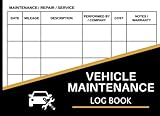
- This book will help you remember your last oil change /last service appointment. You can easily track all services, mileage and maintenance for multiple automobiles - great for business or personal use.
- The yearly expense summary is a very important part of this book. The yearly summary page is a perfect tool for your tax prep and your budget. After every month you should log your total business miles and personal miles in the “Annual Mileage Summary” page.
- This book comes in two convenient sizes, 8.5” x 11” - perfect to fit into any binder or clipboard that you may use for business and 5” x 7” which is the perfect size to fit into your glove compartment!
- Our unique cover is a semi-rigid transparent cover that leads to a sturdy book that resists stains and wrinkles. Reorder SKU: LOG-100-57CW-PP(Auto-Maintenance)
Energy prices and use patterns are local inputs, not fixed properties of “Europe” or “Canada.” A comparison built from a single national or regional fuel price can conceal differences between the actual places being compared. Use local figures appropriate to the buyer and make the date clear.
Add insurance, maintenance, repairs and licensing
Insurance should be estimated for the actual location and driver-vehicle profile, not treated as a standard charge for everyone buying the same model. Obtain or use estimates that reflect the relevant driver, coverage and vehicle specification. Keep the quote date and coverage assumptions with the figure, since a quote for a different driver or policy is not a like-for-like input.
Include expected maintenance and repairs over the full ownership period. Distinguish routine maintenance from unscheduled repair assumptions when the available estimate allows it. Canada Revenue Agency material lists fuel or electricity, maintenance and repairs, insurance, and licence and registration fees among motor-vehicle expense categories in certain employment-related tax contexts. That list is useful for remembering cost categories; it is not a consumer average or a complete personal TCO calculator.
Record licence, registration and other recurring vehicle charges according to the actual jurisdiction. If a source provides only a combined estimate, note what it includes so you do not add the same item separately. If you cannot obtain a comparable insurance or maintenance estimate for both locations, show the gap rather than silently treating the missing cost as zero.
Check vehicle-characteristic taxes
Some taxes depend on the vehicle’s characteristics rather than only on its purchase price. In Canada, a federal excise tax can apply to qualifying fuel-inefficient passenger vehicles. The Canada Revenue Agency’s current reference table begins the tax at a weighted fuel consumption rating of 13 L/100 km, with rates increasing across higher consumption bands. The weighted rating combines city and highway ratings.
This is not a charge to assume for every Canadian vehicle. Check the named vehicle, model year, classification and applicable CRA table before including it. Because the tax bands and classifications are time-sensitive, verify the current treatment for the specific vehicle and transaction. Do not infer a dollar amount from the 13 L/100 km threshold alone.
The Tool Desk
Outbyte Driver Updater FREEFix the driver behind crashes, sound loss and screen glitchesFind Drivers →Outbyte PC Repair FREERepair Windows errors before they cause bigger problemsFix Now →Likewise, identify any applicable vehicle-characteristic, ownership or road tax in the selected European country rather than assigning one EU-wide rate. EU vehicle registration and taxation are not fully harmonised, so a charge that applies in one member country should not be generalized to another.
Best Value
Include financing and currency only when they apply
If the buyer will finance the purchase, include the financing cost over the same ownership period. Use the actual or clearly stated financing assumptions for each market and distinguish the amount borrowed, repayment period and financing cost from the vehicle’s cash purchase price. A cash-buyer comparison should not add hypothetical interest to only one side.
When presenting a cross-currency comparison, keep the original local-currency calculations visible. If converting totals, state the exchange-rate date and convention next to the converted figures. A market’s local tax and operating costs should not be mistaken for an exchange-rate effect.
Use calculators as tools, not regional verdicts
The European Alternative Fuels Observatory’s consumer vehicle calculator provides a useful TCO structure: it asks for purchase price, subsidies, expected residual value, road tax, energy use and price, insurance and maintenance, then calculates depreciation and total ownership cost.
PC Slower Than It Used to Be?
A free scan shows the junk files, broken settings and background clutter dragging Windows down - then fixes them in one click.Free scan · Windows 10 & 11Outdated Drivers Are Slowing You Down
One free scan finds every outdated or missing driver and matches the right update for your exact hardware.Free scan · exact hardware matchIts calculations are based on German market and financial-system data. That makes it a framework for organizing inputs, not a Europe-wide answer. Do not present its output as representative of another European country or of Canada without replacing the relevant price, tax, energy, insurance and financial assumptions with local figures.
Any calculator is only as useful as its inputs. Before relying on a total, check that the tool includes the cost categories relevant to the comparison, that it is configured for the correct market, and that the holding period and use assumptions match the other side. If it omits a cost, add it separately and identify it.
Use this worksheet for a fair comparison
Complete one column for the chosen European country and another for the chosen Canadian province. Keep the values in each market’s currency until the local totals are complete.
| Input | European country | Canadian province |
|---|---|---|
| Currency and exchange-rate date, if converting | Record currency and rate date | Record currency and rate date |
| Vehicle | Model year, trim, powertrain, safety equipment, options and interior | Match the same specification |
| Advertised purchase price | Record source and whether taxes are included | Record source and whether taxes are included |
| Delivered acquisition cost | Add applicable VAT, delivery, accessories and unavoidable fees | Add applicable GST/HST, provincial vehicle tax, delivery and unavoidable fees |
| Registration and road taxes | Record applicable charge and whether one-time or recurring | Record applicable charge and whether one-time or recurring |
| Annual distance and ownership duration | Use the selected common assumptions | Use the same assumptions |
| Energy | Consumption, local unit price and date | Consumption, local unit price and date |
| Insurance | Estimate for the location and driver-vehicle profile | Estimate for the location and driver-vehicle profile |
| Maintenance and repairs | Estimate across the full ownership period | Estimate across the full ownership period |
| Licence and registration fees | Include applicable costs and frequency | Include applicable costs and frequency |
| Financing | Include only if relevant; state assumptions | Use comparable assumptions |
| Expected resale value | Estimate for the selected market and end date | Estimate for the selected market and end date |
Calculate acquisition cost plus ownership-period costs and financing, then subtract expected resale value. Only after both local totals are complete should you convert currencies, if needed. To report an average annual cost, divide each total by the same number of years. To report cost per kilometre, divide each total by the same total distance. Label the chosen measure and do not mix the two.
Quick wins for a faster PC:
Clear out junk files and repair common Windows errorsFree Scan →Scan for outdated or missing drivers - takes under a minuteDriver Scan →Repair Windows errors before they cause bigger problemsFix Now →Checklist before calling one market cheaper
- The comparison uses the same model year, trim, powertrain, equipment and interior.
- Both prices are tax-inclusive delivered costs, or each tax and fee is separately included in the calculation.
- The European country and Canadian province are named, along with the intended registration location.
- Cross-border VAT or interprovincial tax treatment is checked for the actual purchase and delivery.
- Ownership duration, annual distance and currency method are identical or clearly disclosed.
- Depreciation, energy, insurance, maintenance, repairs, financing and registration costs are included or explicitly identified as unavailable.
- Any vehicle-characteristic tax is verified for the specific model and current rules.
- Assumptions such as resale value and insurance are visible, and the conclusion does not claim more than those inputs support.
What broad regional figures can and cannot tell you
The European Commission reported approximately €350 billion in EU28 road-transport taxes and charges in 2016; fuel excise duties accounted for the largest share of that revenue. This is a historical aggregate of public revenue, not a current annual cost per driver, a per-car ownership estimate or a comparison with Canada. It cannot determine which market is cheaper for an individual buyer.
There is no comparable current Europe-versus-Canada average ownership-cost figure established here. A defensible result requires current local vehicle quotations, tax schedules, insurance estimates and running-cost assumptions for the selected places and vehicle. Until those inputs are specified, the useful answer is a comparison method, not a regional winner.
Quick Recap
Product prices and availability are accurate as of the date/time indicated and are subject to change. Any price and availability information displayed on Amazon at the time of purchase will apply.




