For a U.S. electric SUV, the right charging plug depends on whether you are using AC charging at home or DC fast charging on a trip—and on the exact vehicle and model year. The U.S. Department of Energy (DOE) gives broad estimates of about 5 miles of range per hour for Level 1 and 25 miles per hour for Level 2, but an SUV’s actual rate varies with its battery, onboard charger, charge level, equipment, and available electrical service. Check your owner’s manual and charging settings for vehicle-specific limits.
Which charging plug does an electric SUV use?
Start with the SUV’s charge port and the charging level you plan to use. A plug that fits one charging situation may not fit another: AC charging at home and DC fast charging on a road trip use different connector categories. In the United States, the DOE Alternative Fuels Data Center (AFDC) identifies J1772 for Level 1 and Level 2 AC charging. For public DC fast charging, it lists CCS, CHAdeMO, and J3400, depending on the vehicle.
As an Amazon Associate I earn from qualifying purchases.
| Charging use | Connector identified by DOE AFDC | What to confirm |
|---|---|---|
| Level 1 AC | J1772 | Check the SUV’s port and whether the supplied cordset or station connector is compatible. |
| Level 2 AC | J1772 | Check the vehicle’s AC charging limits and the equipment’s connector and power rating. |
| Public DC fast charging | CCS, CHAdeMO, or J3400, depending on the vehicle | Match the station connector to the specific SUV; check current station availability and operating status before relying on it. |
Confirm compatibility before a trip
Look up the charge-port type in the owner’s manual or the vehicle manufacturer’s specifications, then compare it with the connector listed for the charging station. For a longer drive, verify the station in a current route-planning or charging app rather than assuming that a nearby station has the right plug or is operating. Connector adoption is changing, so a claim about compatibility should be tied to a specific vehicle and model year.
An adapter is not automatically a universal solution. Its approval and power limits may depend on both the vehicle and the charging equipment. Check the vehicle and charger manufacturers’ requirements before using one; do not assume that an adapter that works for one charging level or station will work at another.
#1 Best Overall

- Complete Package Contents: Power plug 1; Cable 1; Control box 1 (equipped with an LCD color display, current switch button, and time-setting buttons). The charging gun interface adopts a universal 5-hole US standard design. A US standard plug adapter will also be provided for compatibility with Level 1 household power outlets
- Advanced Portable Charger Features: The Charger is engineered for modern new energy vehicles, such as all-electric, extended-range, and hybrid models, and is compatible with the National Standard 5pin AC charging interface. It automatically stops charging once the battery is full and offers flexible charging options including scheduled start and customizable duration limits. Built in safety mechanisms protect against overvoltage, overheating, and overload, while an intuitive display shows real-time metrics like current, voltage, power, and temperature. Suitable for both home and commercial use, the charger can be permanently installed or carried on the go for flexible charging convenience
- Simple Operation Instructions: To begin normal charging, first ensure the electrical outlet and wiring are functioning properly, then connect the charger to the power supply. Modify the charging current or make time reservation as needed, then connect the vehicle for charging
- Customizable Charging Settings: Initial Interface - Press and hold 3 seconds to enter TIME settings menu - Click once to add 2 hours, 8 hours maximum; Press and hold Initial Interface Set Delayed Time touch key 3 seconds to enter Current settings menu, Click once to select charging current, Long press 3 seconds to confirm
- Safety Guidelines and Specifications: The charging current of the Toptoo charger must not exceed the rated current of your power outlet. Before use, ensure the power outlet is not worn out or of poor quality. Do not use damaged or counterfeit outlets, as they may overheat and pose safety risks. Toptoo is not responsible for accidents caused by improper charging setups including non-compliant wiring or electrical standards
How fast will an electric SUV charge?
Charging speed depends on more than the charger’s advertised output. DOE AFDC’s approximate U.S. estimates below describe range added per hour or a broad DC charging possibility; they are not test results for a named SUV or guarantees for an individual session.
| Charging level | Typical supply identified by DOE | DOE AFDC illustration | How to interpret it |
|---|---|---|---|
| Level 1 AC | 120 V outlet | About 5 miles of range per hour | A slow option that can suit some drivers’ daily use when the vehicle is parked for long periods. |
| Level 2 AC | 240 V residential or 208 V commercial service | About 25 miles of range per hour | Usually faster than Level 1, but the actual rate varies by equipment, vehicle, and electrical service. |
| DC fast charging | Public DC charging equipment | Can take less than 20 minutes in some circumstances | A possible short charging stop, not a promise to reach a particular charge level or add a fixed amount of range. |
DOE AFDC also notes that Level 1 charging can take 20 hours or more in some circumstances. Neither that figure nor the under-20-minute DC example should be treated as a full-charge estimate for every electric SUV. Battery capacity, starting charge, vehicle charging capability, temperature and other battery conditions affect how long a session takes. For Level 2, the available supply and equipment output matter too.
Why two SUVs—or two sessions—can charge differently
- Battery state of charge: The vehicle’s starting charge affects the session, and DC fast charging generally slows as the battery approaches a high state of charge.
- Battery capacity and chemistry: SUVs differ in battery size and design, so the same time connected does not mean the same range added.
- Vehicle charging limits: The onboard charger sets a limit for AC charging, while the vehicle and battery conditions also affect DC charging. A charger’s maximum rating alone does not establish the SUV’s rate.
- Equipment and electrical supply: EVSE output, residential or commercial service, and the home circuit available to the equipment can constrain charging.
Because these variables interact, multiplying an approximate miles-per-hour figure by the number of hours plugged in will not reliably predict a particular SUV’s charge or full-charge time. Use vehicle-specific charging information for planning, and allow for charging to slow as the battery gets close to full.
What’s actually slowing this PC down?
Pick the symptom - the matching free tool is one click away.
Rank #2

- ⚡ Fast, Flexible Charging You Control- Equipped with a NEMA 14-50 plug and adjustable current (10A to 40A), the EVDANCE EV Charger gives you total control over your charging speed. Whether you're topping off at work or doing an overnight charge at home, simply tap the control button to select your ideal amperage. It’s precision charging, made easy NOTE: It is necessary to use a J1772 to Tesla adapter(not including) when charging your Tesla vehicles
- 8X Faster Charging: The EVDANCE ev charger level 2 comes with a NEMA 14-50 plug, charging at 240V and the maximum current can reach 40A, which can provide maximum 9.6kWh charging power. Experience unparalleled speed at approximately 8x faster than level 1 ev chargers
- Adjustable Charging Current: EVDANCE Level 2 charger supports adjustable currents settings ranging from 10A to 40A (10A/16A/20A/24A/32A/40A). Just touch the "A" button, you can easily select the appropriate charging speed to suit your specific needs
- Delayed Charging Function: With the delay start feature, you can set your charging time(delay 1-12 hrs), staggering the peak usage period and reducing your energy costs
- Intelligent 2.4"" TFT Display & & LED Indicators: Our 40A electric car charger equipped with a large 2.4"" TFT screen, it provides clear and real-time charging information, including charging current/voltage/power kWh, charging time and work status, etc.The LED indicator on the control box provides real-time charging status
Do you need a Level 2 charger at home?
Not necessarily. DOE says many EV drivers charge at home overnight using Level 1 or Level 2 equipment, and some vehicles include a portable Level 1 cordset. Whether that is enough depends on how much you drive, how long the SUV is parked, how much energy you need to replace, and the vehicle’s charging limits. Level 2 can replenish energy faster, but it requires a suitable 240 V residential supply and may involve electrical work.
Use your routine to decide
- Level 1 may fit if the supplied cordset is compatible with your vehicle and regular driving leaves enough parked time to meet your needs. Its slower rate means it may not replace a large amount of driving energy during a short overnight window.
- Consider Level 2 if your daily driving and charging schedule call for faster home charging, or Level 1 does not replenish enough during the time the SUV is normally parked.
- Check the vehicle first if you are comparing equipment. Confirm the SUV’s AC charging capability and connector so you do not select equipment based only on a headline power rating the vehicle cannot use.
A useful decision is not simply “Which charger is fastest?” Compare the charge the vehicle can accept, the time it is usually parked, the energy needed for your driving, and the home electrical supply. If those details are uncertain, consult the owner’s manual and a qualified electrical professional before choosing equipment.
What to check before installing Level 2 equipment
Level 2 home EV charging equipment (EVSE) uses a higher-voltage supply than Level 1. DOE’s Federal Energy Management Program (FEMP) notes that installation can involve significant permitting and building-code requirements. Before buying or installing a 240 V home EV charger, check:
Rank #3
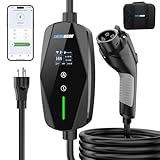
- 📱【2026 SMART CHARGING — FULL CONTROL, ZERO GUESSWORK】Built for modern EV owners, The Level 1 ev charger features adjustable current settings and intelligent scheduling via the mobile app. Easily set charging times, manage power output, and optimize energy usage—whether charging overnight or during off-peak hours. Smarter charging means lower costs, safer operation, and complete convenience on your schedule
- 🚗【ONE CHARGER, ALL J1772 EVs & PHEVs READY】Compatible with all SAE J1772 electric vehicles and plug-in hybrids. Designed to work seamlessly with most EV brands including Ford, GM, Nissan, Audi, BMW, Kia, Hyundai, Honda, Chevy, and more. Ideal for both home and on-the-road charging, this 16A portable Level 1 & Level 2 charger keeps your EV ready for every journey.
- 🔌🔌【LEVEL 1 & 2 PORTABLE EV CHARGER — CHARGE ANYWHERE】Designed for everyday flexibility, this portable EV charger supports both NEMA 5-15 outlets and NEMA 6-20 adapter. Charge at home, at a friend’s house, or while traveling. Level 2 (240V, 16A): up to 3.68kW, approx. 9–12 miles/hour Level 1 (120V): automatically limits current to 12A for safe household use,Smart current management protects your vehicle and your home’s electrical system.
- 🖥️📊【LCD SCREEN + SMART APP — REAL-TIME CHARGING INSIGHT】Unlike basic chargers that hide key data, this portable EV charger features a clear LCD screen and smart app control. Instantly view voltage, current, charging power, energy usage, and temperature—on the charger or remotely from your phone. One glance gives you full confidence and control over every charge.
- 🛡️【BUILT FOR SAFETY, DESIGNED TO LAST】Engineered with multiple safety protections—including over-temperature, over-current, over-voltage, and short-circuit protection. The intelligent control box continuously monitors charging status in real time. Rated IP65 for water resistance and built with flame-retardant materials, this charger is ready for daily use in any environment
- Whether the equipment’s connector and operating limits meet the vehicle manufacturer’s requirements.
- Whether the vehicle’s charging settings or onboard limits affect the charging rate you can use.
- Whether the home’s electrical capacity and the intended circuit can support the installation.
- Which permits, inspections, and local building-code requirements apply.
- What work is required at the installation location, as assessed by an appropriate electrical professional.
Do not assume that a product’s maximum output tells you what your SUV will receive, or that a standard household circuit is suitable for Level 2. Have the installation assessed and follow local requirements. The DOE FEMP purchasing guidance on EVSE was updated in June 2023; electrical requirements and local rules should be checked for the installation at hand.
The Tool Desk
Outbyte PC Repair FREEClear out junk files and repair common Windows errorsFree Scan →Outbyte Driver Updater FREEScan for outdated or missing drivers - takes under a minuteDriver Scan →Should you charge an electric SUV to 100%?
There is no single daily charge target established for every electric SUV by the DOE guidance discussed here. The useful charge level depends on the trip distance and conditions, the vehicle’s battery design, and the manufacturer’s instructions. Check the owner’s manual and charging settings for any model-specific recommendation rather than applying one percentage to all vehicles.
For a road trip, a higher charge may be useful when distance or conditions require it. For DC fast charging, however, DOE notes that most batteries reduce charging power somewhere in the 80%–100% range. That slowdown means the last portion of a fast-charge session can take disproportionately longer than the earlier portion. It is a reason to plan charging around the journey and the vehicle’s guidance, not proof that every driver should use the same cutoff.
Rank #4

- PREVENT BATTERY FAILURE: Ensure reliable starts after storage with this 4-in-1 device that charges, maintains, tests, and restores batteries for cars, motorcycles, ATVs, trucks, SUVs, and boats.
- REVIVE DEAD BATTERIES: Delivers 15A rapid charging power to keep standard, AGM, gel, and deep-cycle batteries healthy, making it the perfect garage upgrade for seasonal or infrequently used vehicles.
- EASY OPERATION: Microprocessor controlled with auto voltage detection and smart trickle charging technology for a seamless charging experience.
- MULTI-FUNCTION VALUE: Maximize battery life and performance with advanced desulfation mode, automatic voltage detection for 6V and 12V batteries, and multi-stage charging algorithms.
- COMPLETE PACKAGE: Includes (1) SC1280 Battery Charger and Maintainer, (1) user manual
Does fast charging hurt the battery?
The cited DOE material does not establish that occasional fast charging necessarily damages a particular electric SUV. Battery life depends on multiple factors, including climate, driving and charging patterns, cell chemistry and design, and the vehicle’s thermal-management system. These differences make a universal claim about fast charging or battery lifespan too broad. Follow the manufacturer’s charging guidance and warranty terms for the specific model.
Battery systems also differ in their maintenance needs. Some use liquid coolant that may require checks, but the service schedule is vehicle-specific. Use the owner’s manual to find required inspections and maintenance; do not infer that every SUV has the same battery-cooling system or service interval.
What battery-life estimates can—and cannot—tell you
DOE AFDC cites predictive modeling by the National Laboratory of the Rockies that estimates today’s batteries may last 12–15 years in moderate climates and 8–12 years in extreme climates. Those are modeled estimates, not a prediction for every SUV, a warranty term, or a guarantee of a particular remaining range. Actual life depends on the vehicle’s design and use as well as climate and thermal management.
Best Value

- 【Caution!】This power cord is Not Suitable for all electric lunch boxes. It is suitable for PHIWILLS electric lunch boxes series and compatible with some other brands electric lunch boxes, but doesn't compatible with crockpot product.
- 【About Compatibility】For other brands electric lunch box except for PHWILLS, please must review our product detail images, carefully check if the interface shape matches your electric lunch box and confirm other details matches your lunch box such as voltage, positive and negative interface before buying.
- 【Max 100W Power】This power cable is made of high quality pure copper which is low resistance & good conductivity support electric lunch box max 100W working that can heated up food quickly to save you time.
- 【UL Certified Power Cable】The insulation layer is made of high-quality PVC material, which is wear-resistant, flame retardant, waterproof, oil-proof and the 110V Power Cable is UL Certified
- 【Package Includes & Warranty】Package includes 1x 2.62 feet 12V/24V power cable , 1x 2.62 feet 110V/230V power cable. Manufacturer warranty for one year from the date of purchase and lifetime customer service with a response within 24 hours.
How should you prepare an electric SUV for cold weather?
Cold conditions can affect an EV’s readiness, range, and charging. DOE’s January 30, 2024 winter guidance recommends covered parking where possible and preconditioning the cabin and battery while the vehicle is still plugged in, if the SUV supports that feature. Preconditioning prepares the vehicle before departure while it remains connected to power.
- Check the manual for cold-weather features. Confirm whether the SUV can precondition its cabin, battery, or both, and how to activate the feature.
- Precondition while plugged in when supported. Use the manufacturer’s controls or schedule so the vehicle can prepare before driving without relying solely on stored battery energy.
- Allow for winter range and charging effects. Plan for conditions that can change the range available and the pace of charging, especially when making a longer trip.
- Store the charging connector as directed. Follow the equipment and vehicle manufacturer’s instructions for stowing and protecting it.
- Plan fast-charge stops around the trip. A DC session may slow as the battery reaches a high state of charge, so consider the distance and conditions ahead rather than expecting the same charging pace throughout.
Not every electric SUV offers the same preconditioning features or controls. If the manual does not confirm a feature, do not assume a generic procedure applies to your vehicle.
Quick Recap
A practical charging checklist for SUV owners
- Identify the exact model year and charge-port type from the owner’s manual.
- Match the vehicle’s connector to the station and to the charging level you intend to use.
- For road trips, verify connector availability and station operating status close to departure.
- Use DOE’s Level 1 and Level 2 rates only as broad illustrations; check vehicle-specific limits for planning.
- Decide whether Level 1 fits your driving and parking routine before assuming a Level 2 installation is necessary.
- Before installing Level 2, confirm vehicle compatibility, circuit capacity, permits, code requirements, and professional installation needs.
- Use the vehicle’s manual and warranty guidance for charge settings, battery care, coolant checks, and cold-weather features.
Product prices and availability are accurate as of the date/time indicated and are subject to change. Any price and availability information displayed on Amazon at the time of purchase will apply.
Do these 3 things before closing this tab:
1Fix the driver behind crashes, sound loss and screen glitches2Repair Windows errors before they cause bigger problems3Scan for outdated or missing drivers - takes under a minute



