Quick wins for a faster PC:
Fix the driver behind crashes, sound loss and screen glitchesFind Drivers →Clear out junk files and repair common Windows errorsFree Scan →It could reduce the electricity needed to make some industrial steam, but the scale of any Gulf-wide grid relief is not independently established. GlassPoint CEO Rod MacGregor argues that supplying process heat directly from concentrated sunlight can avoid converting electricity into heat—a potentially important distinction in a region where industry, cooling and other users compete for power. The operating examples are in Oman; the much larger Saudi project discussed by GlassPoint is planned, not an operating facility.
Why industrial heat matters to electricity grids
Industrial sites need heat for processes such as steam generation. One way to provide it is to generate electricity and run an electric boiler; another is to concentrate sunlight and produce steam directly. GlassPoint says its enclosed-trough system uses curved mirrors to focus sunlight onto a water-filled pipe, then feeds the resulting steam into an industrial steam network. In that arrangement, electricity is not an intermediate step for the solar-supplied heat. That can avoid adding the corresponding electric-boiler load to a grid, but it does not by itself establish how much electricity or fuel a particular plant—or a national system—would save. GlassPoint’s technology description explains the company’s system.
The argument is especially relevant to Gulf grids because industrial heat demand can be large and continuous, while electricity is also needed for other uses. In an interview published on 5 October 2026, MacGregor said industry accounts for “around 20 percent of global energy demand” and attributed a “47 percent” share of Saudi energy consumption to industry. The report does not identify the original statistical publication behind those figures, so they should be treated as estimates cited by the GlassPoint CEO, not independently confirmed statistics. The interview report also does not provide the underlying calculations for its broader grid-pressure argument.
What GlassPoint’s gas scenario does—and does not—show
MacGregor’s analysis, as reported on 5 October 2026, estimates that Saudi industrial heat uses 34 billion cubic metres of gas a year. It estimates that generating electricity to provide the same heat would require 78 billion cubic metres of gas, implying 44 billion cubic metres of additional gas demand in that scenario. The estimates are attributed to GlassPoint analysis based on IEA, KAPSARC and SEEC data, but the report does not provide the source documents, assumptions or calculations needed to independently reproduce them.
Do these 3 things before closing this tab:
1Clear out junk files and repair common Windows errors2Fix the driver behind crashes, sound loss and screen glitches3Repair Windows errors before they cause bigger problems#1 Best Overall

- solar collector of solar hot water heater
- 10 Vacuum glass tubes(diameter 58mm, length 500mm)
- Manifold: Outer shell: Aluminum Alloy, Thickness:1.8mm;Insulating layer:rock wool overall
- 10 units of heat pipe is included.(suitable for tube 58*500mm)
- It can be used as solar collector for solar hot water heating system, for training project, or demon collectors, or as small solar collector for the water heating system at home. etc.
These figures are a scenario presented by the company’s CEO, not a measured forecast of what Saudi Arabia would consume if industry electrified. They illustrate the distinction GlassPoint is making: direct solar heat could displace some fuel-fired process heat without requiring the electricity-generation pathway assumed in an electrification scenario. They do not establish that solar thermal would replace all industrial heat, that every site could use it, or that the full estimated gas difference would be avoided.
How direct solar steam compares with electric routes
The 5 October 2026 report gives four delivered-heat cost estimates from GlassPoint analysis for a 240 MWth project in California. These are company-modelled figures, not Gulf tariffs or independently verified prices; they should not be read as a universal ranking.
| Heat route | Reported modeled cost | What the route implies |
|---|---|---|
| Concentrated solar thermal producing steam directly | About $44/MWh | Produces heat without using electricity as an intermediate step. The project still requires suitable land, integration with the plant, and an approach to maintaining heat supply when solar input is insufficient. |
| Photovoltaics with thermal storage | Approximately $90/MWh | Uses PV-generated electricity and thermal storage. The report does not specify the storage duration or operating assumptions behind this modeled figure. |
| Photovoltaics with batteries and an electric boiler | Approximately $110/MWh | Uses electricity from PV and batteries to run an electric boiler; this route depends on electrical equipment and a storage configuration. |
| Grid electricity with an electric boiler | Approximately $135/MWh | Draws electricity from the grid to make heat, adding electric demand at the industrial site. |
The report does not supply enough detail to make these options an apples-to-apples comparison for a Gulf facility. A project assessment would need to account for solar resource, usable land, required steam temperature and pressure, the plant’s operating schedule, storage and backup needs, local electricity and fuel prices, grid emissions, and the cost and risk of connecting new equipment to an existing process. GlassPoint notes that mirror soiling can reduce reflectivity and energy output; site operations and maintenance therefore matter alongside headline modeled cost. The company’s technology page describes the system and this soiling limitation.
What has operated in Oman, and what is planned in Saudi Arabia
Miraah: an operating Oman project
GlassPoint reports that Miraah, at Oman’s Amal oilfield, began delivering steam in 2017. The company lists 330 MWth peak thermal capacity, average solar steam production of 2,000 tonnes per day, and 445 GWh per year. The steam is used for thermal enhanced oil recovery. These are project figures published by GlassPoint, rather than an independent performance audit. GlassPoint’s Miraah project page provides the company’s figures.
Free tools Windows power users keep installed
One-click scans. No signup required.
Rank #2

- Hailstone Resistance: up to φmm (1"), Max Operating Pressure: 87psi, Max Flow Rate: 5.25 gpm
- 14mm TU1 Copper Heat Pipes, Manifold insulation: 45mm 93 Kg/m^3 Rockwool, Rated Best Heat Retention
- φ58mm x 1800mm Three-Target Cu/SS-ALN(H)/SS-ALN(L)/ALN Vacuum Tubes, High Boron Silicon 3.3 Glass
- Sun Absorption Efficiency: 93-96%, Vacuum Rating: Less than 5.0 x 10^3 Pa, Lifespan:70% @ 15 Years
- OG-100 SRCC Certificate Number: 10001880, Eligible for 30% Federal Tax Rebate, Winter Resistant
Amal I: an earlier, smaller installation
GlassPoint lists Amal I in Oman as a 9 MW thermal project that began producing steam in 2012, with daily output of 50 tonnes and 12 GWh per year. These are also company-published figures. The project provides an earlier operating example, but its scale is far below Miraah and the proposed Ma’aden development. GlassPoint’s Amal I page gives the project details.
Ma’aden Solar I: a planned Saudi project
Ma’aden Solar I is not described in the cited material as a completed, operating full-scale facility. In a 26 November 2024 announcement, GlassPoint said its Ma’aden Technology Showcase would be an initial stage toward a larger project, combining direct solar heat with liquid-salt thermal storage. The announcement said the showcase would provide 1% of the steam required by Ma’aden’s bauxite refinery at Ras Al Khair, while the complete project was intended to supply 65% of the steam requirements of the alumina refinery. The announcement named Saudi Arabia’s Ministry of Investment (MISA) as a partner and Cox as the showcase’s technical and delivery partner. These are announced plans, not evidence of completed delivery or achieved output. GlassPoint’s November 2024 announcement describes the project stages.
The 5 October 2026 report describes the planned full project as 1.5 GWth of capacity, with around 500 MWth of continuous thermal output and about 14,000 tonnes of steam a day. Those are reported planned specifications, not operating results. The distinction between the showcase and the larger project matters: the former is an initial stage; the latter is the development expected to provide the stated share of refinery steam.
Independent reader supportYour contribution helps us test, update, and keep practical guides available for everyone.Where the approach may fit—and what can prevent adoption
MacGregor identifies oil and gas, metals and mining, refining, and chemicals as sectors with large, continuous process-heat requirements. The fit is not automatic: the temperature, pressure and timing of a plant’s heat demand must match what a solar-thermal system can supply alongside storage, backup equipment and the existing steam network.
Rank #3
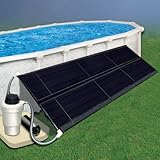
- Eco-Friendly Pool Heating: Uses solar energy to heat your pool, reducing reliance on gas or electricity and extending your swim season.
- Above Ground Solar Heating Panel Systems: Energy-saving solar pool system harnesses the sun’s rays to warm circulating water before returning it to the pool. The collector kit can be mounted on plywood (as shown) beside the pool or roof-mounted. Roof/rack mounting kit required for installation.
- Solar Panel Collector Kit Sizes: Available in 2.5' W x 20' L, 5' W x 20' L (includes two 2.5' W x 20' L panels), and 5' W x 10' L (includes two 2.5' W x 10' L panels). PVC or flex pipes not included.
- Above Ground Roof/Rack Mounting Kits: Include all necessary hardware for mounting panels on roofs or sloped plywood (as shown). Kit contains (5) 6' straps, 15 stainless steel mounting brackets, and (15) #14 stainless steel screws. 2-Way Diverter Valve: Can be plumbed into your filter/solar heating system to function as an on/off switch. Includes diverter valve and spacer.
- Above Ground Collector Sizing Chart: A 12'-15' round pool needs a 2.5' x 20' collector (40,000 BTU), while an 18'-24' round pool requires a 5' x 20' collector (80,000 BTU). For 27'-28' round pools, both sizes are needed (120,000 BTU). A 12' x 24' oval pool uses a 2.5' x 20' collector (40,000 BTU), while 15' x 30' and 16' x 32' oval pools need a 5' x 20' collector (80,000 BTU). An 18' x 34' oval pool requires both a 2.5' x 20' and a 5' x 20' collector (120,000 BTU).
GlassPoint names land, capital requirements, integration with a continuously operating industrial plant, and operator expectations about reliability and safety as adoption barriers. The company also describes a build-own-operate arrangement: it funds and operates the heat facility while the industrial customer buys heat under a long-term agreement. GlassPoint’s website presents this as its Steam-as-a-Service model, including fixed-price arrangements. These are vendor descriptions; the sources do not include a customer contract or independent audit establishing the terms or performance of a specific deal. GlassPoint’s company website describes its heat-service approach.
Direct solar heat is therefore industrial infrastructure, not a plug-in household solar-water-heating product. Its value depends on whether a project can be built and integrated at a suitable industrial site, and on how its heat supply fits the plant’s reliability requirements.
What would establish the size of any Gulf grid benefit
The operating Oman projects show that GlassPoint has supplied industrial steam at commercial sites, while the planned Ma’aden development illustrates a proposed larger application. Neither project record, by itself, quantifies the electricity that would otherwise have been used to make the same steam across the Gulf. Nor do the reported California cost estimates establish Gulf economics.
A credible regional estimate would need site-level heat demand and operating schedules, the share of heat suitable for direct solar supply, storage and backup assumptions, local fuel and electricity costs, land and integration costs, and the grid-generation mix. Until those inputs and the assumptions behind GlassPoint’s gas scenario are available for scrutiny, the defensible conclusion is narrower: concentrated solar thermal can supply some industrial steam without first drawing electricity to produce that heat, but the amount of Gulf grid pressure it could relieve remains unquantified in the cited material.
Quick Recap
Product prices and availability are accurate as of the date/time indicated and are subject to change. Any price and availability information displayed on Amazon at the time of purchase will apply.




