The Tool Desk
Outbyte PC Repair FREEClear out junk files and repair common Windows errorsFree Scan →Outbyte Driver Updater FREEScan for outdated or missing drivers - takes under a minuteDriver Scan →The biggest dividing lines in Yamaha YZF-R1 history are the original 1998 compact-engine formula, the 2009 crossplane-crankshaft reset, and the 2015 shift to a track-first motorcycle built around a six-axis inertial measurement unit. The 2004 model is the major pre-crossplane redesign, while the 2020, 2025, and 2026 motorcycles refine the 2015 architecture rather than creating entirely new numbered generations.
That distinction matters when comparing used R1s. Yamaha’s milestone years are not the same thing as a completely new motorcycle every model year: the 2000 and 2012 bikes, for example, are important updates within broader mechanical families. The table and explanations below separate genuine engineering changes from styling, equipment, and model-year revisions.
As an Amazon Associate I earn from qualifying purchases.
Yamaha YZF-R1 generations at a glance
| Year | Historical position | Defining change | Best understood as |
|---|---|---|---|
| 1998 | First generation | Compact 998cc five-valve inline-four, stacked engine layout, short-wheelbase concept | The original “R1 Shock” and the foundation of the modern liter supersport |
| 2000 | First-generation family | Model-year refinement of the original formula | A developed early R1, not a clean-sheet generation |
| 2002 | Second generation | Updated bodywork, chassis details, and engine calibration | The mature version of the original five-valve concept |
| 2004 | Fourth generation | New high-compression engine, frame, under-seat exhausts, and substantially greater output | The first full redesign and a move toward a more extreme superbike |
| 2006 | R1 SP derivative | Premium limited-production version of the 2004–2006 platform | A special model, not a separate numbered generation |
| 2007 | Fifth generation | Four valves per cylinder replace Yamaha’s earlier five-valve layout | A new engine philosophy before the crossplane era |
| 2009 | Sixth generation | 998cc crossplane inline-four with uneven firing order | The CP4 engine reset and the most distinctive R1 power delivery |
| 2012 | Seventh generation | Refinement of the crossplane platform | A more developed version of the first CP4 concept |
| 2015 | Eighth generation | Track-first design brief, approximately 200 horsepower, six-axis IMU, integrated rider aids | The major electronics and mission reset |
| 2020 | Ninth generation | Engine, intake, valvetrain, bodywork, and aerodynamic refinements | An updated 2015 architecture |
| 2025 | Ninth-generation update | Carbon-fiber winglets, revised KYB fork, Brembo Stylema calipers, and new Brembo master cylinder in the U.S. | A significant chassis and braking update, not a new numbered generation |
| 2026 | Current U.S. model as of August 12, 2026 | Continued CP4 and IMU architecture, including a 70th Anniversary Edition | The current refinement of the 2020-plus platform |
Yamaha’s generation numbering can look confusing because milestone years do not form a simple one-year-per-generation sequence. The 2004 R1 is identified as the fourth generation even though the most visible early milestones in this comparison are 1998, 2000, and 2002. For purchase research, the motorcycle’s exact model year, VIN, market, and equipment matter more than trying to force every year into a separate generation.
Windows Errors? Fix Them Before They Spread
Repair common Windows errors and clear accumulated junk for a smoother, more stable PC - no reinstall needed.Free scan · no reinstallCrashes, No Sound, or Screen Glitches?
Random freezes, missing sound and display glitches usually trace back to one bad driver. Find and replace yours safely.Free scan · under a minute1998: The original R1 changed the liter-bike formula
The first YZF-R1, often called the “R1 Shock,” was designed as a deliberate departure from the larger and heavier character of Yamaha’s YZF1000R Thunderace. Yamaha’s priority was not simply to build a faster top-speed machine. It wanted a compact, light, slim motorcycle with sharp handling and enough excitement to make winding roads its natural environment.
#1 Best Overall

- ODIs proprietary medium compound material provides comfort without sacrificing durability
The mechanical centerpiece was a triangular arrangement of the crankshaft, mainshaft, and driveshaft. By stacking these major engine components more compactly, Yamaha created space for a short wheelbase and a relatively long swingarm. That combination helped the R1 turn quickly without giving up the stability and acceleration benefits of useful swingarm length.
- Engine: 998cc liquid-cooled DOHC inline-four with five valves per cylinder.
- Chassis: Deltabox II aluminum frame and braced alloy swingarm.
- Suspension: Yamaha Monoshock rear suspension and 41mm fully adjustable upside-down front forks.
- Published European figures: 150 PS at 10,000 rpm and 177kg dry weight.
Those specifications are significant because they explain why the 1998 bike remains historically important even when later R1s are objectively faster. Its defining achievement was changing expectations for the whole liter-class category: a large-displacement supersport could be compact, relatively light, and focused on agility rather than merely high-speed performance.
What makes the 1998 model different?
The answer is the combination of the stacked gearbox layout, short and slim proportions, five-valve engine, and road-focused sense of urgency. Later R1s became more powerful, more electronic, and more circuit-oriented, but the first model established the basic idea that every subsequent generation would reinterpret.
2000: An important refinement, not a clean-sheet redesign
The 2000 R1 remains part of the first-generation mechanical family. It refined the original concept instead of replacing it with an entirely new engine-and-frame architecture. That makes it relevant to collectors and early-R1 buyers, but it should not automatically be treated as mechanically identical to a 1998 motorcycle.
Model-year equipment, emissions specifications, calibration, colors, and other details can vary by region. A used-bike comparison should therefore verify the VIN and local documentation rather than assume that every 2000-market R1 has the same specification as an example sold elsewhere.
In practical terms, the 2000 model offers the original R1’s compact five-valve identity in a more developed model-year package. It is best described as an early-generation refinement rather than “generation two.”
2002: The mature version of the first R1 idea
Yamaha’s historical sequence identifies 2002 as the second-generation R1. The bike continued the compact, five-valve formula while receiving updated bodywork, chassis details, and engine calibration.
Quick wins for a faster PC:
Clear out junk files and repair common Windows errorsFree Scan →Fix the driver behind crashes, sound loss and screen glitchesFind Drivers →This is an important distinction. The 2002 model was a substantial development of the original idea, but not a fundamental change to the R1’s underlying architecture. Compared with a 1998–2001 example, it represents a more mature version of the pre-2004 motorcycle. Compared with the 2004 R1, it still belongs to the earlier compact-engine family.
2004: The first full redesign and the major pre-crossplane reset
The 2004 R1 was the first complete redesign after the original model’s introduction. Yamaha’s development comparison cited an increase from approximately 152 to 172 horsepower. The company linked that decision to research into the Isle of Man TT, where engineers concluded that additional power would reduce the time riders spent struggling to accelerate on long, full-throttle sections.
The increase was not just a matter of revised engine tuning. The new powerplant used a high-compression design, closed-deck cylinders, and fracture-split connecting rods. Yamaha also redesigned the aluminum Deltabox frame to manage the greater performance. Its rigidity strategy increased longitudinal rigidity while reducing lateral rigidity, an attempt to preserve the R1’s responsive handling rather than simply making the chassis uniformly stiffer.
The most visible change was the pair of under-seat mufflers. They helped centralize mass and supported the motorcycle’s lean-angle objectives, while also giving the 2004–2006 R1 a distinctive silhouette that separates it immediately from the earlier bikes.
Rank #2

- Grips for 7/8''(22mm) left handlebar and 1''(24mm) right handlebar
- Soft, shock-resistance let you feel comfortable
- Comfort grip, not slippery hands, may be appropriate to relieve hand fatigue long drive
- Easy to install; Instructions Not included
- Surpassme Motorcycle Grips also available for ATV
Why the 2004 model matters
The 2004 R1 is the clearest pre-crossplane engineering reset. It brought a more powerful engine, a new frame philosophy, and a much more aggressive visual and performance identity. If the 1998 model made the R1 concept possible, the 2004 model pushed that concept toward the modern extreme superbike.
For owners doing their own maintenance or restoring an example, a YZF-R1 Haynes repair manual 2004-2006 is the relevant year-specific reference. It also covers the 2006 R1 SP, but it should not be treated as a manual for later four-valve, crossplane, or IMU-equipped R1 generations.
2006 R1 SP: A special version of the fourth-generation platform
The 2006 R1 SP belongs with the 2004–2006 generation rather than counting as a separate generation. It was a limited or premium derivative of that platform. Its significance is mainly its specification and collectability within the fourth-generation family, not a new engine era or chassis architecture.
When researching one, confirm that the motorcycle is genuinely an SP through its documentation and identifying details. Do not assume that an ordinary 2006 R1 and an SP are interchangeable in every equipment or parts detail.
2007: Yamaha abandons the five-valve layout
The fifth-generation 2007 R1 marked a major change inside the engine. Yamaha moved from five valves per cylinder to four valves per cylinder, ending the valve configuration that had defined earlier R1 generations.
Yamaha attributed the change in part to advances in materials. Lightweight titanium valves made it more practical to reduce valvetrain mass while using the four-valve arrangement. The motorcycle remained a liter-class inline-four supersport, but its engine architecture should be discussed separately from the 2004 five-valve family.
The 2007 R1 also revised the styling and chassis, creating a bridge between the aggressive 2004 model and the much more radical 2009 motorcycle. Most importantly for generation comparisons, the four-valve design became the basis for the later crossplane-engine era.
What to look for in a 2007 model
Choose the 2007 generation when the four-valve engine transition is more important to you than the character of the later CP4. It is a useful dividing line in the R1 story: earlier bikes use Yamaha’s traditional five-valve approach, while the later crossplane generation builds on the four-valve foundation.
2009: The crossplane crankshaft changes the R1’s character
The 2009 R1 introduced the most famous mechanical change in the model’s history: a 998cc inline-four with a 90-degree crossplane crankshaft and an uneven firing order. Yamaha developed the engine with substantial technology input from the YZR-M1 MotoGP program.
A crossplane crankshaft does not turn the R1 into a V4. It remains an inline-four, but its crank arrangement changes the timing and character of the power pulses. Yamaha’s engineering explanation is that the layout reduces the fluctuating inertial torque associated with a conventional flat-plane inline-four. The intended result is a more linear torque response and a more direct sense of rear-wheel traction when the rider is using the throttle at corner exit.
That difference is felt in several ways:
- Sound and sensation: the uneven firing order gives the engine a distinctive pulse and exhaust character.
- Throttle response: Yamaha sought a more predictable connection between throttle input and rear-tire behavior.
- Corner exits: the motorcycle’s development centered on managing drive and traction as the rider stood the bike up.
- Overall mission: the engine and chassis were redesigned together under the “Ultimate Cornering Master 1000” concept.
Yamaha’s racing record added to the model’s reputation: Ben Spies won the 2009 World Superbike title on the R1. That result supports the motorcycle’s competition credentials, but it does not prove that every street rider will prefer its response or ergonomics. The crossplane R1 is distinctive; distinctive is not the same as universally better.
Why the 2009 model is a watershed
The 2009 bike is more than a new exhaust note or crankshaft specification. Yamaha changed the way it wanted the rider to access performance. The earlier R1s emphasized compactness, power, and increasingly sharp chassis performance; the 2009 model made controllable corner-exit traction and engine character central to the experience.
Recommended Free Tools
Rank #3
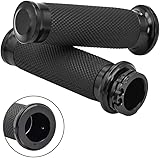
- 【FITMENT】The handlebar grips fit for Harley Touring 2000-2007, Sportster 883 / 1200 / 48 1996-2021, Softail 1996-2021 (Except FLSTNSE, FXSDSE 2010-2011, FXSBSE 2013, FXSTSSE 2008-2009), Dyna 1996-2021 (Except Wide Glide 2006-2013, Fat Bob 2007-2013, Fat boy FLSTF, 2006-2011, FLSTF/B 2010-2013, FLSTSE) and other with 1" handlebars motorcycle models
- 【1INCH & CABLE THROTTLE】① The 1inch hand grips is fit for Harley Davidson Touring Sportster Dyna Softail and not compatible with 1-1/4 inch handlebars; ② The cable throttle handlebar is not compatible with Electronic throttle. NOTE: Please confirm the size and handlebar type of your motorcycle before purchasing
- 【HIGH-INTENSITY CNC ALUMINUM】The black handlebar grip is made of CNC aluminum, which is not easy to deform or loosen, and is not easy to rust, allowing you to drive safely during long trips.
- 【ERGONOMIC ANTI SLIP RUBBER】The hand grip fit for harley are made of ergonomic anti-slip rubber, which allows you to drive comfortably and ensures your safety on rainy days. To provide you with a better product experience, making you long-distance rides smoother and more comfortable.
- 【PLUG AND PLAY】The handlebar grips fit for harley is plug and play, quick and easy to install and remove. After installation, it is more in line with the fashionable and personalized appearance of the motorcycle.
2012: Refining the first crossplane platform
Yamaha identifies 2012 as the updated seventh-generation R1. It retained the crossplane identity and developed the platform rather than introducing another fundamental engine-era break.
Updates during this phase addressed styling, electronics, chassis behavior, and model equipment. Because specifications can differ by market and year, a comparison should not present one country’s equipment list as universal. A 2012 R1 remains a CP4-era motorcycle, but the exact components and calibration should be confirmed from the VIN, service records, and regional documentation.
In the R1 timeline, 2012 sits between the 2009 crossplane breakthrough and the all-new 2015 track-first motorcycle. It is therefore a sensible choice for riders who want the first CP4 concept in a more developed form without moving to the later IMU-centered electronics package.
2015: The R1 becomes a track-first superbike
The 2015 R1 represented the largest change in mission since 1998. Yamaha explicitly shifted the development target from being the fastest motorcycle on winding public roads to being the fastest on a racetrack. The engine, chassis, brakes, and electronics were redesigned together, and Yamaha listed maximum output at 200 horsepower.
What’s actually slowing this PC down?
Pick the symptom - the matching free tool is one click away.
The defining technology was Yamaha’s first six-axis inertial measurement unit on a production motorcycle. It monitors pitch, yaw, and roll, together with acceleration along three axes. That information allows the motorcycle to coordinate several rider-assistance systems according to the bike’s attitude and acceleration state.
The package included coordinated control of:
- traction;
- slide behavior;
- front-wheel lift;
- braking;
- quickshifting functions.
This is why the 2015 R1 should not be summarized merely as “the electronic one.” Its performance concept depends on integrating engine response, chassis behavior, and attitude-sensitive controls. Yamaha’s own engineering explanation frames the electronics as support for rider input, not a replacement for it.
R1 and R1M
The R1M became the range-topping derivative in 2015. It added Öhlins electronic racing suspension and carbon-fiber bodywork. The R1M is consequently more than a color or trim package, but it remains a derivative of the same eighth-generation platform rather than a separate generation.
When comparing a used R1M with a standard R1, identify the model first. Suspension hardware, bodywork, setup requirements, replacement costs, and intended use can differ even when the motorcycles share the same fundamental generation.
Free tools Windows power users keep installed
One-click scans. No signup required.
2020: A comprehensive refinement of the 2015 architecture
The 2020 R1 was an updated ninth-generation motorcycle based on the 2015 platform. Yamaha revised the cylinder head, improved intake efficiency, changed the rocker-arm design, and updated the cam-lobe profiles. The objective was improved rideability and a clearer expression of YZR-M1-inspired character.
The fairing also changed. Yamaha contrasted the smooth upper-middle fairing of the 2015 model with the 2020 motorcycle’s indents and curved surfaces. Those alterations were intended to improve aerodynamic performance as well as give the bodywork a more sculpted appearance.
The important buying distinction is continuity. The 2020 R1 retains the core crossplane and IMU-based performance architecture introduced through the earlier generations, but it benefits from accumulated engine, electronics, and aerodynamic development. When evaluating one, focus on the exact year, regional emissions equipment, electronics software, service history, and whether it is an R1 or R1M.
Rank #4

- Universal fits all 7/8" motorcycles bar
- LEFT side OD is 7/8", RIGHT side OD is 1" for twist gas throttle
- Non slip design, Soft rubber makes your drive more comfortable
- Easy installation,If the surface of your handle is rough, it is recommended to add some lubricant or water to moisten it before installation
- If you have any questions about the product, please contact us, we will give you a satisfactory solution
2025: Major U.S. chassis and braking updates
The 2025 U.S.-market R1 received meaningful hardware changes without becoming a new numbered generation. Yamaha added MotoGP-inspired carbon-fiber winglets, a redesigned KYB front fork, Brembo Stylema front brake calipers, and a new Brembo master cylinder. The 998cc crossplane inline-four and IMU-powered electronic systems remained.
Yamaha’s U.S. specification lists a 448-pound wet weight, 33.7-inch seat height, 55.3-inch wheelbase, and 4.5-gallon fuel capacity. These figures are useful when comparing U.S. listings, but they should not be copied into a European-market comparison without qualification.
The 2025 R1 is best described as a major equipment and chassis update within the 2020-based ninth-generation family. Its fork, braking hardware, and aerodynamic additions matter to track riders, but they do not make it a tenth generation.
2026: The current U.S. R1 continues the CP4 and IMU formula
As of the supplied research date of August 12, 2026, Yamaha’s U.S. site presents the 2026 YZF-R1 as the current model and highlights a 70th Anniversary Edition. The motorcycle continues to use the 998cc crossplane inline-four derived from the YZR-M1 and the modern IMU-based electronic-control package.
The 2026 motorcycle is therefore the current continuation of the 2020-plus platform, not a newly numbered mechanical generation unless Yamaha later publishes a different formal designation. Its distinguishing features are current production status, anniversary presentation, and the accumulated refinement of the 2015-to-present design.
Do these 3 things before closing this tab:
1Clear out junk files and repair common Windows errors2Fix the driver behind crashes, sound loss and screen glitches3Repair Windows errors before they cause bigger problemsYamaha’s European 2026 brochure lists a 998cc engine with a 79.0mm bore and 50.9mm stroke, 24-degree caster, 1,405mm wheelbase, 201kg wet weight, and 17-liter fuel capacity. Those are European-market specifications. They should not be substituted for U.S. figures, especially when comparing wet weight, fuel capacity, equipment, or availability.
The three biggest R1 turning points
1. 1998: Compactness becomes the performance strategy
The stacked crankshaft, mainshaft, and driveshaft arrangement let Yamaha pursue a short, slim motorcycle with a long swingarm and agile handling. The R1 reset what a liter-class road supersport could be.
2. 2009: The crossplane engine changes torque delivery
The 90-degree crossplane crankshaft and uneven firing order made rear-wheel traction and corner-exit feel central to the R1’s identity while giving the engine its unmistakable character.
3. 2015: Electronics become part of the chassis concept
The six-axis IMU connected the motorcycle’s attitude to traction, slide, lift, braking, and quickshift control. The R1’s mission moved decisively toward circuit performance.
Free tools Windows power users keep installed
One-click scans. No signup required.
Which Yamaha R1 generation is right for you?
Choose the 1998 model for historical significance
The 1998 R1 is the obvious choice for a collector or enthusiast who wants the motorcycle that established the modern R1 formula. Its compact proportions, five-valve engine, and place in supersport history are its greatest advantages. It is not the logical choice if your priority is modern electronics, current braking hardware, or the easiest path to fast track riding.
Choose a 2000 or 2002 model for the early five-valve experience
These bikes retain the original concept while representing later development. The 2000 model belongs to the first-generation family; the 2002 model is Yamaha’s second-generation milestone and the more mature expression of the compact five-valve idea. Condition, originality, parts availability, and documentation may matter more than the nominal generation label on an older R1.
Best Value

- Superior Comfort: Made from high-quality, soft foam material to significantly reduce vibration and hand fatigue, ensuring a more comfortable ride.
- Durable Construction: Designed to withstand harsh weather conditions and heavy use, providing long-lasting performance and reliability.
- Enhanced Grip: Features an anti-slip, textured surface that offers exceptional grip and control, enhancing your riding safety.
- Universal Fit: Compatible with most motorcycle, bike, and scooter handlebars, making these overgrips a versatile choice for all riders.
- Easy Installation: Simple to install with no special tools required; just slip them on, trim to fit, and enjoy improved comfort and grip instantly.
Choose the 2004 generation for the most important pre-crossplane redesign
The 2004–2006 family is the strongest choice if you want a major engine-and-chassis reset without moving to the crossplane engine. It combines a large power increase, a new frame rigidity strategy, and the distinctive under-seat exhaust layout. The 2006 R1 SP is the premium special-model option within this family.
Choose the 2007 generation for the four-valve transition
The 2007 R1 is the key choice for someone interested in Yamaha’s move away from five valves per cylinder. It remains pre-crossplane, but its four-valve engine philosophy provides the basis for the later CP4 era.
Choose 2009–2012 for the most distinctive engine character
The crossplane models are the clear choice if sound, pulse, throttle feel, and rear-wheel traction character are more important than having the newest electronics. The 2009 motorcycle is the breakthrough model; the 2012 version represents a later refinement of that first crossplane platform.
Choose 2015 onward for track use and attitude-sensitive electronics
The 2015 generation brought the most important electronics milestone and a track-first development brief. It is the logical starting point for riders who want the R1’s modern performance-control philosophy. The R1M adds electronically controlled Öhlins racing suspension and carbon-fiber bodywork for buyers who specifically value that equipment and can support its cost and setup requirements.
Choose 2020–2026 for the most developed current architecture
The 2020 and later bikes refine the 2015 platform. The 2025 U.S. update is especially relevant to track riders who value the revised KYB fork, Brembo Stylema calipers, new master cylinder, and winglets. The 2026 model is the current U.S. offering as of the research date and adds anniversary presentation while continuing the CP4 and IMU architecture.
Used-buying and ownership checklist
- Verify the model year and VIN. Do not identify an R1 only by fairing shape or paint. Confirm the year, market, model designation, and whether it is an R1 or R1M.
- Classify the engine family. The five-valve early bikes, the 2007 four-valve transition, the 2009 crossplane engine, and the 2015-plus IMU-equipped platform have different mechanical and electronic identities.
- Check market-specific equipment. Emissions hardware, electronics calibration, colors, equipment, and published specifications can vary between the United States, Europe, Japan, and other markets.
- Do not compare horsepower figures casually. The figures cited for the 1998, 2004, 2015, and later motorcycles may represent different markets, testing conventions, or claimed maximum outputs. Check whether a number is a crank figure, a measured wheel figure, or a region-specific claim.
- Inspect service history before chasing generation prestige. A documented, correctly maintained older R1 can be a better ownership proposition than a neglected example from a supposedly superior generation.
- Account for track use and modifications. Later R1s were developed with circuit performance in mind, but track use can affect suspension, brakes, bodywork, electronics settings, and service needs. Check for non-standard parts and ask how the motorcycle was used.
- Match the repair reference to the year range. For early bikes, a YZF-R1 Haynes repair manual 1998-2003 is the relevant kind of hands-on reference for maintenance, restoration, and troubleshooting. It does not cover every R1 generation, so owners of 2004-and-later motorcycles need the correct later documentation.
Parts and service information should be verified against the exact motorcycle rather than assumed to interchange across generations. The R1 has changed engine architecture, electronics, emissions equipment, suspension, braking hardware, and bodywork repeatedly; a generic “R1 parts” listing is not enough evidence of compatibility.
The Tool Desk
Outbyte Driver Updater FREEScan for outdated or missing drivers - takes under a minuteDriver Scan →Outbyte PC Repair FREEClear out junk files and repair common Windows errorsFree Scan →What not to overclaim when comparing R1s
- Do not call every model year a new generation. Yamaha’s official history highlights milestone models, while several intervening years are updates within a broader family.
- Do not treat horsepower as a universal ranking. Market, test method, and whether the number is claimed at the crank or measured at the wheel all affect comparisons.
- Do not turn racing success into a street-bike verdict. Ben Spies’s 2009 World Superbike title and the MotoGP influence behind the crossplane engine are important historical facts, not proof that every rider will prefer a particular R1.
- Do not assume international specifications are interchangeable. The U.S. 2025 figures and European 2026 brochure figures belong to different markets and should be labeled accordingly.
- Do not confuse the R1M with a new generation. It is a higher-spec derivative with Öhlins electronic racing suspension and carbon-fiber bodywork, not a separate step in Yamaha’s numbered history.
Frequently Asked Questions
Which Yamaha R1 generation introduced the crossplane crankshaft?
The 2009 sixth-generation YZF-R1 introduced Yamaha’s 998cc inline-four with a 90-degree crossplane crankshaft and uneven firing order. The 2012 model refined that crossplane platform.
Is the 2004 Yamaha R1 a new generation?
Yes. Yamaha identifies the 2004 motorcycle as the fourth-generation R1 and describes it as the first full redesign after the original model. It introduced a substantially revised engine, new Deltabox frame strategy, and under-seat mufflers.
What is the difference between an R1 and an R1M?
The R1M is the range-topping derivative introduced with the 2015 generation. It adds Öhlins electronic racing suspension and carbon-fiber bodywork. It is not a separate numbered generation, and exact equipment should still be checked by year and market.
Is the 2025 Yamaha R1 a new generation?
No. The 2025 U.S. model received important updates including carbon-fiber winglets, a revised KYB fork, Brembo Stylema calipers, and a new Brembo master cylinder, but Yamaha’s history continues to place it within the ninth-generation, 2020-based family.
Quick wins for a faster PC:
Repair Windows errors before they cause bigger problemsFix Now →Fix the driver behind crashes, sound loss and screen glitchesFind Drivers →Clear out junk files and repair common Windows errorsFree Scan →Which R1 manual should an early-generation owner buy?
Match the manual to the motorcycle’s year range. The Haynes manual covering 1998–2003 is intended for the early R1 family, while the 2004–2006 manual covers the fourth-generation bikes and the 2006 R1 SP. Neither should be assumed to cover later generations.
The Bottom Line
The R1 story is a sequence of engineering resets: 1998 made the liter bike compact and agile, 2004 delivered the major pre-crossplane power-and-chassis overhaul, 2009 introduced the character-defining crossplane engine, and 2015 made the motorcycle’s track-first, IMU-managed electronics central to its identity. The 2020, 2025, and 2026 models are increasingly refined versions of that 2015-to-present architecture. For a used buyer, the right generation depends less on the newest specification than on whether you want historical significance, five-valve or four-valve mechanical character, the CP4 engine, or the modern track-focused electronics package.
Quick Recap
Product prices and availability are accurate as of the date/time indicated and are subject to change. Any price and availability information displayed on Amazon at the time of purchase will apply.




