Windows Errors? Fix Them Before They Spread
Repair common Windows errors and clear accumulated junk for a smoother, more stable PC - no reinstall needed.Free scan · no reinstallOutdated Drivers Are Slowing You Down
One free scan finds every outdated or missing driver and matches the right update for your exact hardware.Free scan · exact hardware matchChina tests maglev cars that travel at 230kph while floating 35mm above the road, but the 2022 Jiangsu experiment used a modified 2.8-tonne vehicle and a specially equipped 7.9-kilometer road section with a conductor rail. It was a technology and safety test, not a production car on a normal highway.
Key takeaways
- The Jiangsu test involved a modified 2.8-tonne car floating about 35 millimeters above a specially prepared road.
- Eight vehicles, including five new-energy vehicles, were tested on a 7.9-kilometer highway section.
- The reported maximum speed approached 230 km/h, but the cars did not use an ordinary, unmodified public highway.
- A permanent-magnet array on the vehicle interacted with a good-conductor rail installed in the road.
- The project studied road design and high-speed-driving safety; it did not establish consumer availability, mass production, or commercial deployment.
How fast did China’s maglev car travel, and did it really float?
China tests maglev cars that travel at 230kph while floating 35mm above the road, but the headline needs an important qualification: the 2022 Jiangsu experiment used a modified 2.8-tonne vehicle and a specially equipped 7.9-kilometer road section with a conductor rail. It was a technology and safety test, not a production car on a normal highway.
As an Amazon Associate I earn from qualifying purchases.
The figures come from Xinhua’s September 10, 2022 report on the Jiangsu maglev-car test. The reported levitation gap was 35 millimeters, while the maximum speed across the test approached 230 km/h. The vehicle was not an unmodified car that could simply be driven onto any existing road and made to hover.
Free tools Windows power users keep installed
One-click scans. No signup required.
What exactly did China test?
The experiment took place in Jiangsu Province in eastern China. Southwest Jiaotong University in Chengdu developed the test vehicle by modifying a traditional car. The vehicle weighed 2.8 tonnes and used a permanent-magnet array. The highway section was fitted with a good-conductor rail, making the roadway part of the levitation system.
#1 Best Overall

- COMPREHENSIVE KIT: Features 12 different magnetic science experiments including magnetic compass, magnetic levitation demonstrations, and interactive physics activities for hands-on STEM learning.
- EDUCATIONAL VALUE: Teaches fundamental principles of magnetism, polarity, and magnetic fields through engaging experiments suitable for ages 8 and up.
- MULTIPLE ACTIVITIES:The science kits Includes magnetic car, floating pen, magnetic fishing game, magnetic stacking challenge, and compass-based experiments for hours of discovery.
- QUALITY COMPONENTS: Constructed with durable materials featuring red and blue magnetic pieces, sturdy bases, and a precise compass for accurate experiments.
- EASY SETUP: Each experiment comes with clear instructions and pre-assembled components, allowing young scientists to start exploring magnetic phenomena right away.
Xinhua described a broader run involving eight cars, five of which were new-energy vehicles, over 7.9 kilometers. One test reached 200 km/h, while the maximum speed recorded across the test approached 230 km/h. Provincial transport authorities organized the work to examine road design and safety measures for high-speed driving, rather than to announce a consumer vehicle.
| Question | What the reported test established | What it did not establish |
|---|---|---|
| Vehicle | A modified conventional car weighing 2.8 tonnes | A production-ready consumer maglev car |
| Levitation | A reported 35 mm gap above the prepared road | Permanent hovering on every road or at every speed |
| Road | A 7.9 km highway section equipped with a good-conductor rail | Compatibility with ordinary unchanged highways |
| Test fleet | Eight vehicles, including five new-energy vehicles | Mass production or public-road deployment |
| Speed | A maximum approaching 230 km/h across the testing | A certified everyday operating speed for buyers |
| Purpose | Research into road design and high-speed-driving safety | A commercial launch or replacement for conventional cars |
How can a maglev car float above a road?
A maglev car floats by using magnetic forces between hardware on the vehicle and a prepared guideway in the road. In this experiment, the vehicle’s permanent-magnet array interacted with a good-conductor rail installed in the highway. The pavement therefore was not merely supporting the car; the road was an active part of the magnetic system.
- Lift: magnetic forces counteract the vehicle’s weight and create the reported gap between the car and road.
- Guidance: the magnetic interaction must keep the vehicle aligned laterally instead of allowing it to drift across the guideway.
- Propulsion: levitation does not automatically move a vehicle forward. A separate propulsion system is still required.
- Control: sensors and feedback systems can be needed to manage lateral motion and disturbances at high speed.
- Infrastructure: the demonstrated arrangement depends on a conductor rail or equivalent prepared guideway beneath the vehicle.
“Floating” should also be read carefully. The reported 35 mm describes the test’s vehicle-road arrangement; the available report does not provide a complete production specification covering every operating condition, emergency state, or low-speed behavior.
Why is lateral control such a serious problem?
High-speed magnetic suspension must control sideways motion as well as vertical lift. Southwest Jiaotong University research on permanent-magnet electrodynamic-suspension vehicles describes lateral instability and disturbance rejection as important engineering problems. The research examines nonlinear model-predictive control and experimental-platform behavior because disturbances, including lateral gusts, can affect safety.
The research characterizes the vehicle as a laterally underdamped system with highly unstable open-loop behavior. In practical terms, a vehicle that levitates vertically is not automatically safe or stable across the road. The system must sense position and motion, reject disturbances, preserve alignment, and provide a predictable fallback when the guideway, control system, or power supply does not behave as intended. See the Southwest Jiaotong University research on lateral control of permanent-magnet electrodynamic-suspension vehicles for the control-engineering context.
Rank #2

- This science kit teaches kids about magnetic force through several fun, hands-on experiments.
- Experiments include floating a pencil, levitating a screw, building a maglev, and more.
- The kit contains all materials necessary for performing the experiments found in the box.
- Detailed instructions for use and care are included.
- Recommended for ages 8 years and up.
What could maglev cars improve?
Maglev vehicles could potentially reduce mechanical contact, rolling-related losses, and wear at the levitation interface. Those are engineering possibilities, not measured outcomes from the Jiangsu test. The Xinhua report provides no vehicle-specific percentage for energy savings, range improvement, noise reduction, operating cost, lifecycle emissions, or maintenance cost.
Professor Deng Zigang of Southwest Jiaotong University said, “The development of maglev vehicles will follow as a focus,” according to Xinhua. The statement describes an ongoing research direction and a hope that the technology could reduce energy consumption and increase vehicle driving range in the future; it is not a published result showing that the tested cars achieved either improvement.
The key trade-off is infrastructure. A levitating vehicle may reduce some vehicle-road losses, but the road must first be rebuilt with the magnetic hardware, alignment controls, safety systems, and maintenance capability needed by the vehicle. The available sources do not provide a cost-benefit study for the Jiangsu system.
Was the Chinese maglev car driving on a normal highway?
No. The cars used a specially prepared highway section containing a good-conductor rail. Existing roads without that equipment could not reproduce the demonstrated levitation arrangement. The test was road-compatible in the limited sense that the vehicle used a car-like body and a highway section, but it was not compatible with ordinary highways without reconstruction.
This distinction separates the experiment from a retrofit in which a driver buys a car and uses it on current roads. A production road-maglev network would need an agreed guideway design, precise construction and maintenance standards, traffic management, emergency procedures, and a way to handle vehicles entering and leaving the levitation infrastructure.
The Tool Desk
Outbyte PC Repair FREEClear out junk files and repair common Windows errorsFree Scan →Outbyte Driver Updater FREEScan for outdated or missing drivers - takes under a minuteDriver Scan →How is a maglev car different from a maglev train?
A road-car experiment and a conventional maglev railway share magnetic suspension, but they are different transport systems. China’s National Railway Administration defines maglev railways as systems that suspend vehicles above guideways using magnetic force and propel them with linear motors. China’s trial technical standard for maglev railways, TB 10630-2019, took effect on January 1, 2020, according to the regulator’s publication.
Rank #3
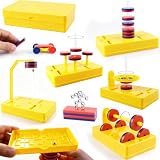
- 10+ Experiments & Complete Core Components: This kit comes with bar magnets, ring magnets, a DIY compass, and assembly parts. With an illustrated instruction manual, users can easily conduct over 10 classic magnetic experiments, such as compass use, magnetic levitation, magnetic maze, magnetic vehicle, magnetic top, and more physics projects. It offers a great hands-on STEM learning experience to help understand magnetic principles through practical operation.
- Top STEM Magnet Kit for Physics Exploration. This hands-on physics set boosts STEM learning, sparks curiosity in magnetism, and teaches magnetic fields, levitation and magnet properties. It improves logical thinking, hands-on skills and problem-solving abilities, perfect for classroom and after-school experiments.
- Custom Educational Physics Experiment Set – Eco-Friendly ABS Material adaptable for multiple scenarios. Bar and ring magnets made of eco-friendly ABS feature suitable magnetic strength for general use and pose no safety risks. Ideal as professional science teaching aids for classroom lessons and home experimental activities. Users can explore physics principles via hands-on experimental operation.
- Comprehensive Safety Specifications for Users – Small Component Reminder Included. Every part passes strict quality inspection and features smooth burr-free edges. Magnets are encased within red and blue plastic housings to avoid damage, offering distinct color marking and convenient use.
- High-Quality Service & Worry-Free After-Sales – Complete Experiment Components Guaranteed: Every kit is strictly inspected prior to shipment to guarantee intact and stable performance of bar magnets, ring magnets and assembly tools. Reach out to customer support for any missing parts or other problems. We offer quick support to deliver a seamless shopping experience for all users.
| Feature | Jiangsu road-car experiment | Dedicated maglev railway |
|---|---|---|
| Vehicle form | Modified car body | Railway vehicle or train formation |
| Guideway | Prepared highway section with a conductor rail | Dedicated railway guideway |
| Operating setting | Road-design and high-speed-driving study | Railway route, stations, signaling, and operating rules |
| Propulsion description | The report establishes levitation hardware but not a complete production propulsion specification | Maglev railway systems use linear motors for propulsion |
| Regulatory context | Experimental road-transport project | China’s maglev railway technical-standard framework includes TB 10630-2019 |
The railway definition and standard context are set out by the China National Railway Administration. A shared magnetic principle does not make the road vehicle interchangeable with a railway train: the guideway, vehicle architecture, operating environment, and safety framework differ.
Can maglev cars replace wheels?
Not on the evidence from this test. The Jiangsu experiment showed magnetic suspension above a specially equipped section, but it did not demonstrate that ordinary cars can discard wheels, operate on unchanged roads, or remain fully levitated in every condition.
A practical road vehicle would need answers to several unresolved questions:
Quick wins for a faster PC:
Repair Windows errors before they cause bigger problemsFix Now →Scan for outdated or missing drivers - takes under a minuteDriver Scan →- How would the car start, stop, and maneuver where the magnetic guideway ends?
- What happens during power loss, control failure, guideway damage, or a severe lateral disturbance?
- How would conventional traffic share the road with vehicles that require a conductor rail?
- Would the infrastructure cost and maintenance burden justify the vehicle’s potential efficiency benefits?
- What safety certification and operating rules would apply to public deployment?
The 2022 report does not answer those commercial and regulatory questions. No authoritative evidence in the supplied research shows that the tested vehicle entered mass production or public road service.
Independent reader supportYour contribution helps us test, update, and keep practical guides available for everyone.What does the 230 km/h test mean for drivers?
For drivers, the result is best understood as proof of a promising research concept rather than a new car-buying option. Researchers demonstrated that a modified vehicle could levitate approximately 35 mm above a prepared road and reach a reported speed near 230 km/h. The result does not mean that a floating car is available for purchase or legal to operate on ordinary roads.
The experiment is significant because it applies magnetic suspension to a car-like vehicle and highway-style infrastructure instead of limiting the idea to a conventional rail line. It remains limited because the demonstration depended on specialized infrastructure and because lateral stability, emergency behavior, cost, and long-term reliability still require validation.
Rank #4

- Package Includes: this magnetic levitation train set includes a wooden block, a roll of single-pole monopolar magnetic tape, three acrylic track plates, and 1 set of assorted color marking tools; Assembly is straightforward, and the included pens allow for designs on the wooden train, creating a special item; Guidance is available if needed; Note: remember to remove the protective film from the acrylic plates
- Simple Assembly Process: to set up, insert the side panels into the acrylic base until a distinct click confirms they are fixed; Apply the adhesive-backed single-pole magnetic strips symmetrically onto the base; Attach two strips similarly to the wooden block; Place the block above the track, ensuring magnetic strips align symmetrically; The block will levitate, and gentle pushes or tilting the track allows smooth floating movement
- Durable and Functional Materials: the track is made from sturdy acrylic that resists damage and ensures long-lasting use; The single-pole magnetic strips offer strong magnetic force and feature adhesive backing for easy installation; The lightweight wooden train facilitates effective magnetic levitation; The accompanying drawing tools enable creative decoration of the train
- Thoughtfully Designed Dimensions: acrylic track plates measure 40 cm in length and 3 cm in height; Each magnetic strip is 2 meters long and 2 cm wide; The wooden block dimensions about 3.94 x 1.97 x 0.79 inches/ 10 x 5 x 2 cm; These proportions support stable levitation and practical handling
- Engaging Scientific Exploration: this set encourages discovery of magnetic principles, including Earth's magnetic field, attraction and repulsion forces, objects attracted to magnets, temporary magnetism, and magnetic strength; Hands-on interaction helps users understand the behind magnetic levitation
Will China’s floating cars become commercially available?
Commercial availability has not been established. The evidence describes a research and safety study, not a production program, sales launch, consumer price, or public-road deployment. China’s test therefore supports the narrower conclusion that road-compatible maglev technology is being investigated, not the broader claim that China has built a ready-to-buy floating car.
The most accurate summary is: Chinese researchers tested specially modified cars on a specially prepared guideway in Jiangsu, reaching a reported speed approaching 230 km/h with a 35 mm levitation gap. Whether the concept can become affordable, safe, maintainable, and useful on a large road network remains an open engineering and economic question.
Frequently Asked Questions
Was China’s maglev car tested on a normal highway?
No. The Jiangsu cars ran on a specially equipped 7.9-kilometer road section containing a good-conductor rail. The test did not show that an unmodified car could levitate on ordinary highways.
How did China’s 35 mm maglev car work?
The reported test involved a modified 2.8-tonne car, a permanent-magnet array, and a prepared road with a conductor rail. The maximum speed across the testing approached 230 km/h, with a reported levitation gap of 35 mm.
Can consumers buy the Chinese floating car?
No. The test did not establish consumer availability, mass production, public-road deployment, or a replacement for conventional cars. The project focused on road design and high-speed-driving safety.
What’s actually slowing this PC down?
Pick the symptom - the matching free tool is one click away.
Are maglev cars the same as maglev trains?
Maglev cars and maglev trains share magnetic suspension, but they use different vehicle architectures, guideways, operating environments, and regulatory frameworks. China’s maglev railway standard applies to railway systems, not automatically to the Jiangsu road-car experiment.
The Bottom Line
Bottom line: China’s 2022 Jiangsu test was a genuine maglev-car experiment, but not a normal car hovering over an ordinary highway. A modified 2.8-tonne vehicle floated about 35 mm above a road equipped with a conductor rail, and the test fleet reached a reported maximum near 230 km/h. The demonstration shows technical potential while leaving commercialization, safety, infrastructure cost, and everyday-road compatibility unresolved.
Quick Recap
Product prices and availability are accurate as of the date/time indicated and are subject to change. Any price and availability information displayed on Amazon at the time of purchase will apply.




