Free tools Windows power users keep installed
One-click scans. No signup required.
CHAdeMO is a DC fast-charging standard and ecosystem, not merely a plug. It lets a compatible electric vehicle and charging station communicate about safety, voltage and current while the station delivers direct current to the battery. The vehicle’s charging hardware and battery limits determine the actual speed.
Short answer: CHAdeMO is a DC fast-charging standard and the ecosystem that supports it—not just the large connector on an electric vehicle. A compatible CHAdeMO station converts grid electricity to DC and sends it directly to the vehicle battery while communicating with the battery-management system. The vehicle, not the label on the station alone, determines how much power it can accept.
As an Amazon Associate I earn from qualifying purchases.
That distinction explains most CHAdeMO confusion. Four separate things must line up: the physical connector, the CHAdeMO communication protocol, the vehicle’s DC-charging hardware and software, and the public charging network. A station can have a CHAdeMO cable but still be unsuitable for a particular vehicle, unavailable when you arrive, or incapable of delivering the vehicle’s advertised maximum speed.
What does CHAdeMO mean?
CHAdeMO is the name used for a DC charging standard and for the association that develops and maintains it. Its purpose is to make high-power charging safe and interoperable between a vehicle and a compatible charging station. The protocol is associated with international charging-system standards work, including IEC standards.
#1 Best Overall

- High-Speed DC Charging: Supports up to 250A and 1000V, delivering 250kW for rapid charging of compatible Japanese electric vehicles
- Durable & Weatherproof: IP55-rated protection against dust and water, with a titanium copper alloy conductor and silicone rubber seal for reliable outdoor use
- Built-in Safety: Dual temperature kill switch automatically stops charging when the adapter reaches 90°C, preventing overheating
- Wide Temperature Range: Operates reliably from -30°C to +50°C, with storage tolerance from -40°C to +85°C for year-round performance
- Easy Plug-and-Play: Compact and lightweight design allows hassle-free connection between CCS1 charging stations and CHAdeMO ports
The name is commonly explained as a contraction of CHArge de MOve, with a Japanese wordplay reference to having tea while charging. That is a fun piece of history, but the practical point is more important: CHAdeMO describes both a communication system and a connector ecosystem. The plug by itself does not tell you everything about compatibility or charging speed.
The four layers of CHAdeMO compatibility
| Layer | What it does | What to verify |
|---|---|---|
| Physical connector | The cable and vehicle inlet make the electrical connection. | Does the vehicle have a CHAdeMO inlet, and does the station actually offer a CHAdeMO connector? |
| Digital protocol | The vehicle and charger exchange information about safety, voltage, current and charging limits. | Do the vehicle, station and any adapter support compatible protocol behavior and firmware? |
| Vehicle charging hardware | The vehicle’s battery, battery-management system, cooling system and DC-input hardware determine what it can accept. | What is the vehicle’s model-specific maximum DC input, and are temperature or battery-condition limits active? |
| Charging network | The network provides the station, authentication, payment system, maintenance and availability information. | Is the station working, accessible, compatible with your account or payment method, and available on your route? |
A charger’s connector and maximum advertised output do not guarantee that every CHAdeMO-equipped vehicle will charge successfully or at that output. Compatibility is the result of all four layers working together.
How a CHAdeMO DC fast-charging session works
CHAdeMO is different from ordinary AC charging at home. With AC charging, the vehicle’s onboard charger converts alternating current into the DC power the battery stores. With CHAdeMO DC fast charging, the station performs the power conversion and sends controlled DC power toward the battery through the vehicle’s DC charging hardware.
The vehicle’s battery-management system remains central to the process. It monitors conditions such as state of charge and battery temperature, communicates limits to the station, and can reduce or stop charging when the battery reaches a limit.
- Find a compatible connector. The driver selects a station that specifically lists CHAdeMO, rather than assuming that any DC fast charger will work.
- Inspect the equipment. Check the cable, connector and any adapter for obvious damage. CHAdeMO cables are heavy, and the connector should not be dropped or forced.
- Connect the vehicle. Insert the CHAdeMO connector fully into the vehicle inlet. If an approved adapter is being used, follow the adapter maker’s connection order.
- Authenticate and start the session. Depending on the operator, this may involve an app, RFID card, payment terminal or station screen. Some stations require authentication before plugging in; others use a different sequence.
- Allow the safety checks to complete. The vehicle and charger establish communication and confirm that the connection and electrical conditions are safe.
- Charge under vehicle control. The station supplies DC power according to the vehicle’s requested voltage and current. The station’s rating is only one limit; the vehicle can request less.
- End the session normally. Stop charging through the station or app before trying to remove the connector. A DC connector may remain locked while the session is active.
- Remove the connector carefully. Follow the station’s release instructions and pull the connector straight out rather than twisting or yanking it.
The exact button sequence varies between networks and station models. Tesla’s CHAdeMO adapter instructions likewise tell users to inspect the adapter, connect it to the station cable and vehicle, wait for vehicle engagement, and follow the station’s instructions. Treat the operator’s on-screen procedure as authoritative for that particular charger.
How fast does CHAdeMO charge?
There is no single CHAdeMO charging speed. The actual rate depends on the vehicle, battery state and temperature, station output, cable limits, station load and the charging curve programmed into the vehicle.
Model-specific Nissan documentation illustrates why broad claims are misleading:
What’s actually slowing this PC down?
Pick the symptom - the matching free tool is one click away.
| Vehicle or specification reference | Published figure or capability | Important qualification |
|---|---|---|
| Certain Nissan LEAF configurations | Up to 62.5 kW in the cited guide | This is not a universal figure for every LEAF trim, market or battery configuration. |
| Certain 40-kWh Nissan LEAF models | Up to 50 kW | The figure applies to the applicable vehicle documentation, not every CHAdeMO vehicle. |
| Certain 62-kWh Nissan LEAF models | Up to 100 kW | Vehicle and market specifications must be checked before relying on this rate. |
| CHAdeMO Version 2.0 | Much higher theoretical power than older implementations | A protocol specification does not upgrade a legacy car or station. |
Those figures should not be combined into one supposed CHAdeMO maximum. They describe different vehicle configurations and specification contexts.
CHAdeMO Version 2.1: what the update does—and does not—mean
The CHAdeMO Association announced Version 2.1 on May 29, 2026. Its announcement specified requirements for charging current up to 800 amperes, safety actions following an interruption of the protective-earth conductor, and a function related to Plug and Charge. Certification under Version 2.1 was scheduled to begin on July 1, 2026.
Rank #2

- CCS1 To CHADEMO EV Charger Adapter, For Japanese Car Adapter DC Fast CCS To CHADEMO Charging Station 1000V 250KW Charger
- Efficient heat dissipation: Efficiently dissipate charging heat, maintain low-temperature operation, avoid overheating and speed reduction, and continuously provide strong charging performance
- Waterproof design: With excellent waterproof performance, it can work normally even in harsh weather conditions
- Durable and sturdy: The shell is made of impact resistant materials, which can withstand long-term frequent use and are sturdy and durable
- Its durable construction guarantees long-lasting performance, while the easy plug-and-play installation allows for hassle-free use
800 A is not 800 kW. Power depends on both current and voltage, and a vehicle, cable, station and regional certification program would all need to support the relevant conditions. Version 2.1 describes what compliant systems may be designed and certified to support; it does not mean that a Nissan LEAF, an older CHAdeMO station or an adapter can charge at that level.
In practice, the maximum session power is limited by the weakest applicable factor:
- the vehicle’s maximum DC input;
- battery voltage and battery-management limits;
- battery temperature and thermal-management capability;
- state of charge and the vehicle’s charging curve;
- battery age and condition;
- station output and cable rating; and
- station load, maintenance status or operator restrictions.
Charging is usually fastest when the battery is relatively low, then tapers as state of charge rises. A high-power station cannot force a vehicle to accept more power than its charging system permits. For many trips, adding enough energy to reach the next reliable stop is more time-efficient than waiting for a full battery.
Which vehicles use CHAdeMO?
The safest answer is model- and market-specific. The Nissan LEAF is the best-known U.S. example, but the quick-charge port was not necessarily standard on every trim or offered in every market. Nissan documentation says a LEAF equipped with the quick-charge port is compatible with most CHAdeMO connectors.
Other older Japanese-market and globally sold electric vehicles and plug-in hybrids may also use CHAdeMO. A worldwide list is difficult to keep accurate because the connector can vary by model year, trim, market and region. Do not identify a vehicle as CHAdeMO-compatible solely because it is Japanese, older or capable of DC fast charging.
How to check your vehicle
- Look at the charging inlet. The vehicle should have a dedicated CHAdeMO DC inlet or a manufacturer-approved arrangement that identifies CHAdeMO support.
- Check the owner’s manual for the terms CHAdeMO, quick charge or DC quick charge.
- Confirm the model year, battery size, trim and market. Two vehicles with the same name can have different charging equipment.
- Check the manufacturer’s compatibility documentation for the station and any adapter.
- Use the vehicle’s published maximum DC input when planning stops, not the maximum number printed on a public charger.
CHAdeMO versus CCS and NACS/J3400
In the United States, the Department of Energy identifies CHAdeMO, CCS and NACS/J3400 as DC fast-charging connector families. They are different physical and communication ecosystems. A vehicle inlet must match the station connector, or the vehicle must be explicitly approved to use a compatible adapter.
PC Slower Than It Used to Be?
A free scan shows the junk files, broken settings and background clutter dragging Windows down - then fixes them in one click.Free scan · Windows 10 & 11Crashes, No Sound, or Screen Glitches?
Random freezes, missing sound and display glitches usually trace back to one bad driver. Find and replace yours safely.Free scan · under a minute| Question | Correct way to think about it |
|---|---|
| Is every DC fast charger interchangeable? | No. DC fast charging is a category; CHAdeMO, CCS and NACS/J3400 are different connector families. |
| Does a station with several plugs support every vehicle? | No. Select the connector that matches the vehicle or an approved adapter arrangement. |
| Does a higher station rating improve every car’s speed? | No. The vehicle’s battery and charging hardware set a ceiling, and the charging curve may reduce the rate. |
| Is CHAdeMO being universally phased out? | Deployment is increasingly centered on CCS or NACS/J3400 in many newer vehicles and infrastructure projects, but a universal phase-out claim requires a specific market and date. |
CHAdeMO is strongly associated with earlier Japanese EVs, particularly many Nissan LEAF configurations. Because newer vehicle launches and some infrastructure deployments increasingly use other standards, CHAdeMO drivers should expect less uniform coverage in some areas and verify every planned stop instead of relying on a general assumption about a national network.
How to find a CHAdeMO charging station
Use a CHAdeMO station locator or route-planning tool that lets you filter by connector type. The U.S. Department of Energy’s Alternative Fuels Data Center provides station-location data, and ChargeHub documents filtering by CHAdeMO connector and charging level. These tools can help identify candidate stops, but station data and live availability can change.
Before leaving
- Filter for CHAdeMO specifically. Do not search only for DC fast charging.
- Confirm the station is on your route. A compatible charger that requires a major detour may not be a practical stop.
- Check live status or recent reports. Confirm that the CHAdeMO connector—not merely another connector at the same site—is working.
- Compare power ratings. A 100-kW station does not make a vehicle that accepts 50 kW charge at 100 kW.
- Check access and payment. Note whether the station requires an account, app, RFID card, payment card or roaming access.
- Plan a backup. This matters especially in regions where CHAdeMO coverage is sparse or stations are frequently occupied.
- Recheck shortly before departure. A station can be online during trip planning and unavailable later.
A location may list multiple connector types under one charging site or port record. That does not mean every connector can charge simultaneously. The Alternative Fuels Data Center notes that multiple connector types can be associated with a charging port and that, in such configurations, only one vehicle may be able to charge at a time.
Rank #3

- PORTABLE: The Adapter is compact and durable; making it ideal for charging on the go; Keep it conveniently in your car to charge your electric vehicle quickly and easily
- FASTER, RELIABLE CHARGING: Built to maximize current flow; reduce heat buildup; and improve charging efficiency
- WEATHER-RESISTANT & DURABLE : Built to perform indoors or outdoors with protection against dust and water; Reinforced housing ensures long-lasting reliability
At the station
- Park so the cable can reach the inlet without being stretched or placed where it can be driven over.
- Inspect the connector and cable for damage.
- Follow the station’s stated connection and authentication order.
- Insert the connector fully and wait for the vehicle and station to confirm the connection.
- Verify on the display that charging has actually started. A connected plug is not proof of an active session.
- Monitor the session long enough to confirm that power is increasing and no fault message appears.
- Stop the session using the station or app.
- Wait for the lock to release, then remove the connector carefully and return it to its holder.
If the session will not start
- Connector listed but unavailable: Try the station’s status screen or app, then use the backup location rather than repeatedly reconnecting a faulty unit.
- Authentication failure: Check the required network, account, payment method and roaming restrictions.
- Charging starts slowly: Low power may reflect high state of charge, battery temperature, battery condition, vehicle limits or station load rather than a failed charger.
- Connector remains locked: End the session normally and use the station’s release procedure. Do not pull against a locked connector; contact the operator if it will not release.
- Adapter-related error: Confirm that the adapter is approved for the specific vehicle, connected in the required order and supported in that region. Physical fit alone is not enough.
CHAdeMO adapters: what they can and cannot do
A CHAdeMO adapter may expand charging access, but compatibility depends on the vehicle model, DC-charging hardware, adapter firmware, charging station and region. Use an adapter approved for your vehicle rather than assuming that any marketplace listing will work.
Do these 3 things before closing this tab:
1Repair Windows errors before they cause bigger problems2Fix the driver behind crashes, sound loss and screen glitches3Clear out junk files and repair common Windows errorsTesla’s documented CHAdeMO adapter is a specific example, not a universal solution. The cited Tesla product information describes use cases for eligible Model S and Model X vehicles and states that the adapter is not supported by Model 3 or Model Y. Tesla owners should confirm the current official compatibility information for their exact vehicle and region before buying or traveling.
Do not assume that a CHAdeMO-to-CCS adapter, CHAdeMO-to-NACS adapter or generic universal EV adapter will work just because the plugs physically mate. DC fast-charging adapters can require protocol conversion, vehicle authorization, thermal protection, compatible firmware and manufacturer support. An adapter that is safe and supported for one model may be incompatible with another.
Before purchasing, verify:
- the exact vehicle model, year, trim and market;
- whether the vehicle manufacturer approves the adapter;
- whether the adapter supports DC fast charging rather than only another charging mode;
- the maximum voltage and current supported by the vehicle and adapter;
- firmware or software requirements;
- supported charging networks and station types; and
- the return, warranty and safety documentation from the manufacturer or authorized seller.
CHAdeMO and bidirectional charging: V2L, V2H, V2B and V2G
CHAdeMO has an important history of bidirectional charging. The CHAdeMO Association identifies applications including:
- V2L: vehicle-to-load, supplying power to individual equipment or appliances;
- V2H: vehicle-to-home, supplying a home through an appropriate system;
- V2B: vehicle-to-building, supplying a commercial or other building; and
- V2G: vehicle-to-grid, exchanging energy with the electrical grid under an approved program.
These are advanced energy systems, not automatic features of every CHAdeMO-equipped vehicle. A usable system requires a vehicle with bidirectional hardware and enabled software, a compatible bidirectional charger or power converter, appropriate electrical protection, professional installation, and utility or grid-interconnection approval where required.
If you are researching a CHAdeMO-compatible bidirectional charger, treat it as an engineered installation rather than a plug-in accessory. Certification and availability depend on the vehicle, country, utility rules and equipment model. CHAdeMO certification guidance says its V2H/V2L guideline is applied to the Japanese market, while overseas certification is handled individually. A U.S. owner should therefore obtain confirmation from the vehicle manufacturer, charger manufacturer, installer and utility before assuming that home backup or grid export is supported.
Independent reader supportYour contribution helps us test, update, and keep practical guides available for everyone.Safety and practical limitations
Handle the connector correctly
CHAdeMO cables and connectors are heavier than ordinary charging connectors. Support the cable when necessary, avoid dropping the connector, and insert and remove it straight. Never force a connector that does not seat or release normally.
Expect charging limits in extreme temperatures
The vehicle may limit DC charging when the battery is too hot or too cold. Ambient temperature, battery age and battery condition can also affect the rate. A slower session does not automatically indicate that the station is defective.
Do not confuse availability with compatibility
A station can appear in a map, have the right connector and still fail to provide a usable session because it is occupied, offline, restricted by payment access, under maintenance or incompatible with an adapter. Build a backup into longer trips.
The Tool Desk
Outbyte PC Repair FREERepair Windows errors before they cause bigger problemsFix Now →Outbyte Driver Updater FREEFix the driver behind crashes, sound loss and screen glitchesFind Drivers →Rank #4
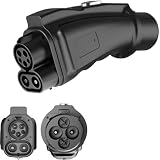
- CCS1 to CHAdeMO fast charging adapter, suitable for DC fast charging.
- Convenient charging of Japan electric vehicles in North America or other CCS1 standard countries. If your electric vehicle complies with the Japan standard CHAdeMO And equipped with CHAdeMO DC charging socket, You wish to use a DC charger in the following situations Charging in the United States, South Korea, or Taiwan, then this adapter is prepared for you!
- Rated DC current up to 250 amperes, with a brand new ultra compact design!
- Reliable design, stable and efficient charging perfommance. it can withstand the demands of different charging environments, ensuring reliable power for your Japan standard electric vehicle.
- The CCS1 to CHAdeMO adapter is manufactured with durable materials to ensure long-asting performance. it is designed to withstand the rigors of everyday charging, providing peace of mind and reliability for Japan EV owners in North America.
Do not confuse a standard revision with a vehicle upgrade
New protocol capabilities do not retrofit older vehicles. A legacy vehicle remains limited by its battery voltage, inlet, cooling system, software and maximum DC-input specification. Likewise, a newly installed high-power charger does not make every connected vehicle a high-power vehicle.
Common CHAdeMO mistakes
- Searching for DC fast charging without filtering the connector: The result may show CCS or NACS/J3400 stations that your vehicle cannot use.
- Planning around the station’s maximum kW: Use the vehicle’s maximum accepted power and expected charging curve instead.
- Assuming every LEAF has the same capability: Quick-charge-port availability and maximum power vary by model, trim, battery and market.
- Buying a generic adapter: Confirm vehicle approval, firmware, power limits and regional support first.
- Removing the cable before ending the session: Stop the session and wait for the lock to release.
- Assuming a working connector means simultaneous charging: Some station records include multiple connector types even though only one vehicle can charge at a time.
- Assuming CHAdeMO means automatic home backup: Bidirectional charging needs supported vehicle hardware, specialized equipment, certification and installation approvals.
- Assuming the connector is disappearing everywhere at the same rate: Coverage trends are market-specific. Verify the actual route and current station status.
Bottom line for CHAdeMO drivers
CHAdeMO remains a capable DC fast-charging system and continues to be developed, but its usefulness depends on the vehicle and the local network. Check the actual inlet, model-specific DC limits, station connector, live availability, payment requirements and any adapter approval before each important trip. For home backup or grid services, investigate the vehicle and electrical system as a complete certified installation—not merely as a CHAdeMO plug.
Source basis: CHAdeMO Association materials on the standard, Version 2.1 and bidirectional charging; U.S. Department of Energy Alternative Fuels Data Center information on DC connector families and station data; ChargeHub connector-filtering guidance; Nissan LEAF charging documentation; and Tesla CHAdeMO adapter documentation and product information.
Frequently Asked Questions
Not technically. The CHAdeMO ecosystem continues to be developed, including the Version 2.1 announcement dated May 29, 2026. However, newer vehicle launches and infrastructure deployments increasingly center on CCS or NACS/J3400 in many markets. Availability is therefore uneven and market-specific rather than universally ended.
Is CHAdeMO obsolete?
There is no universal speed. Nissan documentation cites up to 50 kW for certain 40-kWh LEAF models, up to 100 kW for certain 62-kWh models, and up to 62.5 kW for certain configurations in another guide. Actual power also depends on state of charge, battery temperature, age, station output and the vehicle’s charging curve.
How fast can a CHAdeMO charger charge an EV?
No. The cited Tesla documentation identifies the CHAdeMO adapter for eligible Model S and Model X vehicles and states that it is not supported by Model 3 and Model Y. Tesla owners must verify compatibility for their exact model, software and region before purchasing.
Can every Tesla use a CHAdeMO adapter?
No. V2H, V2L and V2G require a vehicle with bidirectional hardware and software, a compatible bidirectional charger or converter, suitable electrical protection, installation approval and market-specific certification. CHAdeMO compatibility alone does not provide automatic home backup.
Can any CHAdeMO-equipped vehicle power a house?
The station rating is only one limit. The vehicle may be limiting current because of its maximum DC-input specification, high state of charge, battery temperature, battery age or condition. Station load, cable limits and operating restrictions can also reduce power.
Recommended Free Tools
Why is my CHAdeMO session charging more slowly than the station rating?
The Bottom Line
CHAdeMO is both a DC fast-charging connector and the communication ecosystem behind it. The vehicle’s model, battery, temperature, charging curve, adapter support and the station’s live condition determine the result—not the connector label or station kW rating alone.
Quick Recap
Product prices and availability are accurate as of the date/time indicated and are subject to change. Any price and availability information displayed on Amazon at the time of purchase will apply.




