Quick wins for a faster PC:
Fix the driver behind crashes, sound loss and screen glitchesFind Drivers →Repair Windows errors before they cause bigger problemsFix Now →Scan for outdated or missing drivers - takes under a minuteDriver Scan →NVIDIA launched Alpamayo 1 at CES 2026 as a research and development model for autonomous vehicles—not as a complete, certified self-driving system that consumers can download and install in a car. Announced in Las Vegas on January 5, the 10-billion-parameter model forms part of a broader ecosystem that includes the AlpaSim simulator and physical-AI datasets.
Alpamayo is designed to help developers train, evaluate, fine-tune, distill and simulate autonomous-driving policies, particularly in unusual situations where a vehicle must infer what could happen next. The distinction matters: NVIDIA’s downloadable model is a development tool, while a production vehicle still requires an integrated sensor, planning, control and safety stack.
As an Amazon Associate I earn from qualifying purchases.
What NVIDIA announced at CES 2026
NVIDIA’s January 5, 2026 announcement covered three connected pieces:
Crashes, No Sound, or Screen Glitches?
Random freezes, missing sound and display glitches usually trace back to one bad driver. Find and replace yours safely.Free scan · under a minuteWindows Errors? Fix Them Before They Spread
Repair common Windows errors and clear accumulated junk for a smoother, more stable PC - no reinstall needed.Free scan · no reinstall- Alpamayo 1: An open reasoning vision-language-action model for autonomous-vehicle research. It processes multi-camera video and vehicle-motion information, then produces driving trajectories and associated reasoning traces.
- AlpaSim: An open-source, end-to-end simulation framework intended for developing and testing autonomous-driving policies in closed loop.
- Physical AI datasets: Data resources intended to help models learn from varied driving conditions and rare or complex situations. Access is handled through Hugging Face and NVIDIA’s dataset licensing terms.
NVIDIA presents the family as development infrastructure for “reasoning-based” autonomy. It is not selling Alpamayo 1 as a finished consumer feature or claiming that the released checkpoint alone satisfies automotive safety or regulatory requirements.
#1 Best Overall
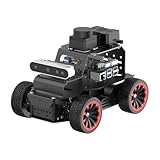
- For Raspberry Pi 5 & ROS2 Robot Car. MentorPi A1 smart AI robot car is powered by Raspberry Pi 5, compatible with ROS2, and programmed in Python, making it an ideal platform for AI robot development.
- High-Performance Hardware. Equipped with Ackerman chassis, closed-loop encoder motors, TOF lidar, depth camera, AI voice interaction box, and other advanced components to ensure optimal performance and efficiency.
- Advanced AI Capabilities. Supports SLAM mapping, path planning, multi-robot coordination, vision recognition, target tracking, and more, covering a wide range of AI applications.
- Autonomous Driving with Deep Learning. Utilizes YOLO model training to enable road sign and traffic light recognition, along with other autonomous driving features, helping users explore and develop autonomous driving technologies.
- Empowered by Large AI Model, Human-Robot Interaction Redefined. MentorPi AI robot car deploys multimodal models with ChatGPT at its core, integrating 3D vision and Al voice interaction box. This synergy enhances its perception, reasoning, and actuation capabilities, enabling advanced embodied AI applications and delivering natural, context-aware human-robot interaction.
The model was originally called Alpamayo-R1 in NVIDIA’s research materials and repository. Following the CES release, NVIDIA renamed it Alpamayo 1; the original name can still appear in repository paths and download commands.
What is a vision-language-action model?
In this automotive context, the terms describe three related capabilities:
- Vision: The model interprets camera or video inputs.
- Language and reasoning: It generates a textual or structured reasoning trace describing relevant events and causal considerations.
- Action: It predicts a vehicle trajectory or driving action.
That does not make Alpamayo a general-purpose chatbot that can answer arbitrary questions about a video. The released Alpamayo 1 implementation is primarily a trajectory-prediction system accompanied by a chain-of-causation reasoning trace. It is not, by itself, a complete vehicle controller.
What’s actually slowing this PC down?
Pick the symptom - the matching free tool is one click away.
The official README says the model uses multi-camera video and egomotion history. The current release does not take explicit navigation or route inputs such as turn-by-turn instructions or waypoints. That is an important limitation when comparing it with a complete driving stack.
Why NVIDIA says reasoning matters
Autonomous-driving systems perform well when the situation resembles their training and testing data. The more difficult cases are part of the industry’s so-called long tail: unusual, ambiguous or infrequent events that are hard to cover with fixed rules or ordinary driving examples.
NVIDIA’s examples include a ball rolling into the road, followed by the possibility that a child will run after it. Other examples involve unusual intersection interactions, temporary obstructions, construction zones, emergency vehicles and unclear right-of-way situations.
In these cases, simply detecting objects is not enough. The vehicle may need to estimate what another road user is likely to do next and select a cautious trajectory before the most important event is fully visible. A reasoning trace can give developers more information about the factors associated with a prediction and may help with data labeling, evaluation and debugging.
Recommended Free Tools
But a plausible explanation is not a safety certificate. The trace is a learned model output; it does not prove human-like understanding, verified causal reasoning or reliable behavior in every comparable real-world situation. NVIDIA’s demonstrations and descriptions show selected capabilities, not statistical proof that Alpamayo handles the entire long tail safely.
Alpamayo 1 is not a complete self-driving system
| Alpamayo 1 is | Alpamayo 1 is not |
|---|---|
| A 10-billion-parameter research model | A complete autonomous-driving stack |
| A trajectory-prediction and reasoning tool | A drop-in car-control system |
| Useful for training, evaluation and auto-labeling | A road-safety certification |
| Released with supporting research code | A commercially licensed production product |
The repository explicitly warns that Alpamayo 1 lacks important elements needed for real-world vehicle deployment, including critical sensor inputs, redundant safety mechanisms and automotive-grade validation.
A production autonomous vehicle needs far more than a model that predicts a trajectory. Its broader system must typically address perception, localization, prediction, planning, controls, sensor health, redundancy, fail-operational behavior, cybersecurity, vehicle integration, verification and validation, and applicable regulatory requirements. Alpamayo can contribute to that architecture, but it does not replace it.
NVIDIA describes Alpamayo 1 as a large “teacher” model. Developers can use its outputs to train, fine-tune or distill smaller models that are more practical for runtime use. That is different from placing the 10B-parameter research model directly in the production control loop.
Is Alpamayo 1 open-source?
Only with an important qualification. NVIDIA released the model weights and inference scripts for research use, and the inference code is licensed under Apache 2.0. However, the Alpamayo 1 model weights are under a non-commercial license.
So the accurate description is: NVIDIA released the model and supporting code for research use, but Alpamayo 1’s weights are not licensed for commercial deployment. Apache licensing for the code does not grant commercial rights to the model weights. Developers should read the applicable terms before using the checkpoint in a business, product or paid service.
NVIDIA said future models could include commercial-use options, but that does not mean those terms apply to Alpamayo 1.
Rank #2

- REAL-WORLD ROBOTICS: Embark on an exciting journey by building your very own self-driving robot car! This DIY kit introduces beginners aged 11+ to the world of robotics, AI, and coding in a fun and engaging way.
- INTERACTIVE LEARNING EXPERIENCE: Control your robot via Wi-Fi or Bluetooth using the included custom-built controller. Drive it around, explore its autonomous driving capabilities, and interact with its sensors to understand how AI perceives the world.
- STEM FUN: Enhance creativity, problem-solving, and critical thinking through hands-on learning. Assembling and programming the robot introduces users to electromotors, sensors, computer vision, and machine learning, providing a comprehensive STEM education experience.
- THE PERFECT GIFT FOR YOUNG INNOVATORS: Ideal for kids who are passionate about robotics and technology, this DIY self-driving car kit offers a hands-on learning experience that makes it a standout gift for any occasion.
Can developers download it?
Yes, in the research-release sense. A developer with suitable hardware, a Linux environment and the required Hugging Face access can set up the repository. That does not make the result a road-legal autonomous-driving deployment.
Hardware and software requirements
- Python 3.12.x.
- Linux, which is the tested operating system in the main repository.
- An NVIDIA GPU with at least 24 GB of VRAM for the repository’s stated inference requirement.
- Tested examples include the RTX 3090, RTX 4090, A5000, A100 and H100.
GPUs below 24 GB are likely to encounter CUDA out-of-memory errors. The default setup uses FlashAttention 2. PyTorch scaled-dot-product attention is available as a fallback if FlashAttention creates compatibility problems.
The AlpaSim tutorial gives a higher practical estimate: approximately 40 GB of VRAM for the documented Alpamayo 1 simulation setup. The figures are not contradictory. The 24 GB number refers to the stated minimum for model inference, while a simulator and its surrounding deployment workflow require additional memory and system resources.
Basic repository setup
The following commands reflect NVIDIA’s documented setup path:
git clone https://github.com/NVlabs/alpamayo.git
cd alpamayo
curl -LsSf https://astral.sh/uv/install.sh | sh
export PATH="$HOME/.local/bin:$PATH"
uv venv ar1_venv
source ar1_venv/bin/activate
uv sync --active
Model and dataset resources require Hugging Face authentication and, where applicable, approval under NVIDIA’s access terms:
The Tool Desk
Outbyte PC Repair FREERepair Windows errors before they cause bigger problemsFix Now →Outbyte Driver Updater FREEFix the driver behind crashes, sound loss and screen glitchesFind Drivers →pip install -U huggingface_hub
hf auth loginThe repository’s model download example is:
huggingface-cli download nvidia/Alpamayo-R1-10BThe older Alpamayo-R1 name in this command reflects the repository’s historical naming, even though the CES launch model is now called Alpamayo 1.
Running AlpaSim locally
NVIDIA’s AlpaSim tutorial provides this one-GPU local deployment command:
uv run alpasim_wizard
  deploy=local
  topology=1gpu
  driver=alpamayo1
  wizard.log_dir=$PWD/tutorial_alpamayo
Expect substantial downloads and setup time. A Hugging Face account and access token are required, dataset access is gated by NVIDIA’s license agreement, and non-Linux systems are not officially verified by the main Alpamayo repository.
Common setup problems
- CUDA out-of-memory: Confirm that the GPU meets the stated VRAM requirement. A card below 24 GB may fail during inference, while the full simulation workflow may need about 40 GB.
- FlashAttention errors: Check the installed CUDA and PyTorch environment, or use the documented PyTorch scaled-dot-product attention fallback.
- Model download failure: Confirm that Hugging Face authentication succeeded and that NVIDIA granted access to the requested model resource.
GatedRepoError: The account may not have accepted the dataset license or may not have permission for the gated repository.- Large-download timeouts: Check network stability and available disk space before retrying checkpoint or dataset downloads.
- License confusion: Apache 2.0 applies to the inference code, not automatically to Alpamayo 1’s non-commercial weights.
What data does the model use?
For its released input format, Alpamayo 1 uses multi-camera video and egomotion history. Egomotion describes the vehicle’s own movement, helping the model relate visual observations to the car’s recent motion.
The associated Physical AI AV dataset devkit provides access to NVIDIA’s autonomous-vehicle data resources. Access is subject to Hugging Face authentication and NVIDIA’s dataset license agreement. The availability of a devkit should not be read as a guarantee that every dataset component is unrestricted or commercially reusable.
That distinction matters for researchers planning reproducible experiments or commercial projects: the model’s input assumptions, the data available for training and evaluation, and the rights attached to each resource are separate questions.
Independent reader supportYour contribution helps us test, update, and keep practical guides available for everyone.What evidence has NVIDIA provided?
NVIDIA says its evaluation program includes open-loop metrics, closed-loop simulation and real-world vehicle tests, with measures involving reasoning, trajectory generation, alignment, safety and latency. Its claims are summarized on the company’s autonomous-vehicle safety and evaluation page.
Those results are relevant, but they should be read as NVIDIA’s own evaluation claims, not independent validation. “State of the art” is a company claim unless independently benchmarked under comparable conditions. Simulation can expose more scenarios than ordinary road testing, but it cannot by itself establish unrestricted road safety. Demonstration videos are selected examples rather than statistical reliability evidence.
The strongest conclusion supported by the release is that NVIDIA has made a substantial research ecosystem available for experimentation with reasoning-based trajectory prediction. It is not that Alpamayo 1 has already solved general autonomous driving.
Rank #3

- 【AI Large Model Interaction & Embodied Intelligence】Rosmaster A1 supports dual-model dynamic reasoning, enhanced RAG search, and free conversation interruption. It recognizes the described scene and boasts superior environmental perception, reasoning, and intelligent execution capabilities, enabling natural, smooth, and context-aware human-computer interaction.
- 【Controller Options for Diverse Applications】Rosmaster A1 Ackerman robot supports 5 different development board configurations: Jetson Orin Nano Super 8GB, Raspberry-Pi 5 (8GB), and Jetson Nano B01 4GB, catering to needs from beginners to advanced developers. Recommended for Orin Nano Super Version, high-performance deep learning research and computation, supporting more complex AI models.
- 【High-performance hardware configuration】Adopts Ackerman steering chassis to realize road sign and traffic light recognition, close to actual driving, helping users develop autonomous driving technology; equipped with Nuwa-HP60C depth camera+TminiPlus lidar/SLAM C1 Lidar, using high-torque 520 motor; large-capacity battery, battery life increased by 170%, and comes with a large-capacity TF card to meet multi-tasking needs.
- 【Relocalization SLAM Navigation】The upgraded SLAM with Relocalization system, high flexibility, requiring no environmental modifications. The map is stored in software, allowing for dynamic changes to tasks, paths, and destinations. It's ideal for complex, dynamic environments with frequent task changes. It also supports various AI applications such as SLAM mapping, path planning, object recognition, and target tracking.
- 【Open Source Ecosystem & Professional Support】Compatible with ROS2/open source code, it provides detailed tutorials and an SDK. Expandable with accessories like robotic arms and sensors, it's suitable for AI research, educational experiments, smart home control, and more. It's an excellent choice for STEM education and robotics programming enthusiasts.
How Mercedes-Benz and NVIDIA DRIVE fit in
At CES, NVIDIA showed a Mercedes-Benz CLA using the company’s broader DRIVE autonomous-driving platform and said the first passenger car featuring Alpamayo would be the new Mercedes-Benz CLA, with U.S. availability planned for 2026. The CES context is described in NVIDIA’s special-presentation coverage.
That announcement should not be confused with the downloadable Alpamayo 1 model:
- Alpamayo 1: A research model and development resource available through NVIDIA’s repositories and Hugging Face.
- NVIDIA DRIVE: A broader, production-oriented hardware and software platform for vehicle integration.
- Mercedes-Benz CLA: An OEM integration and future-product claim, not proof that the unchanged public Alpamayo 1 checkpoint is installed in every CLA.
In other words, “a vehicle featuring Alpamayo” and “the public Alpamayo 1 repository runs a production car” are not equivalent statements.
Free tools Windows power users keep installed
One-click scans. No signup required.
Update: Alpamayo 1.5 is now the newer release
March 16, 2026: NVIDIA announced Alpamayo 1.5, describing improvements including flexible multi-camera support and configurable camera parameters. The same announcement connected the newer model with broader DRIVE Hyperion developments involving BYD, Geely, Isuzu and Nissan.
As of August 18, 2026, NVIDIA’s repository recommends checking Alpamayo 1.5 for continued development and improved performance. Alpamayo 1 remains important for understanding the CES launch and for compatibility with research materials built around the original release, but a new project should generally start by reviewing the newer version’s documentation and licensing.
Version changes also introduce a practical risk: tutorials, APIs, checkpoints and supported camera configurations may differ between 1 and 1.5. Developers should follow the documentation for the exact release they install rather than assuming that an Alpamayo 1 command or configuration transfers unchanged.
Where Alpamayo fits in autonomous-driving research
Alpamayo is best understood as a foundation that can be combined with broader architectures, not as a definitive replacement for them.
Modular AV stacks
Traditional modular systems separate perception, prediction, planning and control. That separation can make components easier to inspect and test, although fixed interfaces and hand-coded assumptions may be less flexible in ambiguous cases.
End-to-end driving models
End-to-end systems map sensor inputs toward driving actions or trajectories with fewer explicitly separated stages. They may simplify parts of the architecture, but can be harder to validate, debug and interpret.
Simulation and world-model platforms
Simulation systems generate or replay scenarios at scale, which is valuable for rare-event testing. Their usefulness remains tied to the quality of the data, scenario coverage and simulation fidelity.
Alpamayo’s combination of a large model, reasoning traces, datasets and closed-loop simulation is intended to support work across these categories. It does not demonstrate that one architecture is universally superior.
Do these 3 things before closing this tab:
1Repair Windows errors before they cause bigger problems2Scan for outdated or missing drivers - takes under a minute3Clear out junk files and repair common Windows errorsWho should pay attention?
Alpamayo 1 is most relevant to AV researchers, automakers, Tier 1 suppliers, robotics developers and teams studying trajectory prediction, model distillation, auto-labeling or rare-event evaluation. It is much less relevant to a consumer expecting a software download that turns an ordinary car into a self-driving vehicle.
The compute requirement is also significant. A suitable local NVIDIA workstation may be convenient for repeated experiments but expensive and difficult to maintain. Cloud GPUs avoid the upfront hardware purchase and can suit occasional evaluation, although storage, data transfer and ongoing usage costs matter. Enterprise teams may instead evaluate NVIDIA’s broader autonomous-vehicle platform, Omniverse or AI Enterprise offerings, with pricing and licensing confirmed directly with NVIDIA.
Quick Recap
Product prices and availability are accurate as of the date/time indicated and are subject to change. Any price and availability information displayed on Amazon at the time of purchase will apply.




