Quick wins for a faster PC:
Clear out junk files and repair common Windows errorsFree Scan →Scan for outdated or missing drivers - takes under a minuteDriver Scan →The right burnout is not the one that makes the most smoke. It is a short, controlled, tire-appropriate setup procedure performed at a sanctioned facility under that venue’s rules. The driven tire is deliberately put into substantial longitudinal slip, converting engine energy into heat, rubber wear, noise, and smoke. That can prepare some racing tires, but excessive heat can make ordinary street tires greasy, damage the tire or drivetrain, reduce launch consistency, and obscure the driver’s view.
This guide explains the tire physics, the differences between street and racing tires, how differentials and electronic systems affect the result, what can fail, and how to approach a permitted track procedure without pretending that one gear, pressure, engine speed, duration, or traction-control setting is safe for every vehicle.
As an Amazon Associate I earn from qualifying purchases.
What a burnout actually does
An automotive burnout deliberately creates a large mismatch between the speed at which the driven tire is rotating and the speed at which its contact patch is moving across the pavement. The engine sends torque through the clutch or torque converter, transmission, driveshafts, differential, axle shafts, hubs, and wheels. When the driven tire cannot transmit that torque without exceeding available traction, the contact patch begins to slide.
The Tool Desk
Outbyte PC Repair FREEClear out junk files and repair common Windows errorsFree Scan →Outbyte Driver Updater FREEScan for outdated or missing drivers - takes under a minuteDriver Scan →That sliding converts energy into heat, rubber wear, noise, and sometimes smoke. The tire is not simply switching from total grip to zero grip. Rubber, tread blocks, belts, and the carcass deform and shear as they pass through the contact patch. Some of the contact patch may still be deforming and generating force while another portion is sliding. Frictional sliding and repeated internal deformation both contribute to heating [SAE, c001][SAE, c002].
#1 Best Overall
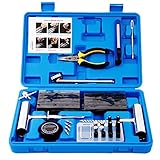
- [🔨PROFESSIONAL QUALITY ] - AUTOWN Tire Repair Kits are made of refined high-quality steel, AUTOWN upgraded tire patch kits comply with exacting standards of audit, can repair the toughest tires on the market.
- [🔨DURABLE & SAFE ] - The tire puncture repair set own great adhesion, flexibility, shock absorption, and not easy to aging and long shelf life, can be able to withstand the toughest repairing, achieve the best tire air tightness.
- [🔨MULTIPLE USES ] - The AUTOWN 68 pcs tire repair heavy duty kit repairs easily all types of tires on cars, motorcycles, ATVs, tractors, lawn mowers, RV, jeeps, trucks and more.
- [🔨EASY TO USE ] - Our tire plug kits have everything you need to make repair easily. This kit with T-handle and spiral probe tool, so you can pierce into easily no matter what tires you repair. The portable storage case takes up very little space.
- [🔨QUICK ACTION] - We care about every customer's sense of use. It is our responsibility to ensure product quality. If you have any questions about the AUTOWN repair kit, please contact us.
Because tire rubber is viscoelastic, its stiffness, friction behavior, and handling response change with temperature and speed. SAE research reports that increased tire temperature and/or rolling speed can degrade handling response in many conditions [SAE, c001]. That makes temperature control important—but it also means that simply producing a larger cloud of smoke is not a reliable way to improve traction.
Why drag racers use burnouts
At a sanctioned drag strip, a burnout can serve a practical setup purpose. It may clean debris or a surface layer from the tread and bring a racing tire closer to the temperature range intended for a launch. NHRA describes a designated water area before the starting line where drivers may perform a burnout to heat and clean the tires [NHRA, c003].
The correct procedure depends on the tire compound, tread design, vehicle, track treatment, weather, and event rules. A specialized racing tire and an ordinary street tire do not respond identically. NHRA specifically notes that many street-driven cars bypass the water box and that street tires generally do not require the same water-assisted burnout used by specialized drag tires [NHRA, c003].
Free tools Windows power users keep installed
One-click scans. No signup required.
That distinction matters because an excessive burnout can move oils in an ordinary street tire toward the tread surface, making it greasy rather than more effective. In other words, the functional objective is a clean, appropriately prepared tire—not the longest possible smoke show. Too much duration can overheat the tread, consume usable rubber, reduce launch consistency, and add unnecessary mechanical stress.
Smoke is heat and material loss—not a traction gauge
Burnout smoke is evidence that the tire is hot enough to break down or remove rubber and other material at the contact patch. It does not prove that the tire is in its optimum operating window. A tire can smoke heavily while its surface is becoming less predictable, especially when it is a street tire being used outside the conditions for which it was designed.
Temperature also does not rise uniformly through the tire. The tread surface, underlying belts, sidewalls, and inner structure experience different stresses and temperatures. A tire that looks normal after the car stops may still have experienced accelerated tread wear, carcass stress, flat spotting, or a pressure change. Neither smoke volume nor a quick visual inspection can establish that the tire remains safe.
Rank #2

- Say goodbye to lost tools! Slime's Mini Tire Maintenance Kit is designed to fit in your glove box and stores your tire care essentials in easy to browse compartments
- Keeps your repair tools together in one place where you can find them with this 14-piece compact storage case, made of durable PVC
- Includes valve cores, a 4-way tool, plastic caps, chrome hex caps and keychain pencil gauge
- 4-way valve tool that removes valve cores, re-taps treads inside/outside and reams inside the valve stem
- Packaged in a super compact, translucent green plastic tire tackle case (3.5"" L x 2.5"" W x 0.875"" D)
How the differential and electronic systems change the result
Drivetrain layout determines how a burnout loads the car:
- Open differential: One driven wheel may spin much more readily than the other when traction differs from side to side. The result can be asymmetric tire wear and less predictable behavior.
- Limited-slip or traction-lock differential: The system is designed to transfer available torque when one wheel begins to lose grip. Ford describes limited-slip differentials in those terms [Ford, c004]. In a burnout, that can make both driven tires participate, increasing heat and wear in the tires, differential clutches or gears, axle shafts, and related components.
- Front-wheel drive: The front tires are responsible for both driving and steering. A loss of front-tire traction can affect the car’s ability to respond to steering inputs.
- Rear-wheel drive: The rear tires provide the driving force, but unequal traction can still move the car laterally or change its direction.
- All-wheel drive: Torque may be distributed through additional differentials, clutches, transfer components, and axles. The systems and their protections vary substantially by vehicle.
Traction control and stability control can reduce engine torque or apply individual brakes when they detect wheelspin or a change in vehicle motion. Ford’s documentation describes traction control as using engine or brake control to maximize traction on slippery surfaces and directs owners to the vehicle-specific manual for the system’s behavior [Ford, c005]. Do not assume that a universal button sequence, setting, or pedal technique applies to every car. Some systems partially intervene, some change behavior by drive mode, and some may impose their own thermal or mechanical limits.
What can go wrong
1. Tire overheating, wear, and failure
Tires are safety-critical components, and a burnout adds an unusually severe, localized thermal and wear event to their service history. Possible consequences include rapid tread loss, flat spotting, irregular wear, belt or carcass stress, sidewall damage, and a pressure change that is not obvious from appearance.
NHTSA recommends regular inspection for tread and sidewall damage, correct cold inflation pressure, and replacement when the tread reaches the legal wear indicators or when cuts, cracks, bulges, or other damage are present [NHTSA, c006]. It also identifies underinflation as a leading cause of tire failure and warns that sustained high temperature can contribute to deterioration, blowouts, and tread separation [NHTSA, c006].
A tire that survives without a visible blowout is not automatically unharmed. NHTSA cautions that tire aging and damage cannot be judged solely by casual visual inspection. Pressure loss, unusual noise, vibration, or a change in performance warrants professional attention [NHTSA, c006].
2. Less grip after more smoke
Excessive heating can make the tire less predictable immediately after the burnout. This is particularly important with ordinary street tires, for which a long burnout may bring oils toward the tread surface rather than create the useful temperature condition associated with a purpose-built racing tire [NHRA, c003]. A driver can therefore create more smoke and end up with a worse launch.
Rank #3

- Professional Quality: The AUTOWN tire repair kits are made of refined high-quality steel and upgraded to comply with exacting standards of audit. This ensures that the kit is of professional quality and can repair even the toughest tires on the market.
- Durable and Safe: The tire puncture repair set has great adhesion, flexibility, shock absorption, and is not easy to age, providing a long shelf life. It can withstand the toughest repairing and achieve the best tire air tightness.
- Multiple Uses: The AUTOWN 31 pcs tire repair heavy duty kit can be used to repair all types of tires on cars, motorcycles, ATVs, tractors, lawn mowers, RVs, jeeps, trucks, and more. This makes it a versatile and essential tool for drivers and mechanics.
- Easy to Use: Our tire plug kits come with everything you need, including a T-handle and spiral probe tool that make piercing into any tire easy. The portable storage case takes up very little space, making it easy to carry with you wherever you go.
- Quick Action: AUTOWN is committed to providing excellent customer service and ensuring the satisfaction of all our customers. We take responsibility to ensure product quality and are always available to help with any questions or concerns.
3. Clutch, transmission, differential, and axle stress
The engine and drivetrain do not become unloaded when the tire spins. Torque pulses still pass through the clutch or torque converter, transmission, driveshaft, differential, half-shafts, hubs, and wheel bearings. If traction repeatedly alternates between sliding and gripping, those components can see shock loads in addition to heat.
Depending on the vehicle and the method used, the clutch, transmission, differential, brakes, wheel bearings, axles, and engine cooling system may all experience substantial thermal or mechanical load. High-energy friction systems are known to operate with significant friction-material heat flux and high temperatures in demanding use [c007]. That supports the general risk, but it does not justify a universal prediction such as a burnout always destroying a transmission. Failure likelihood depends on the vehicle, tire, surface, duration, gearing, temperature, and driver inputs.
4. Loss of control and poor visibility
Smoke can obscure the driver’s view. NHRA has documented situations in which extreme smoke made it difficult to see through the windshield [NHRA, c008]. A spinning car can also move sideways if the driven tires do not share traction equally, if the surface is uneven, or if steering and brake inputs are inconsistent.
That risk is not limited to the person in the driver’s seat. A vehicle moving unexpectedly can strike another car, a wall, timing or track equipment, a spectator, or a person standing near the vehicle. Debris and rubber can also be thrown from the tires. A fire burnout is not a legitimate substitute for a normal track procedure: FIA drag-racing procedures restrict burnouts to designated areas, specify water-only treatment, prohibit fire burnouts, and prohibit people from holding or touching cars during burnouts [FIA, c009].
5. Legal and venue problems
A public-road burnout may violate traffic, noise, reckless-driving, surface-damage, or local nuisance laws. The exact rule depends on the jurisdiction, road, circumstances, and enforcement. There is no responsible way to declare every public-road burnout legal or illegal without identifying the relevant location and facts.
The safe baseline is simpler: use a sanctioned facility or closed course that expressly permits the maneuver, and follow its current rules and staff instructions. A track that allows drag racing does not necessarily allow every type of burnout, and a private property owner’s permission may not override local law or safety requirements.
Rank #4

- 【Car Emergency Kit】-- CKAuto Universal Tire Repair Kit includes T-handle Insertion Tool x 1, Insertion Tool Replacement x 1, T-handle Probe Spiral x 1, Probe Spiral Replacement x 1, 4" Repair Plugs x 20, Valve Stem Caps x 4, 4-Way Valve Stem Tool x 1, Jar of Lubricant x 1, "L" Hex Key x 1, Valve Cores x 4, Knife x 1, Bag x 1. Meet all your needs on tire repairing work totally.
- 【Premium Quality】-- Our T-handle Tools are made of the high strength rustless zinc alloy, can easily pierce the plugs and quickly finished the repair work. Tire repair strips of best natural rubber are equipped with airtight bag, excellent ageing resistant performance.
- 【Easy To Use】-- Repair punctures for all tubeless tire without remove tire from rim, detailed instruction ensures everyone can repair their flat tire in a right and quick way, professional repair without professional skill required.
- 【Universal Fit】--Perfect fit for Autos, Cars, Motorcycles, Trucks, RVs, SUV, Jeep, Tractor, Trailer, Mower and other vehicles with tubeless tire, please note this is not for tube tires.
- 【Portable Bag】-- CKAuto Universal Tire Repair Tools can be conveniently organized in a compact carry bag, airtight plastic bag design for tire plugs can maximize the service life of the strips, which is perfect car emergency accessories.
How to do it the right way
“Right” should mean controlled, tire-appropriate, rule-compliant, and repeatable—not dramatic. The following checklist is intentionally procedural without prescribing a universal gear, engine speed, duration, brake technique, or traction-control setting. Those details depend on the vehicle, tires, surface, and event rules.
Recommended Free Tools
- Choose the right environment. Use a sanctioned drag strip or closed course that expressly permits burnouts. Do not practice on a public road, in traffic, in a parking lot, or near pedestrians and property.
- Read the event procedure before staging. Find out whether the facility uses a water box, whether street tires should avoid it, where the burnout must occur, how long the permitted procedure may be, and what officials require. Follow lane officials rather than copying another driver.
- Confirm vehicle suitability. Consult the owner’s manual for drivetrain, transmission, differential, traction-control, stability-control, tire, and cooling-system limitations. Confirm that the event rules allow the vehicle and its tires.
- Inspect the tires while they are cold. Check the vehicle placard or manual for the manufacturer’s recommended cold pressure; do not substitute the maximum pressure molded into the tire sidewall. An automotive tire pressure gauge makes this check more reliable than judging by appearance. Inspect tread, sidewalls, cuts, cracks, bulges, exposed cords, and unusual wear.
- Retire questionable tires. Do not use a tire with a bulge, serious cut, crack, exposed structure, unexplained pressure loss, or abnormal vibration. A tread-depth gauge can help you check tire tread wear, but a good tread reading does not override visible damage, age concerns, or abnormal behavior. NHTSA recommends professional evaluation when those warning signs appear [NHTSA, c006].
- Use tires intended for the job. If the event and vehicle call for a different tire category, research performance tires for drag racing by vehicle fitment, compound, construction, load rating, speed rating, temperature conditions, and event rules. There is no universally best burnout tire. NHTSA’s tire-rating guidance distinguishes treadwear, wet traction, and temperature grades; a temperature grade describes resistance to heat, not a guarantee that a tire is suitable for burnouts [NHTSA, c006].
- Use the shortest tire-appropriate procedure. A street tire generally does not need the same water-assisted preparation as a specialized drag tire [NHRA, c003]. Stop when the event’s procedure is complete or if visibility, vehicle attitude, noise, vibration, warning lights, or tire behavior becomes abnormal. Do not extend the burnout merely to create more smoke.
- Keep people and prohibited materials away. No one should hold or touch the car during the burnout. Use only the treatment permitted by the facility; FIA drag procedures specify water-only treatment and prohibit fire burnouts [FIA, c009].
- Meet the venue’s safety requirements. A sanctioned event may require a seat belt or harness, helmet, fire extinguisher, closed clothing, or other equipment. NHRA’s introductory guidance emphasizes following lane officials, securing the driver with the required belt and helmet, and ensuring the hood is properly shut and latched [NHRA, c011]. A helmet must meet the current event’s certification, fit, and condition requirements.
- Inspect the car before returning to normal driving. Look again for tire damage, pressure loss, smoke from an unexpected source, fluid leaks, warning lights, vibration, noise, or a change in steering or braking. Chevrolet track guidance recommends correct wheel-nut torque before and after track activity [Chevrolet, c012]. Use an automotive torque wrench only with the vehicle manufacturer’s specified torque and tightening procedure; the tool is not a substitute for proper wheel and stud inspection.
If anything feels or sounds different after the run, do not assume it will disappear on the road. Have the vehicle inspected by a qualified technician or tire professional. Check tire pressure again when the tires are cold, following the vehicle placard or manual rather than trying to infer safe pressure from the appearance of a hot tire.
Independent reader supportYour contribution helps us test, update, and keep practical guides available for everyone.Pressure, tire choice, and measurement
The correct starting point is the vehicle manufacturer’s recommended cold pressure, normally found on the driver’s door-jamb label or in the owner’s manual. It is not automatically the maximum pressure molded into the tire sidewall. NHTSA recommends checking pressure when the tire is cold and inspecting tires regularly [NHTSA, c006].
Pressure matters because it changes the shape and behavior of the contact patch, but that does not make a particular pressure safe for every burnout. Tire construction, load, temperature, vehicle weight, track surface, and event rules all matter. Avoid copying a pressure number from another car or internet video.
Tire category matters just as much. Chevrolet describes performance tires as being designed for demanding handling but warns that low-profile performance tires can be more vulnerable to damage from rough surfaces, curbs, debris, and obstacles [Chevrolet, c013]. A tire with a high temperature grade is not automatically a drag tire, and a drag-oriented tire is not automatically appropriate for wet roads, daily driving, or a particular wheel and vehicle.
Do these 3 things before closing this tab:
1Fix the driver behind crashes, sound loss and screen glitches2Clear out junk files and repair common Windows errors3Scan for outdated or missing drivers - takes under a minuteA burnout is not the same as general tire warming
Drivers sometimes treat any method of raising tire temperature as interchangeable with a drag-strip burnout. It is not. Motorsport disciplines may impose different tire, pressure, surface, and heating rules. FIA regulations for one GT competition required specified tires and prohibited tire-heating, heat-retaining, and cooling devices [FIA, c014]. FIA drift-cup regulations likewise prohibit tire modification, traction compounds, and artificial temperature alteration [FIA, c015].
Best Value

- Complete Repair Kit: This tire repair kit includes all the essential tools and accessories needed for effective tire maintenance, whether you’re at home or on the go.
- Wireless Air Pump: Equipped with a high-efficiency wireless air pump, this kit allows you to inflate tires anytime without the need for a power source. The powerful pump quickly fills tires in minutes, saving you valuable time.
- Smart Digital Display: The integrated digital pressure gauge provides real-time tire pressure readings, ensuring precise inflation. Easily set and monitor the desired pressure to prevent over- or under-inflation.
- Compact and Portable Design: The kit is designed to be compact with all tools and the air pump neatly stored in a durable carrying case, making it easy to transport and store, perfect for long trips and everyday use.
- Versatile Compatibility: The air pump comes with multiple adapters to accommodate various tire types and inflation needs, including cars, motorcycles, bicycles, and sports equipment.
Those rules illustrate the broader principle: follow the current regulations for the specific event and class. Do not transfer a drag-racing practice to a drift event, road course, autocross, or driving school without checking the rules. In some disciplines, the objective is not to create wheelspin at all; it is to bring the tires into a controlled operating condition through legal driving.
Before-and-after checklist
| Check | Before the run | After the run |
|---|---|---|
| Tire pressure | Measure cold pressure against the door placard or manual. | Look for pressure loss; recheck at cold temperature before road use. |
| Tread and sidewalls | Look for legal tread depth, cuts, cracks, bulges, exposed structure, and irregular wear. | Look for fresh damage, flat spotting, melted or torn tread, and unusual rubber loss. |
| Vehicle behavior | Do not proceed with existing vibration, noise, warning lights, leaks, or steering/braking problems. | Stop using the car if new vibration, noise, pulling, warning lights, or performance changes appear. |
| Wheels and fasteners | Confirm wheel condition and manufacturer-specified wheel-nut torque. | Recheck wheel-nut torque according to the manufacturer and event procedure. |
| Venue safety | Know the water-box, staging, equipment, helmet, belt, and personnel rules. | Follow the exit and inspection procedure before driving away. |
The practical answer
A burnout can be a legitimate motorsport setup operation when it takes place at a facility that permits it, with a tire and vehicle suited to the event, and under a short, controlled procedure. It is not a reliable grip-building ritual for every street car. More smoke can mean more heat and more rubber loss, not a better launch.
The responsible driver treats the burnout as one part of vehicle preparation: verify the rules, inspect the tires, use the correct cold pressure, follow vehicle-specific guidance, keep people clear, and inspect everything again afterward. If the goal is to learn the technique rather than perform a public-road stunt, instruction at a sanctioned facility is the appropriate route.
What’s actually slowing this PC down?
Pick the symptom - the matching free tool is one click away.
Source markers in this article refer to the supplied research from SAE, NHRA, NHTSA, Ford, Chevrolet, and FIA materials.
Frequently Asked Questions
Does more burnout smoke mean more grip?
No. Smoke shows that heat and tire material are being generated or removed. It does not prove that the tire is in its best traction range. Excessive heating can make some street tires greasy and less predictable.
Should a street car use the water box?
Not necessarily. NHRA guidance says many street-driven cars bypass the water box, while specialized drag tires may use a designated water area for their intended preparation. The event’s rules and the tire manufacturer’s application guidance control.
Can a tire be safe just because it looks fine afterward?
No. A tire can suffer accelerated tread wear, carcass or belt stress, flat spotting, pressure loss, or other damage without an obvious visual sign. Check pressure and condition, and have any tire with damage, vibration, noise, or abnormal performance inspected professionally.
Are burnouts legal on public roads?
Do not assume so. Public-road burnouts may violate traffic, noise, reckless-driving, surface-damage, or local nuisance laws, depending on the jurisdiction. Use only a sanctioned facility or closed course that expressly permits the maneuver.
The Bottom Line
Bottom line: The biggest smoke cloud is not the goal. A proper burnout is a brief, venue-approved tire-preparation procedure whose value depends on the tire, vehicle, surface, and rules. On a street car or public road, the risks to traction, tires, drivetrain, visibility, bystanders, and legality generally outweigh the spectacle.
Quick Recap
Product prices and availability are accurate as of the date/time indicated and are subject to change. Any price and availability information displayed on Amazon at the time of purchase will apply.




