There is no evidence-based universal “best” DA sander for auto body work: the right choice depends on whether you are preparing a broad panel or refining a small repair. A 150 mm (6-inch) random orbital is documented in 3M panel-repair guidance for panel preparation; a 77 mm (3-inch) tool such as Mirka’s DEROS II 325 is intended for smaller operations and finer finishing. Match the pad, orbit, abrasive, extraction setup, and grit to the job rather than shopping by brand alone.
Choose the sander by repair size
Pad diameter is a practical first filter: a larger pad suits broad panel work, while a small pad offers access and control on localized areas. The examples below document use cases, not a head-to-head performance ranking.
| Use case | Documented tool example | What the evidence supports |
|---|---|---|
| Broad panel preparation | 150 mm (6-inch) random orbital sander | 3M’s panel-repair guide lists its Precision Random Orbital Sander at 150 mm and an electric random orbital sander for panel preparation. This supports the size category in a panel workflow, not a universal model recommendation. 3M Panel Repair & Paint Prep (2024 copyright notice) |
| Small-area repair and fine finishing | Mirka DEROS II 325 EU, 77 mm pad, 2.5 mm orbit | Mirka positions this model for smaller sanding operations, finer grits, and prepolishing. Its size and intended use make it a complementary spot-work option, not a substitute recommendation for every panel. Mirka DEROS II 325 product page |
These sources do not establish a controlled comparison of leading sanders, current price differences, or an independent winner. Confirm the exact machine configuration offered in your region before buying.
Match orbit and abrasive to the operation
Orbit affects how a random orbital sander is applied, but one orbit is not best for every stage. 3M’s Random Orbital Sanding Guide gives starting points including a 3/16-inch orbit for primer sanding, 3/8-inch for coating removal, and 3/32-inch for preparation for polish. The guide advises trials for the application; these are not universal settings for every paint system or repair. 3M Random Orbital Sanding Guide
Do these 3 things before closing this tab:
1Fix the driver behind crashes, sound loss and screen glitches2Clear out junk files and repair common Windows errors3Scan for outdated or missing drivers - takes under a minute#1 Best Overall

- High Speed Performance: Boasts an unloaded working speed of 12000-13000 RPM at 0.8Mpa, enabling fast and efficient material removal for various sanding tasks.
- Lightweight & Ergonomic: The lightweight design combined with an ergonomic shape ensures easy handling and reduces operator fatigue, allowing for long - term use without discomfort.
- Adjustable Speed: The adjustable speed switch offers flexibility, allowing you to adapt the sanding speed to different materials and achieve precise control over your work.
- Noise - Reduction Technology: Equipped with exclusive noise - reduction technology, it minimizes the noise during operation, providing a quieter and more pleasant working environment.
- Optimal Compatibility: Designed with 5/6 inch pads and a 5mm eccentric orbit, and recommended for use with a 15 - gallon - plus air compressor, it is ideal for a wide range of applications, from auto body work to general DIY projects.
Grit should advance with the work. 3M’s procedures illustrate the following sequence and stage-specific choices; follow the applicable OEM and paint-system instructions where they differ.
- Initial paint removal beyond the repair: 80–120 grit in 3M’s panel-repair guide.
- Scratch refinement: 180–320 grit in the same guide.
- Final repair feather-edge refinement: grade 320.
- Primer scratch refinement: 400–500 grit on a DA with a soft interface pad to remove directional hand-sanding scratches.
- Filler and feather edging for large damage: 3M’s large-damage procedure describes 80, 150, and 180 grade abrasive steps.
These figures come from specific 3M workflows, not a universal recipe. See 3M Standard Operating Procedures for Large Damage Repair and the 3M panel-repair guide alongside the instructions for the coating and vehicle involved.
Rank #2

- PROFESSIONAL PNEUMATIC SANDER: With light weight and ergonomic design, ZFE 6 inch random air sander can be easily held in palm. This sander can be used for deburring of wood, polishing and derusting of metals, polishing and buffing of all paint surface.
- GOOD PERFORMANCE: High-precision all-steel movement, manufactured by quenching, all-steel rotor, all-steel cylinder, and high-hardness fan blade movement closely match the speed, not easy to damage! The integrated regulator can achieve speed control of 10,000 rpm, high horsepower, high balance, and long-term use without fatigue.
- DUST BAG INCLUDED: Connect one end of the suction tube to the suction connector, and tie the other end to the bag that collects the dust to use. The 1 meter vacuum tube is very practical and convenient to use. Whether it is used in the workshop or at home, it is your best choice!
- WIDELY APPLICATIONS: ZFE dual action sander is ideal for furniture, metal products, paint surface, fiberglass and other components, widely used for rough grinding, semi-fine grinding, grinding and grooving and cutting, etc.
- COST-EFFICIENT SET: Comes with 1pc air sander, 5 inch and 6 inch backing plates, 24pcs sandpapers, 3pcs polishing pads, 2pcs microfiber cloths, 1pc washing mitt and other accessories. Give all you need to start your project!
Check disc fit and dust extraction before buying
A machine is only part of a sanding setup. 3M describes its Clean Sanding System as combining dust extraction, pneumatic and/or electric random orbital sanders, abrasives, and protective equipment, and its panel guide recommends dust extraction. The pages do not quantify a health or performance advantage, so treat extraction as a system component rather than a promised outcome. 3M Abrasives for Collision Repair
- Confirm the disc diameter matches the backing pad.
- Check the attachment system and whether the abrasive is compatible with the machine and extraction setup.
- Select the abrasive grade for the current repair stage, not simply because it fits the pad.
- Consider the intended task: 3M identifies Cubitron II and Blue discs for random orbital sanders, Purple Finishing Film for paint defects, and Trizact Foam Discs for refining scratches before polishing. These products serve different stages; use the relevant product and paint-system instructions.
Mirka reports a 32% decrease in abrasive material consumption with its simplified OSP system, attributing the figure to body-shop studies. The cited page does not identify the studies, sample size, or publication year, so this is a manufacturer-reported claim, not an independently established industry result. Mirka Optimized Automotive Repair Process
Quick Recap
Best Value

- New version, high strength, wear resistant, long service life
- Air Inlet:1/4", hook and loop sanding pad:5", Free speed: 12,000 revolutions per minute
- Rear exhaust. Built-in regulator for speed control
- Lighter air-motor assembly, ideal for vertical and overhead sanding applications
- Average air consumption: 10.5 CFM;Air Pressure: 90 PSI
Rank #4

- High-Speed Efficient Sanding Performance Powered by 12000–13000 RPM pneumatic system with 0.6–0.8 MPa working pressure, this DA air sander delivers fast material removal and consistent surface finishing, improving workflow efficiency in auto body repair and surface preparation.
- Low Noise & Reduced Vibration Design Engineered with noise reduction and vibration control structure, this orbital sander provides a quieter and more stable working experience, helping reduce operator fatigue during long sanding sessions.
- Precision 5mm Random Orbit Motion 5mm dual-action orbit ensures uniform sanding patterns and minimizes swirl marks, making it ideal for paint preparation, filler leveling, and fine finishing applications.
- Lightweight & Ergonomic Handling Compact body design reduces wrist strain and improves control accuracy. Suitable for extended professional use in automotive workshops and DIY projects.
- Multi-Material Application & Compatibility Compatible with 5 inch sanding pads. Ideal for auto body repair, wood sanding, metal polishing, and fiberglass surface treatment. Recommended air compressor: 15 gallons or larger.
Rank #3
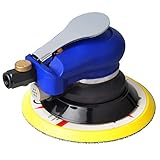
- 6" Air Sanders Hook and loop face design with hook and loop function
- 6" pneumatic Sanders
- sander tools, A built-in regulator in sander allows you to adjust the speed with which you work to satisfy your different sanding, polishing and waxing requirements, for quick and accurate results.
- Suitable for iron, wood, plastic, metal, rubber, stone, marble and other materials grinding, fine polishing.
- Different type of sandpaper can be installed with the different type of disc.
A practical buying decision
- Identify the work area. For broad panel preparation, begin by comparing 150 mm (6-inch) random orbitals; for localized repair and finer finishing, consider a small-pad tool such as the 77 mm DEROS II 325.
- Choose the orbit for the stage. Use application guidance as a starting point, then follow the paint-system and vehicle instructions and validate the setup on the job.
- Plan the abrasive sequence. Select the grit for removal, scratch refinement, feather edging, or primer prep rather than using one grade throughout.
- Verify the whole setup. Match disc size and attachment, backing pad, extraction arrangement, and protective equipment to the machine and work.
- Check regional configuration and support. Confirm the exact model specification and availability with the seller or manufacturer; the cited sources do not provide a current price comparison or independent durability, vibration, noise, or warranty ranking.
Product prices and availability are accurate as of the date/time indicated and are subject to change. Any price and availability information displayed on Amazon at the time of purchase will apply.




