Free tools Windows power users keep installed
One-click scans. No signup required.
For most U.S. commuters, the Honda PCX160 is the best all-around 150-class scooter. It combines useful storage, liquid cooling, fuel injection, a 14-inch front wheel, front ABS, a comfortable automatic transmission, and broad Honda dealer support. Choose the Honda ADV160 instead if your routes include potholes, rough pavement, or light gravel. Choose the Kymco Like 150i ABS for the strongest value and dual-channel ABS, the Kymco People S150i ABS or Piaggio Liberty 150 for large-wheel comfort, the Vespa Primavera 150 for premium style, and the Genuine Buddy 170i for a light, lively, compact scooter.
There is one important limitation: none of these is an ideal regular freeway scooter. A 150-class machine can be practical on city streets, 45-to-55-mph arterials, moderate suburban roads, hills, and short commutes. If your normal route involves sustained 60-to-65-mph traffic, strong winds, steep grades, or frequent two-up riding, a 250cc-to-400cc scooter generally provides a more useful margin of speed and stability.
This guide covers the U.S. market and models verified through manufacturer or distributor sources as of August 10, 2026. Prices are advertised figures before tax, registration, dealer fees, accessories, and other ownership costs. Model-year labels and local inventory can change, so obtain a written dealer quote before buying.
Best 150cc scooters at a glance
In the United States, 150cc scooter is best understood as a marketing category rather than an exact displacement class. The current models below range from 149.8cc to 168.9cc. Their actual performance depends on engine output, CVT calibration, cooling, vehicle weight, aerodynamics, wheel size, gearing, rider weight, hills, and wind—not the badge alone.
Do these 3 things before closing this tab:
1Scan for outdated or missing drivers - takes under a minute2Clear out junk files and repair common Windows errors3Fix the driver behind crashes, sound loss and screen glitches#1 Best Overall

- Suitable for Age 14+ years old
- The package includes knee pad x 2; elbow pad x 2; wrist guard x 2; helmet x 1
- The skateboard helmet is designed with multiple vent, adjustable dail and adjustable strap for proper fit
- Knee elbow pads and wrist guards are made of durable, soft EVA padded material with tough plastic plates
- Appropriate for inline skating; roller skating; skateboarding; scootering; skating and other outdoor sports
| Model | Exact displacement | Wheels | ABS and brakes | Seat / weight | Storage | U.S. price information | Warranty | Best for |
|---|---|---|---|---|---|---|---|---|
| Honda PCX160 | 157cc | 14-inch front | Front-wheel ABS | 30.1 in; 291 lb curb | 27-liter-class weatherproof underseat compartment | $4,349 MSRP + $600 destination | 1-year transferable limited warranty | Most daily commuters |
| Honda ADV160 | 157cc | 14-inch front | Front-wheel ABS | 30.7 in; 294 lb curb | 27-liter underseat compartment + 2-liter front compartment | $4,499 MSRP + $600 destination | 1-year transferable limited warranty | Rough pavement and crossover use |
| Kymco Like 150i ABS | 149.8cc | 12-inch | ABS on front and rear brakes | 31.1 in; 264 lb claimed dry | Underseat storage and lockable USB glove box | $3,299 MSRP + $350 destination | 2-year limited factory warranty | Value and retro styling |
| Kymco People S150i ABS | 149.8cc | 16-inch front / 14-inch rear | Front ABS; rear hydraulic disc | 31.5 in; 286.6 lb claimed dry | Claimed full-face-helmet storage | $3,799 MSRP + $300 destination | 2-year limited factory warranty | Large-wheel urban riding |
| Piaggio Liberty 150 | 155cc | 16-inch front / 14-inch rear | Front ABS; rear drum | Under 790 mm, about 31 in; 124 kg running order | Verify helmet fit on the actual scooter | U.S. pages show about $3,299–$3,349; verify | Verify with dealer | Light, narrow high-wheel riding |
| Vespa Primavera 150 | 155cc | 12-inch | Front ABS; current U.S. page lists front and rear disc brakes | About 30.9 in | Verify full-face-helmet fit | $5,799 MSRP; variants about $5,849–$6,149 | Verify with dealer | Premium style and finish |
| Genuine Buddy 170i | 168.9cc | 10-inch | ABS not published on current product page | Current product page does not provide a full dimension table | Verify with your helmet and daily cargo | Current official page does not clearly publish MSRP | 3-year unlimited-mile warranty | Light, compact, lively riding |
| SYM Jet 14 200i / Fiddle 4 200i | 169cc | Verify current specification | ABS listed for Jet 14 | Verify current dimensions | Verify with dealer | Price and availability vary by dealer | 24 months, unlimited miles, parts and labor | Near-class alternatives |
Manufacturer specifications are not always measured the same way. Honda lists curb weight, Kymco lists dry weight, and Piaggio lists running order. Do not compare those figures as if they were identical. The same caution applies to fuel economy, top speed, storage capacity, and model-year pricing.
Manufacturer pages: Honda PCX, Honda ADV160, Kymco Like, Kymco People S, Piaggio Liberty, Vespa Primavera, and Genuine Buddy 170i.
What counts as a 150cc scooter?
A badge reading 150 does not tell you the engine’s precise displacement. In this guide, 150-class includes the following current U.S. offerings and near-class models:
- 149.8cc: Kymco Like 150i ABS and People S150i ABS.
- 155cc: Piaggio Liberty 150 and Vespa Primavera 150.
- 157cc: Honda PCX160 and ADV160.
- 168.9cc: Genuine Buddy 170i.
- 169cc: SYM Jet 14 200i and Fiddle 4 200i.
The difference between 149.8cc and 168.9cc is not a guarantee of a particular top speed. A scooter with a stronger engine can still be slowed substantially by a heavy rider, a headwind, a hill, a passenger, or restrictive CVT tuning. Wheel size, suspension, brakes, riding position, and dealer support can matter more to your ownership experience than a few cubic centimeters.
Quick wins for a faster PC:
Repair Windows errors before they cause bigger problemsFix Now →Fix the driver behind crashes, sound loss and screen glitchesFind Drivers →Clear out junk files and repair common Windows errorsFree Scan →Best overall commuter: Honda PCX160
The Honda PCX160 is the safest recommendation for the broadest group of buyers: a rider who wants an automatic scooter for commuting, errands, urban travel, and ordinary suburban roads without making a specialty trade-off.
Its 157cc liquid-cooled, fuel-injected, four-valve single-cylinder engine drives through a CVT. The PCX has a 14-inch front wheel, front-wheel ABS, a 30.1-inch seat, a 291-pound curb weight, and a 27-liter-class weatherproof underseat compartment. Honda lists a $4,349 MSRP plus a $600 destination charge for the current U.S. PCX page, or $4,949 before tax, registration, setup, documentation, accessories, and financing.
Why the PCX wins
- Balanced road manners: The 14-inch front wheel is a useful compromise between compact urban handling and greater composure over road defects.
- Commuter practicality: The underseat compartment is substantial for this class, although you should test it with your own full-face helmet rather than trusting a generic helmet-fit claim.
- Temperature control: Liquid cooling is useful under sustained load and hot-weather stop-and-go traffic, though it adds coolant and related components to the maintenance picture.
- Ownership access: Honda’s broad U.S. dealer and parts network is a practical advantage. That is a support-network judgment, not a claim that every Honda dealer will stock every scooter part.
- Reasonable price: It costs less than the ADV160 and substantially less than a Vespa Primavera 150 before dealer charges.
What the PCX does not do
The PCX has front ABS rather than ABS on both wheels, and it is not a high-speed touring scooter. It is an excellent fit for urban streets and moderate arterials, but riders whose daily roads are posted at 60 or 65 mph should test the scooter on those roads—or consider moving to a larger class.
See the current Honda PCX specifications and pricing and Honda’s owner-manual portal.
Best for rough roads: Honda ADV160
The Honda ADV160 uses the same basic 157cc liquid-cooled, fuel-injected, four-valve Honda powertrain concept as the PCX but gives the chassis a more crossover-oriented setup. It is the better choice when your commute includes potholes, broken pavement, poorly maintained alleys, gravel lanes, or frequent speed bumps.
The ADV160 has Showa suspension, approximately 5.1 inches of front travel and 4.0 inches of rear travel, a two-position windscreen, a 30.7-inch seat, a 294-pound curb weight, front ABS, 27 liters of underseat storage, and a 2-liter front compartment. Honda’s current U.S. page is labeled 2027, while the PCX page remains labeled 2026; verify the model year and equipment on the dealer’s actual vehicle.
Why choose the ADV160 over the PCX?
- More suspension travel: It has more capacity to absorb rough surfaces without feeling as easily overwhelmed.
- Better wind and weather flexibility: The adjustable windscreen lets the rider choose between more protection and greater airflow.
- Crossover ergonomics: The riding position and visual design suit buyers who want a more upright, adaptable machine.
- Only a small price premium: Honda lists $4,499 MSRP plus $600 destination, $150 more in MSRP than the PCX.
The ADV160 is not an off-road motorcycle. Its automatic transmission, scooter wheels, tires, ground clearance, and bodywork do not make it appropriate for trails, deep sand, mud, or aggressive off-road riding. It also has front-only ABS, so the Kymco Like is the more attractive choice if dual-wheel ABS is your top priority.
Read the Honda ADV160 model information before comparing a dealer’s 2026 and 2027 inventory.
Best value and strongest published power figure: Kymco Like 150i ABS
The Kymco Like 150i ABS offers one of the most compelling equipment-to-price combinations in the category. Its 149.8cc fuel-injected, forced-air-cooled engine is rated by Kymco at a claimed 13.5 horsepower. It uses a CVT, 12-inch wheels, and ABS on both the front and rear brakes.
Kymco lists a $3,299 MSRP plus $350 destination, or $3,649 before tax and other dealer costs. It is also backed by a two-year limited factory warranty, longer than Honda’s published one-year transferable limited warranty.
Why the Like makes sense
- Dual-channel ABS: Both wheels have ABS, a meaningful safety feature in emergency braking.
- Low purchase price: It costs less than the PCX, ADV160, People S, Liberty, and Primavera on the published figures.
- Light weight: Kymco lists 264 pounds claimed dry, although that is not directly comparable with Honda’s curb weights.
- Useful details: It has underseat storage, a lockable glove compartment with USB, a center stand, and passenger accommodations.
- Retro appearance: The styling gives you a classic look without Vespa pricing.
What you trade away
The Like’s 12-inch wheels are more compact and can feel nimble at low speed, but they generally require more care around potholes, grooves, and sharp road edges than a large-wheel scooter. It is air-cooled rather than liquid-cooled, which is a simpler and lighter arrangement well suited to ordinary urban use but not a reason to treat the Like as a sustained high-load freeway machine.
Kymco’s current product page contains some placeholder-like owner-corner material, so use the specification sheet and owner’s manual for technical and maintenance information. Also confirm that a qualified Kymco dealer is reasonably close to you before choosing the Like over a Honda.
What’s actually slowing this PC down?
Pick the symptom - the matching free tool is one click away.
Best high-wheel choices: Kymco People S150i ABS and Piaggio Liberty 150
Large front wheels are attractive when your roads are scarred by potholes, utility cuts, patched asphalt, and expansion joints. They do not eliminate those impacts, but a 16-inch front wheel often gives the steering a calmer response over irregular pavement than a small-wheel scooter.
Rank #2

- 👍【Adjustable Size】 Adjustable elastic straps help adjust size freely and ensure freedom of movement when doing sports(suggest 15kg-40kg). Adjustable small kids helmet can be adjusted head circumference 18.89inch-21.26inch (48~54cm).
- 👍【All Round Protection】Our protection layers consist of anti-scratch extra hard PVC shell for hard protection, padded with soft EVA material for impact buffering. WayEee protection gears allow our children to play hard while they are well protected, no worry getting hurt.
- 👍【Multipurpose Helmet Set】 Right out of the box! This kids helmet with pads set is flexible and suitable for multi-sport activitie from inline skating to skateboarding, cycling, scooter, roller skating, rollerblading, bicycling, riding, hover board and electric scooter etc.
- 👍【Best Gift for Your Kids】- This bike helmet design with adjustable buttons to offer protection to your kids & youth. This protection set is a perfect gift for girls or boys on Birthday, Children Day, Thanksgiving Day, Christmas Day or other festivals.
- 👍【7 in 1 Protective Gear】Kids Helmet and Pad Set including 1 kids toddler helmet, 2 Kids toddler knee pads, 2 kids elbow pads, 2 kids wrist pads, 1 provided with 1 storage bag keep easy to carry the kids protective gear set with you for any other outside activities.
Kymco People S150i ABS
The Kymco People S150i ABS has a 16-inch front wheel and 14-inch rear wheel, the same claimed 13.5 horsepower as the Like, front ABS, a rear hydraulic disc brake, adjustable-preload rear shocks, a tall windscreen, and a claimed full-face-helmet storage compartment. Kymco lists a 31.5-inch seat and 286.6 pounds claimed dry weight. Its $3,799 MSRP plus $300 destination works out to $4,099 before tax and dealer charges.
This is the more substantial-feeling urban commuter. It should appeal to riders who value wheel size, wind protection, and a tall-road posture over maximum compactness. The compromises are a taller seat, a longer and less nimble package in tight parking spaces, and a smaller fuel capacity than the Hondas. The published equipment describes front ABS and a rear hydraulic disc; do not call it dual-channel ABS unless the current specification sheet explicitly confirms rear-wheel ABS.
See Kymco’s People S150i ABS page and verify full-face-helmet fit, rider reach, and dealer support in person.
The Tool Desk
Outbyte PC Repair FREEClear out junk files and repair common Windows errorsFree Scan →Outbyte Driver Updater FREEScan for outdated or missing drivers - takes under a minuteDriver Scan →Piaggio Liberty 150
The Piaggio Liberty 150 takes a different approach to urban comfort. It uses a 155cc air-cooled, three-valve i-get single with fuel injection and a CVT, plus a 16-inch front wheel and 14-inch rear wheel. It has front ABS, a rear drum, a flat floorboard, and an upright riding position. Official technical data lists 124 kilograms running order and a seat height under 790 millimeters.
The Liberty is a strong choice for a rider who wants a light, narrow, high-wheel scooter with Italian styling but does not want to pay Primavera money. The U.S. model page lists a 5.5-inch color LCD on the current redesign. However, Piaggio’s U.S. presentation needs extra verification: its store page and model page show approximately $3,299 and $3,349 respectively, and the model page warns that images and specifications may reflect European models and can change for North America.
Get the exact model year, equipment, destination charge, warranty, and out-the-door price from a Piaggio dealer. Start with the Piaggio Liberty overview, U.S. model page, and Piaggio U.S. store.
Best premium style: Vespa Primavera 150
The Vespa Primavera 150 is the style-and-finish choice, not the performance-value choice. Its 155cc air-cooled, three-valve i-get engine uses fuel injection and a CVT. It has 12-inch wheels, front ABS, a steel body with welded reinforcements, and a current U.S. equipment list that includes a keyless system, color LCD, USB, and Bike Finder. The current U.S. page lists front and rear disc brakes.
Recommended Free Tools
Vespa lists a $5,799 MSRP for the Primavera 150, with variants ranging approximately from $5,849 to $6,149. Verify warranty terms and the dealer’s actual price. Accessories, racks, top cases, cosmetic parts, and dealer labor can make the ownership cost considerably higher than the base price.
Who should buy the Primavera?
Buy it if design, brand appeal, finish, and the ownership experience are central to your decision and the premium fits your budget. Do not buy it expecting substantially more acceleration or highway ability than a PCX, ADV160, or Like. Its 12-inch wheels are compact and city-friendly, but they do not offer the same rough-road composure as the People S or Liberty. Steel bodywork is attractive and distinctive, but collision or cosmetic repairs can be expensive.
Check the current U.S. Primavera page and Vespa U.S. store for the exact version and price.
Best compact, lively alternative: Genuine Buddy 170i
The Genuine Buddy 170i is the light, simple, small-wheel alternative. Despite the 170 badge, its displacement is 168.9cc. It uses an air-cooled, fuel-injected engine and CVT, and Genuine claims 11.2 horsepower. The product page says up to 55 mph and gives a 100-plus-mpg EPA estimate, while Genuine’s FAQ says the scooter can exceed 60 mph and describes 60-plus-mph capability. Those are inconsistent official claims, so report them as claims rather than treating either figure as a guaranteed result.
The Buddy’s biggest ownership advantage is a three-year unlimited-mile warranty. It is also approachable, compact, and entertaining at urban speeds. The trade-offs are its 10-inch wheels, lack of published ABS on the current product page, less suitability for rough pavement or sustained high-speed riding, and the fact that Genuine’s current official product page does not clearly publish a usable MSRP.
Genuine itself advises against using its 170cc scooters as long-distance interstate machines. Its FAQ says that although the scooters can exceed 60 mph, prolonged riding at 65 mph is not recommended and expressways and interstates should be avoided. That is a useful example of why briefly reaching a speed is not the same as having adequate speed reserve for a fast road.
Review the official Buddy 170i page, Genuine FAQ, warranty terms, and owner-manual resources. Ask the dealer directly whether the exact scooter has ABS, what it costs, and which replacement parts are stocked.
Near-class alternatives: SYM Jet 14 200i and Fiddle 4 200i
The SYM Jet 14 200i and Fiddle 4 200i are 169cc alternatives that fit the same practical shopping conversation even though their badges say 200. SYM publishes claimed output of 12.2 horsepower, 65-plus-mph capability, and 89 mpg for the relevant models; the Jet 14 lists ABS. SYM also publishes a 24-month unlimited-mile parts-and-labor warranty.
Price, current inventory, dimensions, and equipment can vary by dealer, so do not assume every listed model is available nationwide. Use the SYM U.S. model page and ask a local dealer to confirm U.S. certification, parts access, warranty handling, and the exact brake system.
How fast is a 150cc scooter in real life?
There is no single honest top-speed number for the entire class. Manufacturer claims, an indicated speedometer reading, and an independent GPS measurement are different things. Speedometers may read optimistically, and even a GPS-tested maximum is a snapshot under particular rider, road, wind, and temperature conditions.
Rank #3
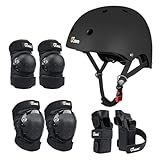
- Suitable for kids 8-14 years old
- The package includes knee pad x 2; elbow pad x 2; wrist guard x 2; helmet x 1
- The skateboard helmet is designed with multiple vent, adjustable dail and adjustable strap for proper fit
- Knee elbow pads and wrist guards are made of durable, soft EVA padded material with tough plastic plates
- Appropriate for inline skating; roller skating; skateboarding; scootering; skating and other outdoor sports
A scooter that briefly reaches 60 mph may not hold 60 mph uphill, into a headwind, with a 200-pound rider, carrying luggage, or with a passenger. Comfortable cruising speed is lower than maximum speed. Acceleration reserve matters because it lets you merge, clear a blind spot, or respond to traffic without operating at the engine’s limit.
A practical road-speed guide
- Urban streets: Every scooter on the main shortlist is appropriate when properly licensed and ridden.
- 50-to-55-mph roads: Most of these scooters can be workable, depending on rider weight, hills, wind, traffic, and the specific machine’s condition.
- 60-to-65-mph roads: Capability becomes model- and rider-dependent. Test the actual route if possible, and do not confuse a brief peak speed with a safe cruising margin.
- Interstates and freeways: Usually a poor fit for sustained use, especially with fast traffic, strong wind, steep grades, or a passenger. A 250cc-to-400cc scooter is normally the more appropriate tool.
Independent road tests can add useful real-world context, but they should not be mixed with manufacturer figures as if they were the same measurement. Examples include a GPS-tested Buddy 170i review, a GPS-tested Piaggio Liberty 150 review, and a Honda ADV160 road review.
Windows Errors? Fix Them Before They Spread
Repair common Windows errors and clear accumulated junk for a smoother, more stable PC - no reinstall needed.Free scan · no reinstallCrashes, No Sound, or Screen Glitches?
Random freezes, missing sound and display glitches usually trace back to one bad driver. Find and replace yours safely.Free scan · under a minuteCan a 150cc scooter use the freeway?
Answer this in three separate parts:
- Is it legal? That depends on your state, the specific road, and sometimes the vehicle’s classification or minimum-speed rules.
- Can it reach the posted speed? That depends on the model, rider, load, grade, wind, and mechanical condition.
- Is it a comfortable and safe choice with reserve power? For regular freeway use, often no.
Federal classification does not settle the operating question. NHTSA describes a two- or three-wheeled powered vehicle with a seat or saddle as a motorcycle for federal classification purposes, but states determine licensing and operating rules and do not all use the same definition of scooter. Genuine’s expressway warning is especially relevant: exceeding 60 mph is not the same as being suited to long periods at 65 mph.
If a 150-class scooter is your only transportation, choose routes with a meaningful speed margin, avoid roads where traffic routinely travels much faster than the limit, and do not assume the scooter’s top speed makes it appropriate for the interstate. If freeway travel is a regular requirement, shop the next class up before buying.
Does a 150cc scooter require a motorcycle endorsement?
In the U.S., assume that a 150cc scooter requires motorcycle licensing, registration, and insurance unless your state’s DMV explicitly says otherwise. The 50cc moped exemption found in some states generally does not apply to a 150cc scooter.
NHTSA notes that motorcycle licensing rules vary by state. Before taking delivery, check your state’s DMV for:
- Motorcycle endorsement or motorcycle license class requirements.
- Learner-permit restrictions and required training.
- Passenger restrictions.
- Daylight, road, or engine-size restrictions.
- Title, registration, and plate requirements.
- Minimum insurance coverage.
- Helmet and eye-protection rules.
- Whether the scooter may use a particular freeway or limited-access road.
California illustrates the problem: its DMV separately discusses motorcycles, motor-driven cycles, and motorized scooters. Do not apply California’s categories to another state, and do not generalize another state’s 50cc rule to a 150cc scooter. Use the California DMV page only as an example of why local verification matters.
Is ABS worth paying for?
Yes. ABS should be one of the first filters in a purchase decision, not an afterthought. An IIHS fleet study found that motorcycles equipped with optional ABS had a statistically significant 22% lower rate of fatal crash involvement per 10,000 registered vehicle years than the same models without ABS. That is an observed association, not a promise that ABS prevents every crash or reduces every rider’s risk by exactly 22%.
ABS helps prevent wheel lock during hard braking, especially when traction changes or a rider brakes abruptly. It cannot fix worn tires, excessive speed, slick painted surfaces, poor technique, following too closely, or a road hazard that leaves no stopping distance.
ABS configurations in this group are not equivalent:
- Front-wheel ABS: Honda PCX, Honda ADV160, Vespa Primavera, and Piaggio Liberty examples.
- ABS on both wheels: Kymco Like 150i ABS.
- Front ABS with rear hydraulic disc: Kymco People S150i ABS; verify whether the exact version has rear ABS before calling it dual-channel.
- Not published: ABS is not listed on the current Genuine Buddy 170i product page, so confirm directly rather than assuming it is equipped.
For buyers comparing similarly priced scooters, dual-wheel ABS is a meaningful reason to favor the Like. For buyers prioritizing ride quality and dealer support, the PCX or ADV160 may still be the better overall choice despite front-only ABS.
Sources: IIHS study bibliography and IIHS study summary.
12-inch, 14-inch, or 16-inch wheels: which is better?
No wheel size is universally best. The correct choice depends on your roads, parking, body size, and preference for compactness versus composure.
- 10-to-12-inch wheels: Compact, light, and often lively at low speed. They can be more sensitive to potholes, grooves, railroad crossings, and broken pavement. The Buddy has 10-inch wheels; the Like and Primavera use 12-inch wheels.
- 14-inch wheels: A strong compromise for city and suburban use. The PCX and ADV160 use a 14-inch front wheel and retain a relatively manageable scooter footprint.
- 16-inch wheels: Often calmer over pavement defects and road irregularities. The People S and Liberty use large 16-inch front wheels, but their longer, taller layouts can feel less compact in tight parking spaces.
Wheel diameter is only one part of ride quality. Tire profile, suspension travel, wheelbase, chassis stiffness, tire condition, and rider weight all matter. A well-maintained 12-inch scooter can ride better than a neglected large-wheel machine.
Quick wins for a faster PC:
Repair Windows errors before they cause bigger problemsFix Now →Scan for outdated or missing drivers - takes under a minuteDriver Scan →Clear out junk files and repair common Windows errorsFree Scan →Air-cooled or liquid-cooled?
Liquid cooling on the Honda PCX and ADV160 provides tighter temperature control under sustained load and hot-weather traffic. It also adds a radiator, coolant, hoses, and related maintenance items.
Air cooling on the Kymco Like, Kymco People S, Piaggio Liberty, Vespa Primavera, Genuine Buddy, and SYM examples is simpler and lighter and is generally well suited to urban use. It does not mean those scooters are inadequate; it means sustained high-load riding deserves more realistic expectations.
Neither system automatically determines reliability. Maintenance quality, correct oil, clean filters, proper valve adjustment, intact cooling components, and appropriate use matter more than a simplistic air-versus-liquid label.
Rank #4

- 【PERFECT GIFT CHOICE】: Great holiday gifts for your boys and girls! It's great gift ideas from parents to children, grandparents to grandchildren, or aunt uncle to niece nephew as birthday gifts, Children's Day gift, Christmas gift, birthday gift and other festival gift. Child will be overjoyed when he/she receive your present!
- 【DOUBLE ADJUSTMENT HELMET】: Our helmets are 2 sizes available for kids aged 2 and older. By twisting the adjustable dial buckle, you can change the size of the helmet head circumference from 48cm to 54cm(size S), 54cm to 58cm(size M). By changing the length of the chin strap, maximize the best fit and comfortable wearing.
- 【HIGH-QUALITY KIDS BIKE HELMET】: The Helmet is the perfect choice for the protection of your child and toddler’s head. our helmets provide good head protection for kids when they are in multiple sports. Comfortable soft lining and 11 ventilation holes design, well avoid kids away from sweat, hot and stuffy.
- 【Wonderful Material】: This small kids protective gear set is adopted anti-scratch high hardness PE shell padded with Soft EVA material. SAFETY, WASHABLE!Those high-quality liners are not only durable for many years, but also breathable. Adopted ventilate fabric to keep cool and kids' safety protection when they are riding bikes, ice rolling, cycling, skateboard, biking, scooter, or skating, etc sports. Our goal is to keep our kids away from hurt and more enjoy the outdoor sports.
- 【7 IN 1 PROTECTIVE GEAR FOR TODDLER TO KIDS】: Provided 1 storage bag including 1 kids toddler helmet, 2 knee pads, 2 elbow pads, and 2 wrist guards. It is easy to carry the kids protective gear set with you for any other outside activities.It includes everything all kids' need for protection and to wear the pads. Not only SAFETY but with all protective elements for babies, toddlers, kids.
Storage: will it carry your helmet and daily gear?
Storage claims need careful interpretation. A compartment that accepts a small open-face helmet may not accept a full-face helmet. The helmet may need to be placed at a particular angle, and storage capacity changes once you add rain gear, a laptop, groceries, a lock, or a passenger’s equipment.
Free tools Windows power users keep installed
One-click scans. No signup required.
- Honda PCX: Honda lists a 27-liter-class weatherproof main compartment.
- Honda ADV160: Honda lists 27 liters under the seat plus a 2-liter front compartment.
- Kymco Like: Underseat storage plus a lockable glove box with USB.
- Kymco People S: Kymco says the underseat compartment fits a full-face helmet.
- Piaggio Liberty and Vespa Primavera: Confirm fit with your actual helmet; do not assume every full-face shell will fit.
- Genuine Buddy: Check the actual scooter with your helmet and cargo because compact dimensions limit flexibility.
Also inspect whether the manufacturer offers a factory top case, whether it needs a rack or accessory bracket, and whether adding a top case changes the permitted load or passenger arrangement. The PCX page, ADV160 page, People S page, and Like page provide the published storage claims.
Rider fit: shorter, taller, and heavier riders
For shorter riders
Published seat height is only a starting point. The relevant measurement is how wide and supportive the front of the seat is, where the floorboard sits, and how easily you can place a foot down while stopped.
- Honda PCX: 30.1 inches.
- Honda ADV160: 30.7 inches.
- Vespa Primavera: about 30.9 inches.
- Piaggio Liberty: under 790 mm, approximately 31 inches.
- Kymco Like: 31.1 inches.
- Kymco People S: 31.5 inches.
A narrow 31-inch seat can be easier to manage than a wide 30-inch seat. Sit on the actual scooter wearing riding shoes, reach the bars at full steering lock, operate the center stand, and practice moving it backward before purchasing.
For tall or heavy riders
Do not recommend a scooter to a larger rider based only on displacement. Check the manufacturer’s combined rider-and-passenger weight limit, seat-to-floorboard relationship, knee angle, handlebar reach, windscreen height, wheelbase, suspension preload, tire-load rating, and luggage restrictions.
Outdated Drivers Are Slowing You Down
One free scan finds every outdated or missing driver and matches the right update for your exact hardware.Free scan · exact hardware matchPC Slower Than It Used to Be?
A free scan shows the junk files, broken settings and background clutter dragging Windows down - then fixes them in one click.Free scan · Windows 10 & 11A 150cc scooter may be mechanically capable of carrying a large rider yet still feel slow in headwinds, on hills, or with a passenger. If your routes include grades, fast traffic, or regular two-up travel, a 250cc-to-400cc scooter may be the more comfortable and safer purchase even if the smaller scooter is easier to park.
Can two people ride a 150cc scooter?
Many of these scooters have a passenger seat and footpegs, but that does not make every one a good regular two-up vehicle. Confirm the combined weight capacity, passenger-seat length, tire-load rating, rear-shock adjustment, braking performance, and acceleration under load. A passenger can turn a scooter that feels adequate alone into one that struggles to maintain speed on a hill or in wind.
Use the manufacturer’s load information for the exact model. Never infer payload capacity from engine size, a long seat, or the existence of passenger pegs. For occasional short trips on slower roads, a 150-class scooter can work. For frequent two-up commuting or fast suburban roads, step up in displacement and chassis size.
What does a 150cc scooter really cost?
The advertised price is not the out-the-door price. Start with MSRP and the published destination charge, then ask the dealer to itemize every additional amount.
| Model | Published MSRP | Published destination | Subtotal before tax and dealer fees |
|---|---|---|---|
| Honda PCX | $4,349 | $600 | $4,949 |
| Honda ADV160 | $4,499 | $600 | $5,099 |
| Kymco Like 150i ABS | $3,299 | $350 | $3,649 |
| Kymco People S150i ABS | $3,799 | $300 | $4,099 |
| Piaggio Liberty 150 | About $3,299–$3,349 on current U.S. pages | Verify | Obtain a written quote |
| Vespa Primavera 150 | $5,799; variants about $5,849–$6,149 | Verify | Obtain a written quote |
| Genuine Buddy 170i | Not clearly published on current official page | Verify | Dealer quote required |
Budget for:
- Sales tax, title, registration, plate, and government fees.
- Dealer setup, assembly, freight, documentation, and administrative fees.
- Motorcycle insurance.
- A properly fitted helmet and protective clothing.
- Top case, rack, windscreen, handguards, lock, cover, or heated gear.
- Initial service, oil, brake-fluid service, tires, battery, and eventual CVT belt and roller replacement.
- Financing interest and the cost of traveling to a distant dealer.
Honda currently lists destination separately for both the PCX and ADV160. Kymco does the same for the Like and People S. Vespa’s U.S. model page lists recommended retail prices but pricing presentation and dealer charges still need verification. Piaggio’s Liberty pages currently show inconsistent pricing, which is precisely why the written quote matters. Do not treat MSRP as a promise of inventory or a final selling price.
Manufacturer price references: Honda PCX, Honda ADV160, Kymco Like, Kymco People S, Vespa Primavera, and Piaggio Liberty.
Independent reader supportYour contribution helps us test, update, and keep practical guides available for everyone.Maintenance and ownership support
A 150cc scooter is not maintenance-free. Its automatic transmission reduces shifting work but adds a CVT belt, variator rollers, clutch components, and a final-drive system that need inspection and eventual service.
Routine ownership items
- Engine oil and final-drive oil.
- Air filter and spark plug.
- Valve inspection where applicable.
- CVT belt, rollers, variator, clutch, and transmission-case inspection.
- Brake pads or shoes, discs, drums, and brake fluid.
- Coolant on liquid-cooled Honda models.
- Tires, tire pressure, wheel bearings, and valve stems.
- Battery, charging system, and electrical connectors.
- Steering-head bearings, suspension, fasteners, and center-stand hardware.
Do not apply one universal service interval to every 150-class scooter. Honda directs owners to the model-specific maintenance schedule. Kymco’s manual says service may need to occur more frequently in dusty conditions, high-speed riding, frequent stop-and-go use, or extreme riding. Follow the exact manual and ask the dealer how it defines severe use.
What’s actually slowing this PC down?
Pick the symptom - the matching free tool is one click away.
Ownership support is a selection criterion:
- Honda: The strongest case for broad U.S. dealer familiarity and a mature service ecosystem, although local inventory and technician expertise still vary.
- Kymco, SYM, and Genuine: These can be good choices, but the quality of the nearby dealer and the ability to obtain parts matter more when the network is less dense in your region.
- Piaggio and Vespa: Verify that a nearby dealer actually services the model and stocks routine maintenance parts rather than merely displaying the brand.
- Budget imports: The low purchase price can be offset by assembly problems, delayed parts, difficult diagnosis, weak resale value, and inconsistent warranty execution.
Use Honda’s maintenance resources and Kymco’s Like 150i manual as examples of the kind of documentation to locate before purchase.
New versus lightly used
Why buy new?
- Current emissions and safety equipment.
- Factory warranty and a known ownership history.
- Easier title and registration documentation.
- Financing availability.
- Lower probability of neglected fuel-system, tire, battery, and CVT problems.
Why buy used?
- Lower initial price and usually less depreciation.
- Access to discontinued but proven models.
- More equipment per dollar if the previous owner maintained it.
Low mileage is not proof of good condition. A scooter that sat for years may have stale fuel, a weak battery, aged tires, deteriorated seals, corroded connectors, contaminated brake fluid, or a neglected belt.
Used-scooter inspection checklist
- Ask to see a cold start; do not accept an engine that was warmed up before you arrived.
- Check for a smooth idle, clean throttle response, fuel smell, oil or coolant leaks, and warning lights.
- Move the bars slowly from side to side and feel for steering-head notchiness.
- Inspect fork tubes and seals, wheels, frame alignment, bodywork, and crash damage.
- Check tire date codes, not just tread depth.
- Inspect brake discs, pads, shoes, lines, and fluid condition.
- Test for CVT vibration, delayed engagement, clutch shudder, or unusual transmission noise.
- Request records for oil, final-drive, belt, roller, valve, brake, and tire service.
- Verify VIN, title, lien status, registration, and recall completion.
- Confirm the vehicle has a U.S.-legal VIN and the required federal certification label.
For an imported or unfamiliar model, review the NHTSA importation and certification guidance. A cheap scooter that cannot be properly titled, registered, insured, or supported is not a bargain.
Safety, weather, and road-surface realities
An automatic scooter is approachable, but it does not have the protective structure of a car. NHTSA emphasizes that motorcyclists are less visible and more exposed to crash forces than passenger-vehicle occupants. A 150cc scooter should not be treated as a low-risk substitute for a car.
Best Value

- 【Adjustable Kids Helmet Set】 The adjustable kids helmet To small size is 18.5-21.6 inches/47-55 cm, medium size head circumference is21.6-23.2 inches/ 55-59 cm,ideal for children aged 3-15 Designed for young children, boys and girls, By twisting the adjustable dial buckle,maximize the best fit and comfortable wearing Stays securely in sports during active play.
- 【Multi-Sport Protection】The Helmet is the perfect choice for the protection of your child and toddler’s head. our helmets provide good head protection for kids when they are in multiple sports. for skateboarding, cycling, BMX biking, inline & roller skating, scooter ,tricycle,Outdoor or indoor activities.
- 【High-Quality Materia】This kids protective gear set features a helmet made of high-quality ABS and shock-absorbing EPS foam.pads are constructed using of robust buffer materials,can reduce the impact effectively.high-hardness PVC shell for hard protection, and soft sponge material for impact buffering,yet comfortable in wearing.
- 【Vented & Comfortable】Helmet With 11 air vents,The ventilation design use special helmet design and breathable foam.This kids safety helmet helps reduce sweating and keep children feel cool even during intense body movement.
- 【Perfect Gift For Boys & Girls】set Includes 1 x Helmet, 2 x Elbow Pad, 2 x Knee Pad, 2 x Wrist Pad this one The kids knee and elbow pads for kids is the perfect gift on Children's Day, Christmas,Christmas etc.Perfect for any youth, girls, boys.It's a good present as a children & kids gift. If our product does not meet your current criteria, please send it back to us for a replacement .
At minimum, wear a properly fitted full-face or modular helmet meeting FMVSS 218, a motorcycle jacket, motorcycle gloves, over-the-ankle boots, abrasion-resistant pants, and eye protection if the helmet does not provide a face shield. Reflective or high-visibility elements are particularly useful at night and in poor weather. The Motorcycle Safety Foundation scooter guidance is a useful companion for new riders.
Scooters deserve extra caution on:
- Painted lane markings and arrows.
- Metal utility covers and manhole covers.
- Wet leaves, oil, and greasy intersections.
- Railroad crossings and metal bridge joints.
- Loose gravel and standing water.
- Grooved pavement and deep road repairs.
- Strong crosswinds and turbulence from trucks.
Kymco’s owner’s manual specifically warns about wet pavement, painted surfaces, manhole covers, greasy spots, railway crossings, and metal surfaces. Reduce speed, keep the scooter as upright as practical, avoid abrupt inputs, and leave more following distance. ABS is helpful, but it cannot create traction on a slick surface.
Which model should you choose?
Use this decision framework instead of treating one ranking as universal.
- Start with the road. If you ride only city streets, all of the main models can work. For 50-to-55-mph arterials, prioritize speed reserve and wind protection. For 60-to-65-mph roads or interstate use, consider a larger scooter first.
- Set an ABS minimum. Choose dual-wheel ABS if available within budget, or at least understand the limitations of front-only ABS.
- Choose wheel size for your pavement. Small wheels favor compactness; 14-inch fronts balance agility and stability; 16-inch fronts favor rough-pavement composure.
- Test the fit. Sit on the actual scooter, check reach and knee angle, put a foot down, move it backward, and try the center stand.
- Test the storage. Bring your full-face helmet, rain gear, laptop, or lock to the dealer.
- Check the dealer before the scooter. Ask who performs warranty work, whether routine parts are stocked, and how long common CVT and bodywork parts take to arrive.
- Request the out-the-door price. Compare the same list of fees, accessories, tax, registration, and destination charges.
- Match the load. Include your own weight, passenger weight, luggage, hills, wind, and traffic when judging whether 150cc is enough.
Use-case recommendations
- Most people commuting on urban and moderate suburban roads: Honda PCX160.
- Potholes, rough pavement, light gravel, and crossover styling: Honda ADV160.
- Lowest price among well-equipped mainstream choices and dual-wheel ABS: Kymco Like 150i ABS.
- Large wheels, tall windscreen, and full-face storage claim: Kymco People S150i ABS.
- Light, narrow, large-wheel Italian alternative: Piaggio Liberty 150.
- Premium design, finish, and technology: Vespa Primavera 150.
- Small, light, playful scooter with the longest listed warranty: Genuine Buddy 170i.
- Regular freeway, interstate, or frequent two-up travel: None of these is the ideal answer; shop the 250cc-to-400cc class.
Models not included in the primary ranking
A trustworthy U.S. buying guide should not mix global-market availability with local availability.
The Tool Desk
Outbyte Driver Updater FREEFix the driver behind crashes, sound loss and screen glitchesFind Drivers →Outbyte PC Repair FREEClear out junk files and repair common Windows errorsFree Scan →- Honda Zuma 125: A capable scooter, but not a 150-class model.
- Honda SH150i: Historically relevant, but not shown in Honda’s current U.S. scooter lineup.
- Yamaha NMAX 155: Important in overseas markets, but not a regular current U.S. offering.
- Lance Cabo 150: The manufacturer labels it discontinued; see the Lance model page.
- Generic TaoTao, Vitacci, X-PRO, BMS, and similar listings: These may be inexpensive, but parts, assembly quality, warranty execution, VIN documentation, emissions certification, and dealer support vary considerably. Treat them as a separate budget-import decision, not as directly equivalent to a supported Honda, Kymco, Piaggio, Vespa, Genuine, or SYM.
A manufacturer web page does not guarantee inventory at a nearby dealer. Call before traveling, confirm the exact model year, and ask whether the vehicle is U.S.-certified and serviceable through that dealer.
Bottom-line buying advice
Buy the Honda PCX160 if you want the most complete all-purpose commuter package. Pay the small premium for the ADV160 when pavement quality matters more than compactness. Choose the Kymco Like 150i ABS when value and ABS on both wheels are more important than wheel size or liquid cooling. Choose the People S150i ABS or Piaggio Liberty 150 for large-wheel comfort, and the Vespa Primavera 150 when style and finish justify its premium. The Genuine Buddy 170i is appealing for light urban fun, but its small wheels, unclear current MSRP, unpublished ABS, and conflicting speed claims require a more careful test ride.
Before signing, ride the actual scooter, bring your helmet, inspect the storage, obtain the written out-the-door price, verify the warranty and local service department, check your state’s motorcycle licensing rules, and compare the scooter’s real route—not its advertised top speed—with your transportation needs.
Frequently Asked Questions
Is a 150cc scooter enough for a beginner?
Often, yes. An automatic transmission, modest weight, and manageable dimensions can make a 150-class scooter approachable. It is still a motorcycle in traffic exposure and crash vulnerability, so take approved training, obtain the required endorsement, wear motorcycle-specific protective gear, and practice emergency braking and low-speed control.
Is 150cc enough for a 200-pound rider?
It can be adequate for city streets and moderate-speed commuting, but rider weight, hills, wind, luggage, and traffic speed reduce acceleration and speed reserve. Test the actual route and check the manufacturer’s payload limit. A 250cc-to-400cc scooter is usually more comfortable for fast roads or frequent two-up riding.
Can two people ride a 150cc scooter?
Some can legally and physically carry a passenger, but regular two-up use may leave little acceleration reserve. Confirm the combined weight limit, passenger seating, tire rating, rear suspension adjustment, and braking performance for the exact model.
Is a 150cc scooter cheaper to insure than a car?
It may be, but there is no universal result. Premiums depend on state, age, riding history, coverage, storage, theft risk, model, and annual mileage. Get an insurance quote for the exact VIN or model before using insurance savings in your budget.
Do all 150cc scooters have ABS?
No. The Honda PCX, Honda ADV160, Vespa Primavera, and Piaggio Liberty examples use front ABS; the Kymco Like 150i ABS has ABS on both wheels; the People S lists front ABS and a rear hydraulic disc; and the current Buddy 170i page does not publish ABS. Confirm the exact model and equipment.
Is a Vespa Primavera 150 worth more than a Honda PCX?
The Vespa can justify its higher price for buyers who value steel-body styling, finish, brand appeal, and premium equipment. It does not provide proportionally greater performance or freeway capability. The PCX is the more rational value-oriented commuter.
Are 150cc scooters safe in rain?
They can be ridden in rain, but traction and visibility are reduced. Slow down for painted markings, metal covers, leaves, oil, standing water, and railroad crossings; use smooth controls and extra following distance. Wear waterproof protective gear and do not assume ABS eliminates wet-weather risk.
Can a 150cc scooter ride on a 55-mph road?
Usually, many 150-class scooters can be workable on a 50-to-55-mph road, but actual performance depends on rider, load, hills, wind, traffic, and condition. A scooter that reaches 55 mph briefly may not maintain it comfortably. Test the route and check local road-access rules.
Should I buy a 125cc, 150cc, or 300cc scooter?
Choose 125cc for lower-speed urban use and maximum economy, 150cc for a useful middle ground on city and moderate suburban roads, and 300cc or similar for sustained 60-to-65-mph travel, hills, wind, or regular passengers. The correct choice is determined more by your roads and load than by engine size alone.
Recommended Free Tools
What is the best 150cc scooter for a short rider?
The published seat heights favor the Honda PCX at 30.1 inches, followed by the ADV160 at 30.7 inches and the Primavera at about 30.9 inches, but seat width and floorboard layout matter just as much. Sit on the actual scooter in riding shoes and verify that you can support it comfortably at stops.
What is the best 150cc scooter for hills?
The answer depends on hill steepness, rider weight, and traffic speed. The Honda PCX and ADV160 provide liquid cooling and a strong overall package, while Kymco publishes 13.5 horsepower for the Like and People S. For frequent steep hills or fast traffic, a 250cc-to-400cc scooter offers more useful reserve.
What is the best scooter for carrying a full-face helmet?
Honda lists 27-liter-class underseat storage for the PCX and 27 liters plus a front compartment for the ADV160. Kymco says the People S compartment accepts a full-face helmet. Fit varies by helmet shell, so bring your helmet to the dealer rather than relying only on the published capacity.
The Bottom Line
The best 150-class scooter is the one that matches your roads, load, body size, and local support—not necessarily the one with the highest displacement or top-speed claim. For most U.S. buyers, start with the Honda PCX160; move to the ADV160 for rough pavement, the Kymco Like 150i ABS for value and dual-wheel ABS, or a People S/Liberty for large-wheel comfort. Choose the Vespa Primavera for premium style and the Buddy 170i for compact fun. If freeway travel is routine, skip the 150 class and compare 250cc-to-400cc scooters instead.
Do these 3 things before closing this tab:
1Clear out junk files and repair common Windows errors2Scan for outdated or missing drivers - takes under a minute3Repair Windows errors before they cause bigger problemsQuick Recap
Product prices and availability are accurate as of the date/time indicated and are subject to change. Any price and availability information displayed on Amazon at the time of purchase will apply.