Free tools Windows power users keep installed
One-click scans. No signup required.
Neither AWD nor 4WD is a universal winner on snow and ice. Both can help a vehicle get moving by sending power to more wheels, but neither guarantees grip or shortens stopping distances. The better choice depends on the particular vehicle’s system, tires, route and conditions. For winter safety, prioritize suitable tires, lower speeds and more room to stop.
What AWD and 4WD can—and cannot—do
AWD and 4WD are ways of delivering engine power to more than two wheels. That can help a vehicle get moving when traction is limited, but it cannot create grip where the tires have little purchase. System designs and controls vary, so the badge alone does not tell you exactly how a vehicle will behave.
Subaru describes its AWD systems as operating automatically, while its 4WD comparison discusses selectable High and Low modes. Those are manufacturer descriptions, not rules for every vehicle; check the manual for the exact model you drive. Subaru’s AWD and 4WD comparison
Does 4WD help you stop on ice?
No. More driven wheels may help with acceleration, but they do not make the vehicle stop faster. Ford’s 2011 Explorer owner’s guide puts it plainly: “Although a 4WD vehicle may accelerate better than a two-wheel drive vehicle in snow and ice, it won’t stop any faster, because as in other vehicles, braking occurs at all four wheels.” The key factor remains the available tire grip, along with speed and following distance. Ford owner’s guide hosted by NHTSA
#1 Best Overall
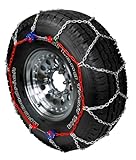
- Worry-Free Self-Tightening Ratchets Provide Automatic Tightening And Centering
- Easy Installation And Removal In Minutes
- Do Not Exceed 30 Mph With These Chains On
- Diamond Pattern Cross Chain Provides A Smoother Ride And Superior Traction
How to compare two vehicles for winter driving
Compare the vehicles’ actual equipment and likely use instead of treating AWD and 4WD as performance grades. These differences can matter more than the drivetrain label:
- System operation: Find out whether AWD operates automatically or whether the vehicle offers selectable drive modes. Confirm which modes are appropriate for the conditions in the owner’s manual.
- Low-speed control: Some 4WD vehicles offer low range for slow travel in difficult terrain. Subaru describes 4WD Low as a low-speed, higher-torque mode for uses such as steep inclines; it is not a promise of better highway performance on ice. Follow the instructions for the specific vehicle.
- Tires: Check the type, condition, size and fitment of the tires, and whether the vehicle has an appropriate complete set for winter conditions.
- Ground clearance and setup: Clearance can matter in deeper snow, but it does not replace tire grip.
- Route and exposure: Consider whether you usually drive on plowed roads or encounter unplowed snow, hills or ice, and how often those conditions occur.
- Driver inputs: Speed, following distance, and gentle steering, throttle and braking all matter on slippery roads.
There is no established universal AWD-versus-4WD winner from a controlled comparison of matched vehicles and tires. The practical answer is to compare the specific vehicles, equipment and conditions you expect to face.
Rank #2
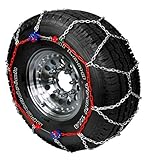
- Worry-Free Self-Tightening Ratchets Provide Automatic Tightening And Centering
- Easy Installation And Removal In Minutes
- Do Not Exceed 30 Mph With These Chains On
- Diamond Pattern Cross Chain Provides A Smoother Ride And Superior Traction
- Meets Class "S" clearance requirements, even in light truck sizes
Do you need snow tires with AWD or 4WD?
Winter tires can improve traction in snow and ice, and NHTSA says they are more effective than all-season tires in deep snow. NHTSA-hosted winter tire guidance recommends fitting winter tires on all wheel positions. Check your owner’s manual and the vehicle’s tire label for the correct tire size and specifications; the right fitment depends on the vehicle. NHTSA TireWise guidance · NHTSA-hosted winter tire bulletin
Can AWD drive in deep snow?
AWD may help a vehicle get moving, but that alone does not establish whether it can travel through deep snow. The tires, ground clearance, vehicle setup and depth and condition of the snow all matter. Do not assume AWD makes an unsuitable route safe or passable.
Rank #3
- Worry-free self-tightening ratchets provide automatic tightening and centering
- Easy installation and removal in minutes
- Do not exceed 30 MPH with these chains on
- Diamond pattern cross chain provides a smoother ride and superior traction
- Note-Chains should be fitted to tire before actual use. Fitment can be affected by age of tire, tire manufacturer and/or tread type
How to drive when roads are slick
NHTSA advises drivers to slow down and increase following distance because slick or snow-covered roads make vehicles harder to control or stop. Subaru also recommends gentle acceleration and braking, cautious turns, and using wipers and headlights to maintain visibility. These precautions apply whether a vehicle is AWD, 4WD or neither. NHTSA winter driving tips · Subaru winter driving guidance
NHTSA reports that in 2023, snow or sleet was present at the time of 320 fatal traffic crashes, an estimated 22,293 injury crashes and an estimated 101,390 police-reported crashes. The weather condition’s presence at the time of a crash does not establish that it caused that crash. NHTSA winter driving tips
Rank #4
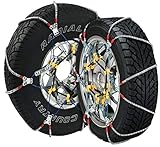
- Country of origin : China
- Designed for cars, pickups, and SUVs with very limited operating clearance around the drive tires
- Fast easy installation with no need to move the vehicle
- Designed-in rubber tightener means there is no need to stop and retighten after installation
When to use tire chains
Chains are vehicle- and fitment-specific, not universal winter equipment. Check the exact owner’s manual before buying or installing them: approved chain types, tire sizes and permitted axle positions can vary. A Tesla bulletin hosted by NHTSA, for example, says Tesla-approved chains can increase traction in snowy conditions, but its instructions apply to particular Tesla fitments—not other vehicles. Tesla chain bulletin hosted by NHTSA
Quick Recap
Best Value
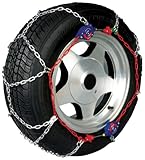
- The Right Traction Product For Your Vehicle Is Determined By Tire Size However Not All Tires Are Made The Same From One Manufacturer To Another So We Strongly Suggest Doing A Test Fit To Ensure Proper Fitment
- Easy Installation And Removal In Minutes
- Do Not Exceed 30 Mph With These Chains On
- Diamond Pattern Cross Chain Provides A Smoother Ride And Superior Traction
Product prices and availability are accurate as of the date/time indicated and are subject to change. Any price and availability information displayed on Amazon at the time of purchase will apply.




