Do these 3 things before closing this tab:
1Repair Windows errors before they cause bigger problems2Fix the driver behind crashes, sound loss and screen glitches3Clear out junk files and repair common Windows errorsThe numbers in an engine-oil grade describe two parts of its SAE viscosity classification: the number before W is the winter grade, and the number after the hyphen is the other viscosity grade. In these four labels, 5W-30 differs from 10W-30 in the winter grade; 10W-30 differs from 10W-40 in the second grade. 20W-50 has higher-numbered grades in both positions than the others. None is automatically better or suitable for your car just because its numbers are higher or lower.
How to read the oil grades
SAE J300 classifies engine oils by rheological limits—that is, viscosity-related properties. SAE International says its standard “defines the limits for a classification of engine lubricating oils in rheological terms only. Other oil characteristics are not considered or included.” The current listing is SAE J300_202405, revised May 9, 2024. The grade label therefore does not tell you an oil’s complete performance, formulation, or vehicle suitability.
The W stands for winter. Read a multigrade label as two grade designations, rather than as a direct statement that the oil is one exact viscosity when cold and another when hot. A lower number before W indicates a different winter grade; the number after the hyphen identifies the other SAE grade. The standard listing does not provide its full numerical requirements, so the labels alone should not be used to infer specific test thresholds or an exact operating-temperature range.
How the four grades compare
| Grade | Winter grade | Second SAE grade | What changes in this comparison |
|---|---|---|---|
| 5W-30 | 5W | 30 | Compared with 10W-30, the winter grade differs; the second grade is the same. |
| 10W-30 | 10W | 30 | Compared with 10W-40, the winter grade is the same; the second grade differs. |
| 10W-40 | 10W | 40 | Compared with 10W-30, the second grade differs. |
| 20W-50 | 20W | 50 | Both numbers are higher than the corresponding numbers on the other three labels. |
This is a comparison of grade labels, not a ranking of oil quality or a recommendation based on climate, engine age, or condition. Oils carrying the same SAE grade can still differ in formulation, service category, and approvals.
#1 Best Overall
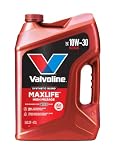
- Formulated for engines with 75,000 miles or more, Valvoline MaxLife High Mileage synthetic blend is formulated with seal conditioners to help prevent oil leaks and reduce oil consumption
- Delivers 20% better wear protection and 15% better sludge defense than industry standards to help prevent engine breakdown
- Extra detergents safeguard against friction, corrosion and deposits to keep high-mileage engines clean
- Advanced friction-fighting additives help maximize performance and improve fuel efficiency
- Provides performance benefits for high mileage, new and re-built engines alike
What the grades mean for common comparisons
5W-30 versus 10W-30
Both have the same second grade, 30. Their winter grades differ: 5W versus 10W. The grade labels do not, by themselves, establish which one your vehicle requires.
10W-30 versus 10W-40
Both carry the 10W winter grade; the second grade changes from 30 to 40. This is a difference in SAE viscosity classification, not proof that one oil is universally safer, better, or an acceptable substitute.
Rank #2

- Helps extend engine life, even in severe conditions
- Protects for 15,000 miles – guaranteed*
- Contains additives to help fight sludge
- Keeps your engine running like new
20W-50 versus the other three
20W-50 has higher-numbered grades in both positions than 5W-30, 10W-30, and 10W-40. That label comparison alone does not make it the right choice for a hot climate, an older engine, or any particular car.
Viscosity grade is not the whole oil specification
SAE viscosity and API service category answer different questions. API describes engine-oil performance categories and certification separately from viscosity classification; its licensing system covers performance categories and API marks. An oil can match a requested viscosity grade without that fact alone establishing that it meets the required performance category or a vehicle maker’s approval.
Rank #3

- High Mileage for engines 75,000+ miles
- Helps extend engine life of higher mileage vehicles
- Protects for 15,000 miles – guaranteed*
- Contains additives to help fight sludge
- Keeps your engine running like new
API states that API SP can provide full protection where a manual calls for API SN. It also distinguishes FA-4, which applies to certain XW-30 diesel oils and select applications. Do not treat these categories as interchangeable across every engine: follow the vehicle maker’s stated requirements for your engine and application.
How to choose oil for your car
- Check the owner’s manual. Find the recommended viscosity grade for your vehicle and the conditions or applications the manual specifies.
- Check the required performance category. Match the API service classification or other performance requirement stated by the manufacturer; an SAE grade by itself is not enough.
- Check for a required builder approval. ExxonMobil’s January 2026 U.S. Mobil Special product data sheet advises: “Always check your owner’s manual for the manufacturer’s recommended oil viscosity grade, API service classification and any builder approval.”
- Compare the product label or data sheet with all of those requirements. Do not choose a substitute based only on a higher or lower number, the weather, or engine age.
Example: typical viscosity figures for one product line
ExxonMobil’s January 2026 U.S. Mobil Special product data sheet lists all four grades discussed here. For those specific formulations, it reports the following typical kinematic viscosity at 100°C:
Rank #4

- SAE 10W-30 MOTOR OIL FOR SMALL ENGINES: One 32 fl oz bottle of STP Premium Synthetic Blend 4 Cycle Small Engine Oil SAE 10W-30, formulated for small engines in lawnmowers, generators, tractors, snow blowers, and other outdoor power equipment
- FIGHTS THERMAL BREAKDOWN: Antioxidants fight thermal breakdown to enhance oil durability, helping the SAE 10W-30 oil handle high temperatures without losing its effectiveness
- PREVENTS BUILDUP: Detergents help keep small engine components clean and control carbon deposits, preventing buildup that can affect performance and start-up
- HOW TO USE: Use it as a lawnmower oil, generator oil, or for other small engines commonly used outdoors; simply check the oil and change as necessary per the owner's manual
| Mobil Special grade listed | Typical kinematic viscosity at 100°C |
|---|---|
| SAE 5W-30 | 10.3 mm²/s |
| SAE 10W-30 | 10.3 mm²/s |
| SAE 10W-40 | 15.7 mm²/s |
| SAE 20W-50 | 19.5 mm²/s |
These are manufacturer-reported typical properties for the listed Mobil Special formulations, not universal values or limits for every oil carrying those grades. ExxonMobil says typical properties are not specifications and that normal manufacturing and blending variations may occur.
Quick Recap
Best Value

- Advanced protection against the four main causes of engine breakdown: wear friction heat and deposits
- Delivers 40% stronger wear protection than industry standards to reduce friction and improve fuel economy
- Provides 15% better deposit defense vs. industry standards, keeping engines cleaner for smoother performance and longer-lasting protection
- Up to 2.5X better heat protection vs. industry standards to fight harmful sludge formation and thermal breakdown
- Engineered for excellent low-temperature flow, reducing metal-to-metal contact during cold starts — when most engine wear typically occurs
Product prices and availability are accurate as of the date/time indicated and are subject to change. Any price and availability information displayed on Amazon at the time of purchase will apply.




