Recommended Free Tools
For 2026, the Toyota Camry is a hybrid-only sedan, while the Hyundai Sonata lineup also offers gas-powered models and the performance-oriented N Line. If you want a hybrid, start by comparing the Camry LE Hybrid with the Sonata Blue Hybrid: both are listed at 51 mpg combined, the Sonata’s listed starting MSRP is $400 lower, and the Camry has the higher listed horsepower figure. Neither price nor horsepower alone settles which is the better buy; your choice depends on the actual dealer quote, equipment, warranty priorities and how well each car fits your passengers and cargo.
The broader Toyota Camry vs. Hyundai Sonata decision is less about finding one universal winner and more about choosing the right kind of sedan. The Camry simplifies the lineup around hybrid power. The Sonata gives shoppers more powertrain choices, including a lower-priced gas model and an N Line. For a fair hybrid comparison, focus on similarly positioned trims, confirm what each actual vehicle includes, and treat published prices and fuel-economy estimates as starting points rather than promises.
As an Amazon Associate I earn from qualifying purchases.
How the 2026 lineups differ
The main distinction is powertrain choice. Toyota presents the 2026 Camry as a hybrid model. Hyundai’s 2026 Sonata range includes conventional gas trims, hybrid trims and the N Line. That gives the Sonata a lower advertised gas-model entry point as well as a performance-oriented option that the Camry lineup does not mirror.
For a like-for-like efficiency comparison, the most useful starting point is the Camry LE Hybrid versus the Sonata Blue Hybrid. Other Sonata trims may suit different budgets or priorities, but their figures should not be treated as interchangeable with the Blue Hybrid’s. Hyundai lists both Blue and SEL Hybrid versions, and their fuel-economy ratings differ. The Sonata gas SE and N Line are different kinds of alternatives, not direct equivalents to the two entry hybrid trims.
#1 Best Overall
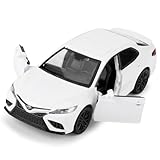
- [Product Size] 4.9×1.9×1.5 inches(1:36 scale). Package weight: Approx. 0.37 pounds. Suitable for playing.
- [Good Quality] Detailed interior and exterior trim, using high grade alloy die-cast into form.
- [Great Diecast Toy Car] Made of non-toxic paint spray, doesn’t contain harmful substances, protecting the safety of children greatly.
- [Funny Pull Back Car Model] Left and right doors can be opened. Place the car on the ground, press down on the body and pull it back, the car will move forward.
- [Awesome Toy for Kids] Sturdy body, fine workmanship. Suitable for collections, birthdays, Christmas and decorations. Great for kids, boys, girls and adults.
This lineup difference matters before you compare any individual specification. A shopper who wants a conventional gasoline engine or specifically wants an N Line can investigate the Sonata range; there is no equivalent gas-only Camry choice in the 2026 lineup described here. Conversely, if you have already decided that your next sedan must be a hybrid, begin with the two hybrid trims that Toyota’s comparison page places side by side. Then consider whether another trim’s equipment or price makes it a better fit for your own needs.
Camry LE Hybrid vs. Sonata Blue Hybrid: the published figures
The following figures are manufacturer-published information for the 2026 U.S. models. Fuel economy is estimated, not a promise of what an individual driver will achieve. Starting MSRPs are not out-the-door prices.
| Measure | 2026 Toyota Camry LE Hybrid | 2026 Hyundai Sonata Blue Hybrid |
|---|---|---|
| Starting MSRP listed on Toyota’s comparison page | $29,600 | $29,200 |
| EPA-estimated fuel economy | 51 mpg combined, as listed by Toyota | 47 city / 56 highway / 51 combined mpg, as listed by Hyundai |
| Horsepower listed on Toyota’s comparison page | 225 hp | 192 hp |
| Cargo capacity listed on Toyota’s comparison page | 15.1 cu. ft. | 16.0 cu. ft. |
| Front and rear legroom | Measurements are listed separately by row; check the exact trim figures on Toyota’s comparison page. | Measurements are listed separately by row; check the exact trim figures on Toyota’s comparison page. |
The MSRP comparison comes from Toyota’s Camry-versus-Sonata page, which lists the selected trims side by side. Hyundai’s separate specifications page warns that displayed MSRP excludes freight, tax, title and license, and that dealer prices and availability can vary. Ask for a current, itemized quote for the exact car and market rather than treating either starting price as the amount you will pay.
Quick wins for a faster PC:
Repair Windows errors before they cause bigger problemsFix Now →Fix the driver behind crashes, sound loss and screen glitchesFind Drivers →Clear out junk files and repair common Windows errorsFree Scan →The table is useful for narrowing a shopping list, but it does not establish that every vehicle on a dealer lot has the same equipment, price or availability. Toyota’s comparison gives a side-by-side baseline for the selected models; Hyundai’s specifications page provides trim-specific information and its own pricing caveats. Check current manufacturer pages and dealer listings for the vehicle you can actually buy. Model-year pricing, incentives and availability can change.
There is also an important source detail in the fuel-economy figures. Toyota’s comparison table presents the Sonata Blue Hybrid at 47 city, 56 highway and 51 combined mpg, while a separate sentence on that page appears to show the 44/51/47 figures associated with Hyundai’s SEL Hybrid. Hyundai’s own trim-labeled figures distinguish the two: Blue is 47/56/51 and SEL is 44/51/47. Use those labeled ratings rather than accidentally assigning the SEL rating to the Blue.
Which one is more fuel-efficient?
For the two highest-efficiency hybrid trims cited here, the published combined estimate is a tie at 51 mpg: Toyota lists that figure for the Camry LE Hybrid, and Hyundai lists 47 city, 56 highway and 51 combined mpg for the Sonata Blue Hybrid. Hyundai also lists the Sonata SEL Hybrid at 44 city, 51 highway and 47 combined mpg. Trim matters: the Blue Hybrid’s rating should not be assigned to the SEL Hybrid.
These are manufacturer/EPA estimates, not guaranteed results. Driving style, conditions and other factors affect real-world fuel use. Use the ratings to narrow the comparison, then consider the routes you drive and compare the exact trims available to you. A combined rating is a useful common reference, but it does not tell you exactly what you will see on your commute, on a long highway trip or in changing conditions.
Free tools Windows power users keep installed
One-click scans. No signup required.
If efficiency is the main reason you are considering these sedans, make sure the comparison stays between the relevant hybrid trims. The Sonata’s gas SE may have a lower starting price, but its powertrain is different, so its price should not be compared with a hybrid as though both vehicles had identical operating costs. The available figures do not establish a personalized fuel-cost difference or a payback period. To estimate your own costs, use the ratings for the exact trims you are considering and your own driving pattern rather than assuming the lower starting price automatically means the lower total cost.
It is also worth separating a published rating from a buying decision. The two cited entry hybrid trims share the same listed combined estimate, while the Camry has the higher listed horsepower and the Sonata Blue has the lower listed starting MSRP. Those facts make the tradeoffs clear, but they do not say how each vehicle will feel to you or what a dealer will charge. A test drive and current local quotes remain part of the comparison.
Rank #2

- High-Quality Materials:The camry die-casting car is made of zinc alloy, plastic parts and rubber tires, the body is strong and impact-resistant, both sides of the door can be opened to show the details of the simulation of equal proportions to restore the real feeling of the real car;
- Pull Back Function: Our camry toy car's rear wheels have strong rebound force, so there is no need for batteries, simply pull the car back and release your hand, and the car will travel a long distance, providing a great sense of play and being very attractive to children;
- Size Perfect: 1/36 Scale just as much as an adult's palm,the camry toy model vehicle is a perfect option for to play with and carry, it is also an ideal desktop or shelf display item for car collectors. Size: 4.8 * 1.9 * 1.2 inches;
- Growth in Games: Help children learn more about cars, expand their knowledge, and improve their hand eye coordination and reaction speed in games. Enable children to experience the joy of playing games with the company of their parents and promote parent-child relationships;
- Best Gift: LOVEPOSELY Die Casting Model Car is a great stress relieving toy for adults in the office. For children, it is also a perfect Christmas, birthday, Children's Day, New Year gift, etc;
What the price difference does—and does not—tell you
On Toyota’s comparison page, the Sonata Blue Hybrid’s listed starting MSRP is $29,200, compared with $29,600 for the Camry LE Hybrid—a $400 difference in those advertised figures. That is a useful starting point, not proof that the Sonata will cost less to buy in your area. Freight or delivery charges, dealer pricing, current incentives, availability and the equipment on the specific vehicle can change the transaction price.
The Sonata SE gas model has a lower published starting MSRP of $27,450 on Hyundai’s specifications page. This makes it the relevant Sonata option for shoppers focused on the lowest advertised entry price, but it is not a powertrain-matched comparison with either hybrid. Consider expected fuel use and included equipment alongside the initial price before deciding which car is less costly for your needs.
Think of the three prices as answers to different shopping questions. The $27,450 figure identifies the cited starting point for a gas Sonata SE. The $29,200 and $29,600 figures compare the Sonata Blue Hybrid and Camry LE Hybrid on Toyota’s comparison page. They are not a complete ranking of all Sonata and Camry trims, nor are they dealer quotes. A buyer choosing among them should first decide whether the gas or hybrid powertrain is appropriate, then compare the exact trim and equipment at the prices available locally.
Hyundai’s specifications page specifically says its displayed MSRP excludes freight, tax, title and license, and notes that dealer prices and availability may vary. The comparison therefore should not be used as an out-the-door budget. Ask the dealer to identify the price of the vehicle, delivery or freight charges, dealer-added items and applicable incentives separately. That makes it easier to tell whether an apparent difference comes from the car itself, the quote, or the terms of an offer.
Get comparable dealer quotes
- Choose the exact trim and powertrain you want to compare: for hybrids, begin with Camry LE Hybrid and Sonata Blue Hybrid.
- Request an itemized quote for each available vehicle, including delivery or freight charges and dealer-added items.
- Ask which current incentives apply to you and how long they remain available.
- Compare the equipment on the quoted vehicles, not just the trim names or starting MSRPs.
Keep the comparison within the same market and timeframe. A quote for one car with a current incentive should not be compared with an older advertised price for another. If a dealer does not have your preferred trim, ask whether the quote is for an in-stock vehicle or a different configuration. No current official listing in this comparison verifies any incentive or destination charge for a particular location, so those details need to come from the current dealer quote.
Does the Camry’s horsepower advantage make it quicker?
Toyota lists 225 hp for the Camry LE Hybrid and 192 hp for the Sonata Blue Hybrid on its comparison page. That gives the Camry the higher published horsepower figure for these trims, but horsepower alone does not establish acceleration, handling or driving enjoyment. The cited figures do not provide a controlled performance comparison.
If how a car drives matters to you, test-drive the exact trims you are considering. Try both in the conditions that matter most—such as stop-and-go traffic, highway merging and parking—rather than inferring the experience from one specification.
Use the horsepower comparison as one piece of information, not as a substitute for an evaluation. It tells you which of these two listed trims has the larger published figure; it does not establish which one feels more responsive in a particular situation or is more enjoyable to drive. The Sonata N Line is a separate performance-oriented choice in Hyundai’s broader range, but no matched performance test or enough figures are available here to rank it against the Camry on acceleration or handling.
On a test drive, take time to use the controls and seating position as well as driving the route. If possible, drive both cars close together in time and on similar roads so your impressions are easier to compare. Consider whether visibility, parking ease and the way each car fits your routine matter more than a specification difference. No road-test result in this comparison represents comparative test data, so your own test drive is the appropriate next step.
Rank #3

- [Product Size] 4.9×1.9×1.5 inches(1:36 scale). Package weight: Approx. 0.37 pounds. Suitable for playing.
- [Good Quality] Detailed interior and exterior trim, using high grade alloy die-cast into form.
- [Great Diecast Toy Car] Made of non-toxic paint spray, doesn’t contain harmful substances, protecting the safety of children greatly.
- [Funny Pull Back Car Model] Left and right doors can be opened. Place the car on the ground, press down on the body and pull it back, the car will move forward.
- [Awesome Toy for Kids] Sturdy body, fine workmanship. Suitable for collections, birthdays, Christmas and decorations. Great for kids, boys, girls and adults.
How their warranty and maintenance benefits differ
These coverage packages protect different things, so comparing only the number of years can be misleading. Hyundai advertises a 10-year/100,000-mile powertrain limited warranty, subject to terms. Toyota’s 2026 brochure lists 10-year/150,000-mile hybrid battery coverage, whichever comes first, as well as ToyotaCare scheduled maintenance for 2 years/25,000 miles, whichever comes first. Toyota separately lists roadside assistance for 2 years with unlimited mileage.
What’s actually slowing this PC down?
Pick the symptom - the matching free tool is one click away.
Before purchase, read the warranty booklet that applies to the vehicle and confirm eligibility, exclusions and any transferability terms. A powertrain warranty and a hybrid-battery warranty are different categories of coverage; neither description alone answers every question about a particular repair or owner.
For a practical comparison, write down which benefit you are trying to value. Hyundai’s advertised powertrain warranty is a powertrain coverage statement. Toyota’s cited 10-year/150,000-mile term applies to the hybrid battery, while ToyotaCare is scheduled maintenance with a separate time-and-mileage limit. Toyota’s roadside assistance is another separate benefit, listed for 2 years with unlimited mileage. These are not three versions of the same warranty, and they should not be reduced to a simple contest over which brand offers “more years.”
Ask what the terms mean for the specific vehicle and buyer. The published warranty information cautions that eligibility and exclusions should be checked in the applicable documents; it does not establish that every warranty benefit transfers in the same way or covers every owner under identical conditions. Read the booklet before relying on a headline term, especially if you are buying a vehicle that has already had a prior owner or if you expect to keep the car for many years.
Likewise, ToyotaCare’s scheduled service coverage should not be mistaken for a complete estimate of all maintenance or repair costs over ownership. The cited brochure gives its duration and mileage limit, but no lifetime ownership-cost comparison between the Camry and Sonata is provided here. Treat the listed benefits as factors to verify, not as proof that one sedan will necessarily cost less to maintain.
Passenger and cargo fit: check the exact car
Toyota’s comparison lists 16.0 cu. ft. of cargo capacity for the Sonata Blue Hybrid and 15.1 cu. ft. for the Camry LE Hybrid. The cited figures favor the Sonata on capacity, but a volume measurement cannot show whether a particular stroller, suitcase or bulky item will fit easily. Load the kinds of items you regularly carry if possible.
The comparison also presents front and rear legroom measurements separately. If you often carry adults in the back, bring them along for a test sit in the exact trims. Parents should check a child seat’s installation and the space left for front-seat occupants; the published measurements cannot replace trying your own seat and seating positions.
The listed cargo difference is 0.9 cu. ft. in favor of the Sonata Blue Hybrid. That is a comparison of published capacity, not a guarantee that every shape of luggage will fit better in the Sonata. A wide item, a tall item or a stroller with a particular folded shape may interact differently with a trunk opening and interior layout than its volume suggests. If cargo fit matters, bring the item or a close substitute to the dealership and try it in the actual trim.
Seat comfort is similarly personal. Published front and rear legroom figures are separate measurements, so do not rely on a single overall impression of cabin space. Sit in both the front and back, adjust the driver’s seat to your position, and check where a rear passenger’s knees and feet fall. If the sedan will regularly carry adults or children, testing the full seating arrangement is more useful than comparing a single dimension in isolation.
Rank #4

- Toyota Camry - 32459D Showcasts Model Vehicle
- 1/34 Scale Collectible Model Mid-size Compact Car
- This is a 5.625"L x 2.25"W x 1.625"H Diecast Metal model with some plastic parts
- Openable Doors And Pullback Action
- 1 car, no box
For families, test the child seat you use and confirm that it can be installed in the configuration you need. Also check whether the front passenger or driver can sit comfortably once the child seat is in place. No specific child-seat fit verdict for either sedan is provided here; check your own seat in the exact car rather than assuming the published legroom figures answer the question.
Safety ratings and equipment: verify before choosing
The available comparison does not establish a complete, independently verified set of 2026 IIHS and NHTSA ratings for both cars, nor whether every rating applies across all trims. Do not infer a safety winner from the specifications above. Check the current rating records for the exact model year and confirm that any rating covers the trim or configuration you plan to buy.
Also compare the actual safety, infotainment and comfort equipment on the vehicles in your quotes. Feature availability can differ by trim, and the starting MSRP alone does not tell you whether two cars have equivalent equipment.
Make that equipment check concrete. Compare the safety and convenience features listed for each exact trim and vehicle, then confirm what is installed on the car you would buy. A trim name and a starting price are not enough to establish that two vehicles are similarly equipped. If a feature is important to you, verify its availability on the specific vehicle rather than assuming that it is standard across the whole model range.
Outdated Drivers Are Slowing You Down
One free scan finds every outdated or missing driver and matches the right update for your exact hardware.Free scan · exact hardware matchWindows Errors? Fix Them Before They Spread
Repair common Windows errors and clear accumulated junk for a smoother, more stable PC - no reinstall needed.Free scan · no reinstallFor independent crash-safety information, use current IIHS and NHTSA records for the 2026 model year and check any configuration limitations shown with the rating. Complete records for both vehicles were not verified for this comparison, so it cannot responsibly identify a safety winner. If ratings are central to your decision, make this a required step before finalizing a purchase rather than filling the gap with assumptions based on brand or older model years.
Independent reader supportYour contribution helps us test, update, and keep practical guides available for everyone.Which one should you buy?
The evidence supports a conditional answer. If you are choosing between the cited entry hybrids, the Sonata Blue Hybrid has a $400 lower listed starting MSRP and a 51-mpg combined estimate, while the Camry LE Hybrid is also listed at 51 mpg combined and has the higher published horsepower figure. The Sonata’s listed cargo capacity is 0.9 cu. ft. greater. Those differences are useful, but none alone determines value once equipment, actual price, fit and the terms of coverage are considered.
If you are not committed to a hybrid, the Sonata’s wider lineup is more relevant: the gas SE has a lower advertised starting price than either compared hybrid, and Hyundai also offers an N Line. That breadth is an option, not a reason to assume the gas model is cheaper to own or the N Line is the right performance choice. Compare each model for the use you have in mind and confirm the equipment and price of the exact trim.
Choose the Camry as your leading candidate if…
- You are shopping for a hybrid and value the Camry’s higher listed horsepower figure among these two entry hybrid trims.
- You want to compare Toyota’s listed hybrid-battery coverage and ToyotaCare maintenance with Hyundai’s coverage on their respective terms.
- The Camry’s seating, cargo fit, equipment and dealer quote work better for your household after a test sit and drive.
Choose the Sonata as your leading candidate if…
- You want a gas-powered entry model, a hybrid or an N Line within one model range.
- You are comparing the Blue Hybrid’s $29,200 listed starting MSRP with the Camry LE Hybrid’s $29,600 figure and the Sonata’s actual local quote is more attractive.
- The Sonata’s listed cargo capacity, passenger fit, equipment or warranty terms better match your needs.
A practical hybrid-shopping shortlist
- Compare Camry LE Hybrid and Sonata Blue Hybrid first, using the same market and current, itemized quotes.
- Check the equipment on each quoted vehicle and identify any meaningful differences in safety, comfort or infotainment features.
- Test-drive both and test-fit your passengers, child seats and regular cargo.
- Read the applicable warranty documents and check the current independent safety ratings for the exact model year and configuration.
- Make the decision from the complete package—price, equipment, fit and driving experience—not a single advertised number.
If the lower advertised entry price is your first priority, add the Sonata SE to your list, but keep it in a separate comparison from the hybrids. If your priority is efficiency, begin with Camry LE Hybrid and Sonata Blue Hybrid. If you specifically want a performance-oriented model, investigate the Sonata N Line on its own terms. These paths reflect the lineup difference; they are not interchangeable versions of one comparison.
Do these 3 things before closing this tab:
1Fix the driver behind crashes, sound loss and screen glitches2Clear out junk files and repair common Windows errors3Scan for outdated or missing drivers - takes under a minuteFinally, check that the information you use is current. Manufacturer pages and brochures can change, and the source pages used for these 2026 figures were accessed on October 9, 2026. Confirm current pricing, availability, trim content and warranty language before buying. The best buy is the car that meets your powertrain preference, fits your passengers and cargo, has equipment you want, and is available on acceptable terms—not simply the one with the lowest advertised number.
Best Value

- 【Collector Car & Toy Car】The toy car with base can be used as a collector car for viewing or can be removed from the base to be used as a pull back toy car, with a variety of functions for different people.
- 【High-grade texture】 Made of zinc alloy and excellent ABS material, it is stronger and more resistant to fall than ordinary plastic. Designed according to the prototype of the RAV4 car 1:32, fully satisfying children to explore the fun of experiencing vehicles.
- 【Pull back the toy car】After removing the base,pull the toy car backwards and let go, the toy car will slide forward for some distance. Press the front of the caravan or open the door to trigger sound and light effects.
- 【Safety Guarantee】This 1/32 pull back model has passed the American Toy Standard CPC, CPSIA. safe for children over 3 years old. If you have any questions about this product, please feel free to contact us.
- 【FUN AND UNIQUE GIFT】: This toy car is the perfect educational toy gift for any kid interested in science, Construction vehicle, and more! It's the perfect gift for kids on birthdays, Christmas, Thanksgiving, Easter and more. Equally suitable for toy car collectors.
Frequently Asked Questions
Is the 2026 Toyota Camry available with a gas-only engine?
The 2026 Camry is presented as a hybrid-only model. Hyundai’s 2026 Sonata range includes gas-powered trims as well as hybrids and the N Line, so shoppers seeking a gas-only entry model have more choice in the Sonata lineup.
Should I buy a Camry Hybrid or a Sonata Hybrid?
Compare the Camry LE Hybrid and Sonata Blue Hybrid first. Both are listed at 51 mpg combined; Toyota lists 225 hp for the Camry and 192 hp for the Sonata, while the Sonata’s listed starting MSRP is $400 lower. Get current itemized quotes and compare equipment, fit and warranty terms before deciding.
Which has better fuel economy, the Camry LE Hybrid or Sonata Blue Hybrid?
The cited figures list both at 51 mpg combined. Hyundai lists the Blue Hybrid at 47 city, 56 highway and 51 combined mpg. These are estimates, not guaranteed real-world results. Hyundai lists the SEL Hybrid separately at 44 city, 51 highway and 47 combined mpg.
The Tool Desk
Outbyte Driver Updater FREEFix the driver behind crashes, sound loss and screen glitchesFind Drivers →Outbyte PC Repair FREEClear out junk files and repair common Windows errorsFree Scan →Is the Sonata cheaper than the Camry?
Toyota’s comparison page lists the Sonata Blue Hybrid at $29,200 and the Camry LE Hybrid at $29,600, a $400 difference in starting MSRP. Hyundai lists the gas Sonata SE at $27,450, but that is a different powertrain comparison. Freight, tax, title, license, dealer pricing, incentives and availability affect what you actually pay.
Does the Camry’s higher horsepower mean it is faster?
Not necessarily. Toyota lists 225 hp for the Camry LE Hybrid and 192 hp for the Sonata Blue Hybrid, but horsepower alone does not establish acceleration, handling or driving enjoyment. Test-drive the exact trims to compare how they feel.
Which car has more trunk space?
The cited figures list 16.0 cu. ft. for the Sonata Blue Hybrid and 15.1 cu. ft. for the Camry LE Hybrid. Actual fit depends on the shape of your luggage or cargo, so try your regular items in the exact car if space is important.
Which has the better warranty?
The benefits cover different things. Hyundai advertises a 10-year/100,000-mile powertrain limited warranty, subject to terms. Toyota lists 10-year/150,000-mile hybrid battery coverage, ToyotaCare scheduled maintenance for 2 years/25,000 miles, and separate 2-year/unlimited-mileage roadside assistance. Check the applicable documents for eligibility and exclusions.
Which is safer, the 2026 Camry or Sonata?
Complete 2026 IIHS and NHTSA rating records for both vehicles and how ratings apply across trims were not verified for this comparison. Check the current records for the exact model year and configuration rather than assuming a safety winner.
The Bottom Line
The Camry and Sonata are not perfectly parallel choices: Toyota’s 2026 lineup is hybrid-only, while Hyundai offers gas, hybrid and N Line versions. Among the cited entry hybrids, both are listed at 51 mpg combined; the Sonata Blue Hybrid starts $400 lower on Toyota’s comparison page, while the Camry has the higher listed horsepower figure. Compare current itemized quotes, equipment, coverage terms and real passenger and cargo fit before choosing. If your priority is a lower advertised gas-model entry point or more powertrain variety, investigate the Sonata range; if you are focused on hybrids, test-drive the Camry LE Hybrid and Sonata Blue Hybrid against your own needs.
Quick Recap
Product prices and availability are accurate as of the date/time indicated and are subject to change. Any price and availability information displayed on Amazon at the time of purchase will apply.




