The Tool Desk
Outbyte PC Repair FREEClear out junk files and repair common Windows errorsFree Scan →Outbyte Driver Updater FREEScan for outdated or missing drivers - takes under a minuteDriver Scan →For the 2026 model year, the Camry LE Hybrid is the stronger fit if you prioritize a lower listed price and better fuel economy; the Accord Sport Hybrid is the better fit if rear-seat room and trunk capacity matter more. In Toyota’s published comparison, the Camry LE Hybrid starts at $29,600 and is rated at 51 mpg combined, while the Accord Sport Hybrid starts at $33,795 and is rated at 44 mpg combined. The Accord has 2.8 cubic feet more listed cargo space and 2.8 inches more rear legroom. These are manufacturer-published figures for two specific trims, not a complete comparison of every version or an independent road test.
At a glance: the compared 2026 trims
Toyota’s 2026 Camry-versus-Accord comparison pairs the Camry LE Hybrid with the Accord Sport Hybrid. The prices are starting MSRPs, not negotiated prices or out-the-door totals; Toyota lists delivery at $1,295 for each.
As an Amazon Associate I earn from qualifying purchases.
| Specification | 2026 Toyota Camry LE Hybrid | 2026 Honda Accord Sport Hybrid |
|---|---|---|
| Starting MSRP in Toyota’s comparison | $29,600 | $33,795 |
| Delivery listed by Toyota | $1,295 | $1,295 |
| EPA-estimated city/highway/combined fuel economy, as listed by Toyota | 53/50/51 mpg | 46/41/44 mpg |
| Engine and hybrid system | 2.5-liter four-cylinder hybrid | 2.0-liter four-cylinder hybrid |
| Horsepower listed by Toyota | 225 hp | 204 hp |
| Drive configuration in the comparison | Front-wheel drive | Front-wheel drive |
| Cargo volume listed by Toyota/JATO | 15.1 cu. ft. | 16.7 cu. ft. |
| Rear legroom listed by Toyota | 38.0 in. | 40.8 in. |
| Hybrid-battery warranty listed by Toyota | 120 months/150,000 miles | 96 months/100,000 miles |
| Whole-vehicle warranty listed by Toyota | 36 months/36,000 miles | 36 months/36,000 miles |
Figures in this table are those Toyota publishes for these named trims. Check the manufacturer’s current information and the warranty booklet for the exact vehicle, market, equipment, exclusions, and terms before purchase.
The table is a starting point, not a verdict on every Camry and Accord. It compares one hybrid trim from each model, and the equipment, price, or specifications of another trim may differ. The drivetrain comparison is also specific: both cars in the table are front-wheel drive. Toyota’s broader Camry lineup information includes another drivetrain option, but that does not change what is listed for this particular LE Hybrid.
#1 Best Overall
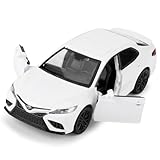
- [Product Size] 4.9×1.9×1.5 inches(1:36 scale). Package weight: Approx. 0.37 pounds. Suitable for playing.
- [Good Quality] Detailed interior and exterior trim, using high grade alloy die-cast into form.
- [Great Diecast Toy Car] Made of non-toxic paint spray, doesn’t contain harmful substances, protecting the safety of children greatly.
- [Funny Pull Back Car Model] Left and right doors can be opened. Place the car on the ground, press down on the body and pull it back, the car will move forward.
- [Awesome Toy for Kids] Sturdy body, fine workmanship. Suitable for collections, birthdays, Christmas and decorations. Great for kids, boys, girls and adults.
Price: the Camry has the lower listed starting MSRP
Toyota’s comparison puts the Camry LE Hybrid’s starting MSRP $4,195 below the Accord Sport Hybrid’s. With the same $1,295 delivery amount listed for each, the corresponding figures before taxes, registration, dealer-installed items, and other local charges are $30,895 for the Camry and $35,090 for the Accord. Those sums simply add the delivery amount shown in Toyota’s table; they are not out-the-door quotes.
Actual transaction prices can differ by location, inventory, incentives, and dealer charges. Ask for an itemized quote for the exact trim and options you intend to buy, and compare the same fee categories on both cars. Toyota’s comparison does not establish what a dealer will charge or whether a particular offer is available.
The $4,195 gap is useful as a first comparison, but it is not necessarily the difference you will pay. A starting MSRP does not tell you the price of a particular car with its options, the amount of any available incentive, or a dealer’s fees and add-ons. The delivery figure is the same in Toyota’s table for both trims, so adding it to each preserves the same gap; other charges and any negotiated price can change the final totals.
PC Slower Than It Used to Be?
A free scan shows the junk files, broken settings and background clutter dragging Windows down - then fixes them in one click.Free scan · Windows 10 & 11Crashes, No Sound, or Screen Glitches?
Random freezes, missing sound and display glitches usually trace back to one bad driver. Find and replace yours safely.Free scan · under a minuteWhen you request quotes, make sure each one is for the trim and equipment you actually want. Ask the seller to separate the vehicle price, delivery, dealer charges, optional products, taxes, and registration so you can compare like with like. If one quote includes an add-on and the other does not, the headline totals can be misleading. Toyota’s comparison supports a comparison of Toyota-listed starting MSRPs and delivery, not a prediction of what a buyer in a particular market will pay.
There is also a value question beyond the sticker amount: how much you care about the Camry’s higher listed fuel-economy rating versus the Accord’s extra listed rear legroom and cargo space. Those differences may matter more than the initial price gap to some households, but their dollar value depends on your driving and priorities. Treat the price figures as an opening filter, then decide whether the space or fuel-economy tradeoff is meaningful in your own use.
Fuel economy: the Camry leads in Toyota’s trim comparison
Toyota lists the Camry LE Hybrid at 53 mpg city, 50 mpg highway, and 51 mpg combined; the Accord Sport Hybrid is listed at 46/41/44 mpg. On those estimates, the Camry’s combined rating is 7 mpg higher. These are EPA-estimated figures as presented by Toyota, not a promise of the mileage a driver will get. Speed, weather, terrain, traffic, load, and driving style affect real-world fuel use.
There is an important trim-and-page distinction: Toyota’s separate 2026 Camry LE FWD specifications page lists 52/49/51 mpg city/highway/combined, while Toyota’s Camry LE Hybrid-versus-Accord Sport Hybrid comparison gives 53/50/51 mpg for the Camry. Keep the figures attached to their respective Toyota pages rather than treating them as interchangeable. The combined figure is 51 mpg in both listings.
Free tools Windows power users keep installed
One-click scans. No signup required.
If you drive many miles, the Camry’s higher listed rating may be meaningful, but a precise fuel-cost advantage depends on annual mileage, local fuel prices, and actual consumption. Estimate your own use rather than assuming the EPA ratings will match your commute exactly.
Rank #2

- High-Quality Materials:The camry die-casting car is made of zinc alloy, plastic parts and rubber tires, the body is strong and impact-resistant, both sides of the door can be opened to show the details of the simulation of equal proportions to restore the real feeling of the real car;
- Pull Back Function: Our camry toy car's rear wheels have strong rebound force, so there is no need for batteries, simply pull the car back and release your hand, and the car will travel a long distance, providing a great sense of play and being very attractive to children;
- Size Perfect: 1/36 Scale just as much as an adult's palm,the camry toy model vehicle is a perfect option for to play with and carry, it is also an ideal desktop or shelf display item for car collectors. Size: 4.8 * 1.9 * 1.2 inches;
- Growth in Games: Help children learn more about cars, expand their knowledge, and improve their hand eye coordination and reaction speed in games. Enable children to experience the joy of playing games with the company of their parents and promote parent-child relationships;
- Best Gift: LOVEPOSELY Die Casting Model Car is a great stress relieving toy for adults in the office. For children, it is also a perfect Christmas, birthday, Children's Day, New Year gift, etc;
The city and highway ratings show a larger listed gap in the city figures than on the highway: Toyota’s comparison gives the Camry a 7-mpg city advantage and a 9-mpg highway advantage. The combined ratings are the simplest single-number comparison for a mixed driving pattern, but your own split between city and highway miles will affect how closely those combined estimates represent your use. Neither rating says what an individual driver will achieve on a particular trip.
You can make the efficiency comparison more personal without treating the estimates as a guarantee. Use your expected annual mileage and local fuel price to estimate each car’s fuel spending, then compare the results with the price difference in the quotes you receive. The calculation needs your own inputs: mileage, price per gallon, and a realistic assumption about the fuel economy you will get. Toyota’s published comparison does not supply local gas prices or a typical annual-mileage figure, so a single savings number would not be reliable for every buyer.
For clarity, do not mix the separate Camry LE FWD page’s city and highway figures into the Camry-versus-Accord table. The comparison itself reports 53/50/51 mpg for the Camry LE Hybrid; the separate specifications page reports 52/49/51 mpg for the Camry LE FWD. Both pages give 51 mpg combined, but their city and highway figures are not identical. Keep the source and trim context attached when evaluating a listing or discussing the comparison.
Do these 3 things before closing this tab:
1Repair Windows errors before they cause bigger problems2Scan for outdated or missing drivers - takes under a minute3Clear out junk files and repair common Windows errorsPassenger and cargo space: the Accord gives more room in the back
Toyota’s comparison lists the Accord with 40.8 inches of rear legroom, compared with 38.0 inches in the Camry. The Accord also has a listed 16.7-cubic-foot cargo volume versus 15.1 cubic feet for the Camry. That makes the Accord the more promising starting point if adults regularly ride in the rear seat or you often carry luggage.
In simple terms, the listed difference is 2.8 inches of rear legroom and 1.6 cubic feet of cargo volume in the Accord’s favor. Those measurements point toward a practical advantage for passengers and luggage, but they do not tell you whether an individual occupant will find the seat more comfortable or how easily a particular item will fit through the trunk opening. Published capacity is one useful screening measure, not a substitute for trying the car with your own people and belongings.
Published dimensions do not settle comfort or loading ease. If possible, sit in both cars with the front seats set as they would be for your regular drivers. Bring a child seat, stroller, mobility aid, or typical luggage if those determine whether a sedan works for you. Check trunk opening shape and seat-folding arrangements in person; the comparison’s cargo-volume figure alone does not describe those details.
For a household that regularly carries rear-seat passengers, pay attention to the seating position behind the person who normally drives. Set the front seat where that driver needs it, then have the usual rear passenger sit behind it. The comparison’s legroom figures suggest the Accord may offer more room, but a measurement does not account for every person’s proportions, preferred posture, or child-seat setup. A short fitting check can reveal whether the difference matters in your routine.
Likewise, the larger stated cargo volume does not automatically guarantee that every suitcase, stroller, or bulky purchase will be easier to load. Bring representative items if trunk use is a deciding factor. Look at the opening and the available loading path, not just the capacity number. If the Camry’s smaller listed trunk still accommodates what you carry, the Accord’s additional volume may not change your decision; if you often run out of room, it deserves more weight.
Rank #3

- [Product Size] 4.9×1.9×1.5 inches(1:36 scale). Package weight: Approx. 0.37 pounds. Suitable for playing.
- [Good Quality] Detailed interior and exterior trim, using high grade alloy die-cast into form.
- [Great Diecast Toy Car] Made of non-toxic paint spray, doesn’t contain harmful substances, protecting the safety of children greatly.
- [Funny Pull Back Car Model] Left and right doors can be opened. Place the car on the ground, press down on the body and pull it back, the car will move forward.
- [Awesome Toy for Kids] Sturdy body, fine workmanship. Suitable for collections, birthdays, Christmas and decorations. Great for kids, boys, girls and adults.
Power and drivetrain: compare the specific trims, not the whole lineups
For the compared front-wheel-drive hybrids, Toyota lists 225 horsepower for the Camry’s 2.5-liter four-cylinder hybrid system and 204 horsepower for the Accord’s 2.0-liter four-cylinder hybrid system. That is a specification comparison, not an acceleration test or a conclusion about how either car feels in everyday driving.
The listed horsepower difference is 21 hp in the Camry’s favor for these two trims. It does not establish which sedan is quicker, quieter, more responsive, or more enjoyable to drive. Power figures alone do not capture how a vehicle behaves in traffic or on a road you use often. A test drive on familiar conditions is the appropriate way to judge those qualities, and Toyota’s published comparison does not provide independent performance-test results.
The Camry lineup has options that are not represented by the LE Hybrid row. Toyota’s 2026 Camry overview says the range offers front-wheel drive or electronic on-demand all-wheel drive and up to 232 net combined horsepower. The “up to” horsepower and AWD availability are lineup-wide claims; they should not be attributed to the specific LE Hybrid comparison, which lists 225 hp and FWD. The figures provided here do not establish a corresponding Accord lineup-wide drivetrain or power comparison.
What’s actually slowing this PC down?
Pick the symptom - the matching free tool is one click away.
If all-wheel drive is important to you, use Toyota’s lineup overview as a cue to check which Camry trims offer it, then verify the exact vehicle’s specification. Do not assume the compared LE Hybrid has AWD: Toyota’s comparison lists that trim as front-wheel drive. Similarly, the overview’s “up to 232 net combined horsepower” describes the broader Camry range, not the specific 225-hp LE Hybrid in the table. Toyota’s comparison does not give enough information to make an equivalent lineup-wide statement about the Accord.
That distinction is important when comparing dealer inventory. A shopper may see a Camry listing with a different trim or drivetrain and assume the price, fuel economy, or horsepower in the table applies. It may not. Check the name of the trim and the individual vehicle’s current specifications before relying on any figure, particularly when the vehicle is not the LE Hybrid or Sport Hybrid discussed here.
Warranty: Toyota lists longer hybrid-battery coverage for these trims
In Toyota’s comparison, the Camry hybrid-battery warranty is listed as 120 months or 150,000 miles, while the Accord’s is listed as 96 months or 100,000 miles. Toyota lists a 36-month/36,000-mile whole-vehicle warranty for both. Warranty coverage is governed by the actual manufacturer terms, which can vary by component, usage, and market; review the warranty documentation for the car you are considering rather than relying on a comparison table alone.
On the figures Toyota publishes, the Camry’s listed battery term is 24 months longer and 50,000 miles higher than the Accord’s. That is a difference in stated coverage duration and mileage limit, not proof that one car’s battery will last longer or that a repair will be covered in every circumstance. A warranty is subject to its written terms, definitions, and exclusions. Ask for the applicable booklet and verify the coverage for the exact car and market.
Recommended Free Tools
The whole-vehicle warranty listed in the comparison is the same for both: 36 months or 36,000 miles. Do not confuse that shared figure with the separate hybrid-battery coverage, or assume a single warranty term applies to every component. Before purchase, confirm when coverage begins, how mileage limits apply, and what the documentation says about the component you are asking about. Toyota’s comparison provides the listed terms but not every condition or exclusion.
Rank #4

- Toyota Camry - 32459D Showcasts Model Vehicle
- 1/34 Scale Collectible Model Mid-size Compact Car
- This is a 5.625"L x 2.25"W x 1.625"H Diecast Metal model with some plastic parts
- Openable Doors And Pullback Action
- 1 car, no box
Safety and equipment: verify features and ratings separately
Toyota’s table lists multiple standard driver-assistance and safety features for the selected trims. A list of features does not establish that the cars have equivalent independent crash-test results, nor does it say how a feature performs in every situation. The comparison does not provide an independent crash-rating conclusion.
Before choosing, confirm the exact equipment on the vehicle’s window sticker and consult current ratings from an independent safety authority for the model year and body style. Do not assume that a feature listed for one trim is standard on every version, or that similar feature names mean identical operation.
The source limitation matters here: Toyota’s manufacturer comparison and Toyota’s Camry specifications and overview pages are the sources presented here. They do not include an independent crash-test result or a direct Honda specification page. That means this article cannot responsibly name a safety winner or claim that the two cars have equal protection. If safety ratings are central to your decision, check the current results from the relevant independent rating authority and make sure they apply to the model year and body style you are considering.
Quick wins for a faster PC:
Fix the driver behind crashes, sound loss and screen glitchesFind Drivers →Repair Windows errors before they cause bigger problemsFix Now →Features also need to be checked on the exact trim. Toyota’s comparison says the selected trims have multiple standard driver-assistance and safety features, but it does not provide enough detail to list or compare individual systems here. Verify the window sticker and the manufacturers’ current information for the specific cars rather than extrapolating from a general model description. Similar labels do not necessarily mean the same operating behavior, and a feature is not a substitute for attentive driving.
Independent reader supportYour contribution helps us test, update, and keep practical guides available for everyone.How to choose between the Camry and Accord
Choose the Camry LE Hybrid if your priorities are price and fuel economy
- You want the lower starting MSRP among these two compared trims.
- You value the higher combined EPA-estimated rating Toyota lists for the Camry LE Hybrid.
- You are satisfied with the Camry’s listed rear legroom and cargo volume.
- You want to investigate Camry lineup options such as available electronic on-demand AWD, while confirming which trims actually offer them.
This case is strongest when the price and fuel-economy differences matter more to you than the Accord’s additional listed space. The Camry also has the longer hybrid-battery warranty term in Toyota’s comparison, though you should confirm its exact terms. If you mainly need the compared LE Hybrid’s front-wheel-drive configuration and its reported specifications suit your needs, the headline figures make it the lower-priced, more fuel-efficient starting point.
Choose the Accord Sport Hybrid if your priorities are rear-seat and trunk space
- Adults or older children frequently ride in the rear and you want the larger listed rear-legroom figure.
- You often carry bags and prefer the Accord’s larger listed cargo volume.
- You are comfortable paying the higher starting MSRP shown in Toyota’s comparison, subject to local pricing.
The Accord’s space advantage is straightforward in Toyota’s table: 2.8 inches more rear legroom and 1.6 cubic feet more listed cargo volume. If those differences address a frequent pain point, they may justify giving the Accord a closer look despite its higher MSRP and lower listed fuel economy. Try the car with your actual passengers and cargo before deciding how much the figures matter to you.
Use a same-day, same-conditions comparison before buying
- Pick the exact trims and options you would actually purchase. The headline figures here compare a Camry LE Hybrid with an Accord Sport Hybrid, not equivalent equipment across every trim.
- Request itemized local quotes for both, including delivery, dealer charges, taxes, registration, and add-ons. Compare the total rather than MSRP alone.
- Check each vehicle’s current official specifications, window sticker, warranty documentation, and applicable independent safety ratings.
- Test-drive both on a route that includes the conditions you encounter most, and check rear-seat comfort and trunk usability with your real passengers and cargo.
- Estimate fuel spending using your annual mileage and local fuel prices. Treat EPA estimates as a consistent reference point, not a guarantee.
Doing the checks close together can make differences easier to spot, especially when you are comparing two cars with different equipment or quotes prepared under different assumptions. Keep a written note of the trim, options, delivery charge, other fees, and total for each. Ask the seller to clarify anything that is not itemized. The goal is not to assume that the least expensive advertised number is the best deal, but to understand the complete cost of the vehicles you would actually take home.
On the test drive, evaluate how each car works for your normal use rather than trying to infer driving character from horsepower alone. Include the types of roads and traffic you encounter regularly where practical. Before you leave the dealership, sit in the rear seat and use the trunk as you would at home. These steps answer questions the comparison table cannot: whether the seats suit your passengers, whether your cargo fits, and which car you prefer behind the wheel.
Best Value

- 【Collector Car & Toy Car】The toy car with base can be used as a collector car for viewing or can be removed from the base to be used as a pull back toy car, with a variety of functions for different people.
- 【High-grade texture】 Made of zinc alloy and excellent ABS material, it is stronger and more resistant to fall than ordinary plastic. Designed according to the prototype of the RAV4 car 1:32, fully satisfying children to explore the fun of experiencing vehicles.
- 【Pull back the toy car】After removing the base,pull the toy car backwards and let go, the toy car will slide forward for some distance. Press the front of the caravan or open the door to trigger sound and light effects.
- 【Safety Guarantee】This 1/32 pull back model has passed the American Toy Standard CPC, CPSIA. safe for children over 3 years old. If you have any questions about this product, please feel free to contact us.
- 【FUN AND UNIQUE GIFT】: This toy car is the perfect educational toy gift for any kid interested in science, Construction vehicle, and more! It's the perfect gift for kids on birthdays, Christmas, Thanksgiving, Easter and more. Equally suitable for toy car collectors.
What the published comparison does—and does not—settle
Toyota’s comparison is useful for a direct snapshot of two named hybrid trims, including its published prices, fuel economy, space, power, and warranty figures. It is also a Toyota-published comparison, so its Accord specifications should be understood as figures Toyota reports. It is not an independent test, a dealer quote, or an independent safety assessment. For a final purchase decision, confirm the Accord’s current specifications with Honda and check safety ratings with the relevant independent authority, alongside the exact vehicle’s documentation.
Toyota cautions that its specifications are subject to change and may vary by region. That is another reason to verify the exact model, trim, market, and equipment before purchase. The listed figures answer a useful first question—how the Camry LE Hybrid and Accord Sport Hybrid compare in Toyota’s table—but they do not resolve local transaction pricing, real-world fuel consumption, individual comfort, or the terms that apply to a particular warranty claim.
There is no need to turn every difference into a universal winner. If you cover substantial mileage and the Camry’s higher listed combined rating is important, it deserves priority on your shortlist. If you regularly transport passengers or luggage and the Accord’s additional listed space solves a real need, that may be the more persuasive advantage. For buyers whose priorities are close, exact quotes, a careful test drive, and a check of current documentation are more useful than treating a single specification as decisive.
Frequently Asked Questions
Which 2026 model has the lower starting price in Toyota’s comparison?
The Camry LE Hybrid is listed at $29,600, compared with $33,795 for the Accord Sport Hybrid. Toyota lists $1,295 delivery for each. These are starting MSRP figures, not negotiated or out-the-door prices.
Which gets better fuel economy in the compared trims?
Toyota’s comparison lists the Camry LE Hybrid at 53/50/51 mpg city/highway/combined and the Accord Sport Hybrid at 46/41/44 mpg. The Camry’s listed combined rating is 7 mpg higher. Actual mileage varies with driving conditions and habits.
Does the Accord have more passenger and trunk space?
Toyota’s comparison lists 40.8 inches of Accord rear legroom versus 38.0 inches for the Camry, and 16.7 cubic feet of Accord cargo volume versus 15.1 for the Camry. Try your usual passengers and cargo in both cars, since the measurements do not describe comfort or loading ease.
Which compared hybrid has the longer battery warranty?
Toyota lists 120 months/150,000 miles for the Camry hybrid battery and 96 months/100,000 miles for the Accord. It lists both whole-vehicle warranties at 36 months/36,000 miles. Confirm the written terms, exclusions, and market-specific coverage for the car you are considering.
Does the Camry LE Hybrid in the comparison have all-wheel drive?
No. Toyota’s comparison lists the Camry LE Hybrid as front-wheel drive. Toyota’s broader 2026 Camry overview says the lineup offers front-wheel drive or electronic on-demand all-wheel drive, but you should verify which specific trims offer AWD.
Are these figures an independent test or safety comparison?
No. The figures are from Toyota’s manufacturer-published comparison, which reports specifications for both named trims. Toyota’s comparison does not provide independent crash ratings or an independent road test. Confirm current Honda specifications with Honda and consult an independent safety authority for ratings.
The Bottom Line
In Toyota’s 2026 comparison, the Camry LE Hybrid is the better starting point for shoppers focused on lower listed price and higher fuel economy; the Accord Sport Hybrid is the stronger starting point for shoppers who need more rear legroom and trunk volume. The Camry also has the longer hybrid-battery warranty listed, while both have the same listed whole-vehicle warranty term. Because these are manufacturer-reported figures for specific trims—not a dealer quote, independent test, or full lineup comparison—confirm the exact vehicle, equipment, price, warranty terms, and safety ratings before you buy.
Quick Recap
Product prices and availability are accurate as of the date/time indicated and are subject to change. Any price and availability information displayed on Amazon at the time of purchase will apply.
Do these 3 things before closing this tab:
1Scan for outdated or missing drivers - takes under a minute2Clear out junk files and repair common Windows errors3Fix the driver behind crashes, sound loss and screen glitches



