A 1956 Chevy Bel Air’s value depends on its body style, engine, condition, originality, options, and history—there is no single price for every car. Hagerty’s July 2026 guide estimates $53,967–$69,667 for one specific configuration: a #3 Good-condition two-door convertible with the 162-hp 265-cubic-inch V-8. The 1956 lineup also included four 265 V-8 power ratings, from 162 to 225 hp.
What is a 1956 Chevy Bel Air worth?
Start by identifying the exact car, then compare it with recent completed sales of similar examples. A guide estimate for one body style and condition is not a universal appraisal, and asking prices or unsuccessful bids are not completed-sale prices.
| Evidence | What it describes | How to interpret it |
|---|---|---|
| $53,967–$69,667 | Hagerty’s July 2026 estimate for a 1956 two-door convertible with the 162-hp 265 V-8 in #3 Good condition | A specific guide estimate, not a range for all 1956 Bel Airs |
| $16,750 sale | Modified four-door sedan, recorded May 11, 2026 | A completed sale for a modified car |
| $19,000 sale | Four-door hardtop categorized as original/highly original, recorded April 11, 2026 | A completed sale for a different body style and classification |
| $121,000 sale | Convertible categorized as original/highly original, recorded April 18, 2026 | A completed sale example, not a typical value or guarantee |
Hagerty’s July 2026 rolling 12-month data for the broader 1955–57 Bel Air series reports 354 sales, $26.7 million in total sales volume, and a $75,400 average sale price. Those are series-level figures, not 1956-only values. CLASSIC.COM’s records include different configurations and statuses; compare completed sales with completed sales, and do not treat asking prices or unsold bids as sales.
How to estimate the value of a particular car
- Confirm the body style, engine, transmission, and factory options.
- Assess condition, rust, restoration quality, and originality.
- Review title and ownership history, documentation, and any known modifications.
- Find recent completed sales of cars with a similar configuration and condition.
- Keep guide estimates, sale results, unsold bids, and asking prices distinct when weighing the evidence.
How does mileage affect my classic car’s value?
Mileage is one part of a car’s history, but it does not establish value by itself. For a 1956 Bel Air, also consider the body style, condition, originality, restoration work, options, documentation, and whether the mileage is supported by records. Compare the car with similar examples rather than applying a mileage adjustment without evidence.
Do these 3 things before closing this tab:
1Fix the driver behind crashes, sound loss and screen glitches2Clear out junk files and repair common Windows errors3Scan for outdated or missing drivers - takes under a minute#1 Best Overall
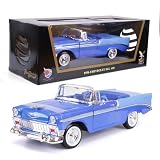
- Officially Licensed Collector’s Car This 1:18 scale die-cast model is officially licensed by Chevrolet, perfectly replicating the 1956 Bel Air. Measuring 10"L×3.5"W×3"H (255×90×75mm) and weighing 2.7 lbs (1.223kg), it’s both a premium collectible and a high-end car for kids & adults.
- Iconic 1950s American Vehicle A dream for boys and dads, featuring the Bel Air’s legendary "Shoebox" design with opening doors. Combines playability (as a vintage car) with historical authenticity.
- Durable Alloy Construction for Play & Display Made with heavy-duty die-cast metal (2.7 lbs) and scratch-resistant paint. Smooth-rolling wheels make it a fun car, while the detailed interior satisfies collectors.
- Best Gift for Men, Dads & Kids The ultimate Christmas/birthday gift for car lovers—whether as a father’s day present, boy’s car, or man cave decor. Includes elegant gift-ready packaging.
- Dual Value: Collectible + More than a display model car, it’s an interactive alloy for ages 14+. Fits perfectly on shelves (10" long) or in collections.
1956 Bel Air body styles
The 1956 Bel Air came in multiple body styles, and a four-door hardtop joined the lineup that year. Hagerty’s 2024 report says, “A stylish four-door hardtop model joined the Bel Air lineup in 1956, bringing the body style count to seven.” Confirm the exact body style before using a price comparison; a sedan, hardtop, convertible, and wagon are not interchangeable comparables.
The Bel Air was Chevrolet’s top passenger-car series above the 150 and 210. For its 1956 model description, Hagerty notes a restyled body and says those series designations carried over. Avoid assuming that every feature or design detail was shared across all body styles and trim configurations.
Rank #2

- Iconic Tri-Five Era Replica: Faithfully recreates the legendary 1956 Chevrolet Bel Air—centerpiece of Chevy’s "Tri-Five" series (1955-1957)—with its signature full-width grille, bullet-shaped tail lights, and chrome accents that defined 1950s American car culture . A must-have for vintage automotive enthusiasts and classic Chevy fans.
Engine options and performance
Hagerty’s October 24, 2024 report lists four 265-cubic-inch V-8 configurations for 1956: 162, 170, 205, and 225 hp. The exact carburetion and version matter when identifying a car or comparing specifications.
| 265-cubic-inch V-8 rating | Configuration described by Hagerty |
|---|---|
| 162 hp | Two-barrel carburetor |
| 170 hp | Two-barrel carburetor |
| 205 hp | Four-barrel carburetor; described as the Super Turbo-Fire |
| 225 hp | Dual four-barrel carburetors; Hagerty says this version arrived in January 1956 |
Hagerty gives a historical 0–60 mph claim of 8.9 seconds in its high-performance discussion. Treat that as a period performance claim reported by Hagerty, not a modern independent test or a result representative of every Bel Air. A four-door V-8 sedan specification entry from the Classic Car Database lists 265.07 cubic inches, 162 brake horsepower at 4,400 rpm, and 257 lb-ft of torque at 2,200 rpm; those figures describe that listed configuration, not every body style or engine.
Rank #3

- Brand new 1/24 scale diecast car model of 1955 Chevrolet Bel Air Green die cast car by Motormax. Brand new box. Real rubber tires.
What to check before buying
Condition and evidence matter more than broad claims about rarity or investment potential. Have a qualified classic-car inspector assess the vehicle, especially its structure and restoration, and verify the description against records where possible.
- Inspect the body, frame, floors, and other structural areas for rust or repairs.
- Check that the stated body style, engine, transmission, and options are consistent with the car and available documentation.
- Assess the quality and scope of restoration work, and distinguish original components from replacements or modifications.
- Review title, ownership history, and supporting records before relying on mileage or originality claims.
- Compare the car with recent completed sales of similar configurations and condition, not just advertisements or unsold bids.
Restoration and service research
A year-specific shop manual can help with restoration and service research, but verify that any manual you consider actually covers the 1956 Chevrolet model and the work you plan to do. The research available here does not verify a particular product listing, edition, availability, or affiliate offer, so no specific manual is recommended.
Rank #4
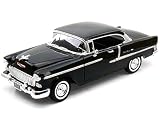
- Brand new box. Real rubber tires. True-to-scale detail. Officially licensed product. Has opening hood and doors. Manufacturer's original unopened packaging. Made of diecast metal with some plastic parts. Detailed interior, exterior, engine compartment. Dimensions approximately L-10, W-4.5, H-3 inches.
FAQ
How much is a 1956 Chevrolet Bel Air worth?
It depends on the individual car. Hagerty’s July 2026 estimate for a #3 Good-condition 1956 two-door convertible with the 162-hp V-8 is $53,967–$69,667, while recorded sales for other configurations differ substantially. Match the car’s body style, engine, condition, originality, and history to comparable completed sales.
What engines were available in the 1956 Bel Air?
Hagerty lists four 265-cubic-inch V-8 configurations rated at 162, 170, 205, and 225 hp. The 205-hp version used a four-barrel carburetor, and the 225-hp version used dual four-barrel carburetors and arrived in January 1956, according to Hagerty.
Did Chevrolet offer a four-door hardtop in 1956?
Yes. Hagerty’s 2024 report says a four-door hardtop joined the Bel Air lineup in 1956. Confirm the body style before comparing a car with sale records for sedans, convertibles, or other versions.
Is a 1956 Bel Air a guaranteed investment?
No. The available evidence does not establish guaranteed appreciation. Sale outcomes vary with configuration, condition, originality, documentation, and market context; use comparable completed sales rather than investment claims.
Quick Recap
Product prices and availability are accurate as of the date/time indicated and are subject to change. Any price and availability information displayed on Amazon at the time of purchase will apply.




