Recommended Free Tools
The coolest cars of the 1970s are not a measurable category, and this list is an editorial selection—not a market ranking. It favors cars with a distinctive visual identity, unusual engineering, meaningful motorsport connections, or lasting cultural recognition. The 17 entries include production cars and one clearly labeled concept; each belongs to the decade by its stated debut or production history.
What makes a 1970s car cool?
For this collector-oriented list, “cool” means a car gives you something specific to notice: an unmistakable shape, an engineering idea that defined its character, a competition story, or a recognizable place in automotive culture. That lens does not establish which cars are most valuable, rare, or desirable today. The list is not ranked.
Dates and production figures below are attached to the particular model or version identified; they should not be generalized to an entire nameplate. The BMW Turbo is a concept, not a production car.
17 coolest cars of the 1970s
1. Lamborghini Countach LP 400
The Countach LP 400 is the list’s defining wedge-shaped statement: a design first presented as an idea car on March 11, 1971, before series production began in March 1974. Lamborghini records 152 LP 400s produced from 1974 to 1978, a figure for this version alone—not for every Countach. Its journey from show-stopping concept to low-volume production car makes it a natural collector touchstone. Lamborghini’s Countach history documents those dates and the LP 400 total.
Free tools Windows power users keep installed
One-click scans. No signup required.
#1 Best Overall

- AUTHENTIC REPLICA: Highly detailed 1:40 scale model of the iconic 1957 Chevrolet Bel Air Coupe, measuring 5 inches in length with classic finish
- WORKING FEATURES: Functioning doors that open and close, plus pull-back motor action for interactive play value
- QUALITY CONSTRUCTION: Die-cast metal body construction provides durability and authentic feel, enhanced with detailed plastic components
- REALISTIC DETAILS: Features rubber tires for enhanced realism and smooth rolling action on various surfaces
- DISPLAY WORTHY: Perfect size for collectors and enthusiasts, combining playability with showcase appeal
2. Porsche 911 Turbo
Porsche unveiled the series-production 911 Turbo on October 3, 1974. The 1978 model-year version grew to 3.3 litres and gained a charge-air cooler; Porsche lists its output as 221 kW (300 PS) and torque as 412 Nm. That update shows how turbocharging became central to the car’s identity, rather than a cosmetic badge. Porsche also records 2,850 examples for the first-generation 911 Turbo. Porsche Newsroom’s 911 Turbo history provides the chronology and version-specific figures.
3. Lancia Stratos HF
The Stratos HF was presented at the Turin motor show in November 1971. Its sharp, compact shape looks inseparable from its rally role, and its competition story is unusually clear: the cited marque history records World Rally Championship titles in 1974, 1975, and 1976. Those results belong to the rally program; they do not mean every road-going Stratos shared the competition car’s specification. Lancia’s Stratos history and Stellantis Media’s heritage release document the presentation and championship years.
4. BMW M1 Procar
The BMW M1 Procar brings a purpose-built motorsport edge to the decade’s exotic-car landscape. BMW’s heritage account dates the Procar to 1979, making the competition connection part of the model’s appeal rather than an inference drawn from the road car alone. BMW M’s M1 Procar heritage page identifies its 1979 motorsport association.
5. Ferrari 308 GTB
The 308 GTB earns its place for the instantly recognizable mid-engined Ferrari profile that became one of the era’s most familiar sports-car silhouettes. Its compact proportions give it a different visual character from the long, low front-engined grand tourers elsewhere on this list. Consider it here as a 1970s production-car choice, not as a claim about current value or rarity.
Rank #2

- Volkswagen beetle
- Vw van
- Volkswagen van
- Item Category: Non Riding Toy Vehicle
6. Ferrari 512 BB
The 512 BB represents the decade’s appetite for dramatic, low-slung Italian grand touring. Its broad stance and cab-forward, mid-engined proportions make it a visually assertive counterpoint to more restrained European GTs. It belongs in a design-led list of the 1970s, though this article makes no production-count or market-ranking claim for it.
7. Porsche 911 Carrera RS 2.7
The Carrera RS 2.7 is a road-going 911 with a direct motorsport aura: the ducktail rear spoiler is both a visual signature and an engineering feature, not merely decoration. It represents a different kind of Porsche cool from the later 911 Turbo—lighter, more overtly focused, and closely associated with the idea of a road car shaped by competition priorities.
8. Lotus Esprit S1
The Esprit S1 brought a sharply geometric, mid-engined profile to the British sports-car scene. Its wedge design makes it one of the decade’s clearest expressions of the era’s angular styling, while the low roof and compact cabin give it a distinctly purposeful look even at rest.
9. De Tomaso Pantera
The Pantera’s appeal lies in its blend of Italian styling and American V8 character. That cross-continental mix gives it a personality distinct from the European cars that pursued refinement or high-revving engineering above all else. Its long hood and low, wide body make the combination legible before the engine is ever started.
Rank #3
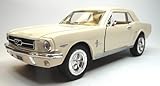
- Authentic 1:36 Scale: Meticulously crafted 1964 1/2 Ford Mustang model car with impressive 5-inch length.
- Realistic Details: Die-cast metal body with opening doors and eye-catching blue finish.
- Interactive Play: Engaging pull-back action for thrilling motion across smooth surfaces.
- Collectible Quality: Ideal for model car enthusiasts and collectors seeking miniature automotive replicas.
- Brand: KiNSMART, a trusted name in die-cast vehicle models and toys.
10. Chevrolet Corvette C3
The third-generation Corvette made the long-hood, short-deck American sports-car formula unusually theatrical. Its curving body and pronounced fenders are a strong visual contrast to the wedge shapes and compact European coupes in this selection. The C3’s decade-long presence also makes it a useful reminder that 1970s car design was not one single style.
11. Datsun 240Z and 260Z
The 240Z and 260Z pair a long-nose sports-car profile with a more approachable scale than many high-end European coupes. Including both acknowledges the Z line’s development through the decade while avoiding the implication that the two are identical versions. Their appeal here is the clear, balanced shape and the alternative they offered to buyers drawn to the traditional European sports-car look.
12. BMW 3.0 CSL
The 3.0 CSL is a standout for its close association with touring-car competition and its deliberately purposeful appearance. The lightweight-special idea gives the car a character beyond polished luxury: it looks like a road car that has been pared back and sharpened for a job. Its motorsport identity is the reason it belongs among the decade’s most memorable BMWs.
13. Mercedes-Benz 450 SEL 6.9
The 450 SEL 6.9 is the list’s great high-speed saloon: understated in outline compared with the supercars, yet compelling for the way it combines executive-car form with imposing performance intent. It demonstrates that a cool 1970s car did not have to be small, exotic, or overtly sporting.
The Tool Desk
Outbyte Driver Updater FREEFix the driver behind crashes, sound loss and screen glitchesFind Drivers →Outbyte PC Repair FREEClear out junk files and repair common Windows errorsFree Scan →Rank #4

- Pullback Action: Experience realistic racing with the pullback action feature.
- Opening Doors: Explore the intricate interior details with the opening door feature.
- 1:38 Scale: Enjoy a detailed 1:38 scale die-cast model (approx. 5 inches long).
- Authentic Design: Modeled after the iconic 1967 Ford Shelby Mustang GT500.
- Display Piece: A must-have collectible for car enthusiasts and model collectors.
14. Citroën SM
The SM feels unlike almost anything else on the list. Its long, tapered body and distinctive front treatment reflect Citroën’s willingness to make a grand tourer that looked and felt unconventional. For collectors drawn to engineering character as much as familiar badges, its visual originality is the point.
15. Aston Martin V8
The Aston Martin V8 gives the decade a distinctly British grand-touring answer: muscular proportions, a restrained surface treatment, and a sense of substantial presence. It occupies a different emotional register from the lighter sports cars here, favoring the image of a fast, long-distance coupe.
16. Alfa Romeo Montreal
The Montreal is a striking design-led choice, with unusual headlamp detailing and a sculptural front end that make it recognizable in a crowded field of Italian coupes. Its distinctive face rewards close inspection and gives the list a car whose coolness comes as much from visual eccentricity as from performance associations.
17. Pontiac Firebird Trans Am
The Trans Am supplies the list’s most unmistakably American muscle-car attitude. Its bold stance and conspicuous styling made it a natural cultural symbol of the decade’s performance-car image. That visual confidence is a different kind of cool from the technical subtlety of the BMW Turbo or the rally focus of the Stratos.
Quick wins for a faster PC:
Fix the driver behind crashes, sound loss and screen glitchesFind Drivers →Clear out junk files and repair common Windows errorsFree Scan →Scan for outdated or missing drivers - takes under a minuteDriver Scan →Which 1970s cars are collectible?
All 17 are plausible subjects for a collector’s shortlist, but “collectible” does not establish a single price tier, rarity level, or investment outlook. This list supplies no current market values or auction-trend comparisons. When evaluating a specific car, distinguish its exact version and production history from the broader nameplate: for example, the 152-unit figure applies only to the Countach LP 400, while Porsche’s 2,850 figure refers to the first-generation 911 Turbo.
For a tangible enthusiast display project rather than a real vehicle or restoration part, LEGO’s catalog includes a Lamborghini Countach 5000 Quattrovalvole building set, and Revell lists a Countach LP500S model kit. Product catalogs do not establish live retail availability. LEGO’s car catalog and Revell’s Countach LP500S kit listing describe those scale/build products.
Quick Recap
Product prices and availability are accurate as of the date/time indicated and are subject to change. Any price and availability information displayed on Amazon at the time of purchase will apply.




