What’s actually slowing this PC down?
Pick the symptom - the matching free tool is one click away.
The most consequential electric vehicles are not necessarily the fastest, longest-range, or most expensive. They are the EVs that changed what buyers, engineers, and automakers believed an electric car could be. The Nissan LEAF normalized mass-market ownership; the Tesla Model S made long-range, software-led luxury credible; the Hyundai IONIQ 5 and Porsche Taycan made ultra-fast charging a central engineering goal; and newer vehicles such as the Ford F-150 Lightning and Kia EV9 expanded the definition of automotive utility.
This is a curated technology-and-market-impact list, not a definitive ranking of the ten best EVs. It spans different eras, body styles, price classes, and markets. Range figures are labeled by test cycle and geography wherever available because historical JC08 results, U.S. EPA estimates, and European WLTP figures are not directly interchangeable.
The 10 EVs at a glance
| EV | Segment | What made it consequential | Representative specification or claim | Status and caveat |
|---|---|---|---|---|
| Nissan LEAF | Compact hatchback | Helped establish the modern mass-market EV | Original 200-kilometer JC08 range claim | Historical figure; not a current U.S. EPA estimate |
| Tesla Model S | Luxury sedan | Combined long range, acceleration, software, and charging infrastructure | Up to 410 miles of U.S. EPA-estimated range on Tesla’s current U.S. page | Trim, wheels, conditions, and charging state affect results |
| Hyundai IONIQ 5 | Electric crossover | Moved 800-volt charging and vehicle-to-load power toward the mainstream | 2025 U.S. model: 10% to 80% in as little as 20 minutes on an 800-volt, 350-kW charger | Manufacturer timing under stated conditions |
| Porsche Taycan | Performance sedan and wagon | Made repeatable electric performance a core engineering objective | Up to 320 kW and approximately 18 minutes from 10% to 80% with Performance Battery Plus under optimal conditions | Peak charging power is not an average |
| Lucid Air | Luxury sedan | Made efficiency, not just battery size, the headline technology | Range varies substantially by trim, wheels, battery, and market | Check the exact current EPA configuration before comparing |
| Ford F-150 Lightning | Full-size electric pickup | Turned the truck battery into a worksite and home-energy resource | Up to 9.6 kW of Pro Power Onboard output | Home backup requires compatible hardware and installation |
| Rivian R1T | Adventure pickup | Used EV packaging to create new recreation and storage functions | Gear Tunnel, 120-volt outlets, and a 1,500-watt shared outlet-circuit limit on documented equipment | Equipment varies by model year and configuration |
| Kia EV9 | Three-row SUV | Made genuinely family-sized electric transportation more practical | Up to 160.3 cubic feet of passenger room and 81.7 cubic feet of cargo volume behind the first row | U.S. pricing and equipment are model-year specific |
| Tesla Cybertruck | Full-size pickup | Introduced production steer-by-wire and a 48-volt low-voltage system | Four-wheel steering and no mechanical steering connection according to Tesla documentation | Describe Tesla’s implementation rather than generalizing to all EVs |
| Mercedes-Benz EQS | Luxury flagship sedan | Reimagined the flagship around electric efficiency and aerodynamic design | Exact range, drag, battery, and charging specifications vary by market and model year | Use the relevant current-market specification sheet |
How to read the table: Manufacturer specifications and claims are identified as such. Charging figures are usually peak or best-case values, while range figures depend on the testing authority, trim, wheels, temperature, and driving conditions.
1. Nissan LEAF: the mass-market starting point
The Nissan LEAF belongs on this list because it helped turn a battery-electric car from a fleet experiment or luxury novelty into a globally marketed consumer product. Nissan began production in 2010 and identifies the LEAF as the world’s first mass-market electric vehicle.
PC Slower Than It Used to Be?
A free scan shows the junk files, broken settings and background clutter dragging Windows down - then fixes them in one click.Free scan · Windows 10 & 11Outdated Drivers Are Slowing You Down
One free scan finds every outdated or missing driver and matches the right update for your exact hardware.Free scan · exact hardware match#1 Best Overall

- Flex Level 1 EV Charger - The EVDANCE Level 1 electric car charger is compatible with J1772 electric vehicles and plug-in hybrid vehicles (North American Standard). *Tesla requires a SAE J1772 adapter.
- Convenient to Use - This charger has both NEMA 6-20 plug for 16A 240V charging (3.68kW, 10-12 mi/h) and a NEMA 6-20 to 5-15 plug adapter for 12A 120V charging (1.44kW, 2-5 mi/h). The included bag makes it easier to carry on the go. It also has a 25ft cable length, you can use it flexibly from anywhere in the garage or driveway.
- Check Your Outlet Type -This charger works with standard 120V NEMA 5-15/5-20 outlets (2-5 mph charging speed) and 240V NEMA 6-20 outlets (10-12 mph) . It's not compatible with NEMA 6-15/10-30/14-30/14-50/6-50 outlets – you'll need a NEMA 14-50/14-30/10-30/6-50 to 6-20 adapter (sold separately) to connect.
- Compatible EV Models -This EV charger works with most major electric vehicles, including Ford, Chevrolet, Hyundai, Audi, Nissan Ariya, Rivian R1S, Kia, and others. However, it's not compatible with Mini Cooper Electric Hardtop,Toyota Prus Prime/Z4X/RAV4Prime, Porsche Taycan Base/4S/Turbo/Turbo S or Tesla models (Tesla requires a J1772 to Tesla Adapter, sold separately). For a full list of compatible models, check out the Full Compatibility List on our product page.
- Indication Displays - LED display that can tell you the status as well as indicate errors while charging your electric vehicle.
Its importance was not simply that it used lithium-ion propulsion. The LEAF presented EV ownership as an ordinary consumer choice: a hatchback that could be purchased, driven daily, monitored remotely, and charged at home. Remote battery and climate controls also helped establish the connected-EV ownership experience that is now common across the industry.
Nissan’s early work also treated the vehicle battery as more than a propulsion device. The company documented vehicle-to-home ambitions and broader vehicle-to-grid possibilities, helping introduce the idea that parked EVs could become energy assets. Those concepts were not equally available in every market or on every LEAF, but they anticipated the energy-management role that newer EVs are beginning to pursue.
One frequently repeated LEAF statistic requires careful labeling. The original car’s roughly 200-kilometer range was a Japanese JC08 test-cycle figure. It should not be placed beside a modern U.S. EPA estimate as if both measurements represented the same conditions. The comparison that matters historically is not whether the first LEAF matched today’s road-trip EVs; it is that the car made mass-market electric ownership visible and commercially plausible.
2. Tesla Model S: the long-range, software-led luxury EV
The Tesla Model S changed the conversation by showing that an EV could compete with premium sedans on several fronts at once: range, acceleration, cabin technology, software, and long-distance usability. Earlier electric vehicles often required buyers to accept compromises in performance or practicality. The Model S instead made the battery-electric powertrain part of the vehicle’s appeal.
Its influence extended beyond the car itself. A large central touchscreen, frequent software updates, integrated route planning, and a dedicated fast-charging network made the ownership experience feel more like a continuously updated technology product than a conventional sedan. Route planning that accounts for charging stops also helped make battery range a system-level question rather than a number printed on a window sticker.
Tesla’s current U.S. Model S page lists up to 410 miles of EPA-estimated range for a dual-motor version. Tesla also claims that the car can add up to 205 miles of range in 15 minutes under its stated conditions. The second figure is not a universal charging result: battery state of charge, temperature, charger availability, battery conditioning, and the vehicle’s configuration all affect how quickly energy is added.
The Model S therefore changed two expectations simultaneously. It raised the perceived ceiling for EV range and helped convince the industry that charging infrastructure, software, and vehicle design need to be developed as one ownership ecosystem.
3. Hyundai IONIQ 5: the flexible-platform and fast-charging breakthrough
The Hyundai IONIQ 5 brought several ideas that had previously seemed specialized into a relatively mainstream crossover. Its dedicated EV platform supports an 800-volt electrical architecture, unusually flexible interior packaging, vehicle-to-load power, and high-speed DC charging. Its retro-futurist shape also made advanced EV engineering visually distinctive rather than anonymous.
Do these 3 things before closing this tab:
1Scan for outdated or missing drivers - takes under a minute2Repair Windows errors before they cause bigger problems3Fix the driver behind crashes, sound loss and screen glitchesFor the 2025 U.S. model, Hyundai says the IONIQ 5 can charge from 10% to 80% in as little as 20 minutes when connected to an 800-volt, 350-kW DC charger. Hyundai also says it can add up to 178 miles in 15 minutes under stated conditions. These are manufacturer figures, not guarantees for every charging stop. Actual results depend on the charger, battery temperature, starting state of charge, vehicle configuration, and how the charging curve is managed.
The significance of 800 volts is not that voltage alone makes every charging session faster. The architecture can permit high power with lower current for a given power level, but the vehicle and the charging station must both support the necessary hardware. The IONIQ 5 helped make that distinction part of the mainstream EV discussion.
Vehicle-to-load capability adds another layer of usefulness. With the appropriate equipment, the car can supply power to external devices, turning a family crossover into a source of electricity for tools, appliances, camping equipment, or emergency uses. The 2025 U.S. model also introduced a factory NACS port for access to Tesla Superchargers while retaining compatibility with other networks through a CCS adapter. That change reflects the industry’s connector transition, but it does not mean every adapter works with every car, charger, or authorization system.
Rank #2
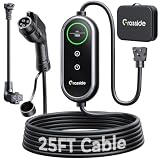
- Universal J1772 Compatibility: Designed with a standard J1772 connector, this J1772 charger works with most J1772 electric vehicles and PHEVs, including BMW, Mercedes-Benz, Hyundai, Kia, Nissan, Rivian, Ford, Chevy, Volkswagen, Toyota and more. Note: Tesla vehicles require a J1772 to Tesla adapter (not included)
- Flexible Outlet Compatibility: This portable EV charger comes with a NEMA 6-20 plug and a NEMA 5-15/5-20 to 6-20 adapter. Supports Level 1 (8–12A) and Level 2 (16A). Max 12A (1.44kW) on 120V NEMA 5-15/5-20 outlets, and full 16A (3.84kW) with a 240V NEMA 6-20 outlet. One charger is designed to cover home, garage, and travel charging needs with reliable performance
- Adjustable Smart Charging Control: Customize charging safely with adjustable current settings (8A/10A/12A/16A) to match different circuits. The 0–12 hour delay timer helps schedule overnight charging during lower electricity rates. Integrated LCD display shows real-time voltage, current, power, and charging status for clear monitoring without apps. Note: Press 'A' or 'T' for 3s to set and confirm.
- Home Charging & Travel Backup: For daily home use while remaining fully portable for travel. This level 1 ev charger includes a durable 25FT ev charging cord, providing flexible reach for garage or driveway charging. Charge overnight to take advantage of lower utility rates—potentially saving up to $500 annually on electricity costs. The included carrying case makes storage easy and keeps a dependable backup charger available in your trunk for road trips or visiting friends
- Engineered For Safety & Durability: Built for dependable daily use, this electric car charger features an IP65 waterproof rating for all weather operation. Equipped with a UL-listed cable, fully rubberized connector, and advanced protection against overcurrent, overheating, and electrical faults. Designed to ensure safe, stable, and long-term charging performance in demanding environments
A charging accessory is only useful when the connectors match
For home or travel AC charging, a J1772 EV charging cable can be useful, but buyers should verify the vehicle inlet, the outlet or EVSE plug, amperage, voltage, cable length, weather rating, and whether the product carries appropriate UL or ETL certification. A J1772 cable is not a universal replacement for a DC fast-charging connection, and an adapter does not automatically guarantee access to every public charging network.
Recommended Free Tools
4. Porsche Taycan: proving that EV performance can be repeatable
The Porsche Taycan challenged the idea that electric performance was mainly a brief acceleration spectacle. Its engineering emphasis includes sustained performance, high-speed stability, thermal management, rapid charging, and predictable handling—qualities that matter on a road trip, a demanding road, or a track session.
Porsche’s current U.S. material describes an 800-volt architecture, charging capability of up to 320 kW with the Performance Battery Plus, and an approximate 10% to 80% charging time of 18 minutes under optimal conditions. Porsche also highlights thermal management and a two-speed transmission on the rear axle.
That two-speed arrangement is significant because it shows that electric drivetrains do not have to follow a single-speed formula in every application. The first ratio can support acceleration while the second helps sustain high-speed performance and efficiency. More broadly, the Taycan treated battery cooling, motor control, and charging behavior as parts of a performance system rather than secondary details.
The 320-kW figure should always be written as “up to.” It is a peak under suitable 800-volt charging conditions, not the average power a driver will receive throughout a session. Charging normally tapers as the battery fills, and conditions outside Porsche’s optimal scenario can produce different results.
Quick wins for a faster PC:
Scan for outdated or missing drivers - takes under a minuteDriver Scan →Clear out junk files and repair common Windows errorsFree Scan →Fix the driver behind crashes, sound loss and screen glitchesFind Drivers →5. Lucid Air: making efficiency a headline technology
The Lucid Air represents one of the clearest arguments that EV range is not only a battery-size contest. Its technological significance comes from the combination of aerodynamic design, compact electric-drive hardware, high energy density, and long-distance range in a luxury sedan.
That approach matters because a larger battery can increase range while also adding weight, cost, material demand, and charging burden. Improving the efficiency of the motor, inverter, battery integration, thermal system, and body can deliver more usable distance without relying solely on additional battery mass.
Lucid Air range varies substantially by trim, wheel design, battery configuration, model year, and market. A buyer comparing the Air with another luxury EV should therefore use the exact current EPA configuration for a U.S. comparison, or the relevant regulatory figure for another market. A single range number presented as universal would be misleading.
The Air’s larger contribution to the EV landscape is conceptual: it makes efficiency itself a premium feature. Lower energy consumption can reduce the size of the battery needed for a target range, shorten charging demands for a given trip, and improve the relationship between vehicle size and energy use.
The Tool Desk
Outbyte Driver Updater FREEScan for outdated or missing drivers - takes under a minuteDriver Scan →Outbyte PC Repair FREEClear out junk files and repair common Windows errorsFree Scan →6. Ford F-150 Lightning: turning an electric pickup into an energy tool
The F-150 Lightning uses its battery for familiar pickup functions and for tasks that conventional trucks cannot perform as naturally. Ford documents Pro Power Onboard output of up to 9.6 kW, with outlets in the cab, frunk, and bed. That can support tools at a worksite, equipment at a campsite, or electrical devices during an outage.
The truck also helped make vehicle-to-home backup understandable to mainstream truck buyers. Ford says an extended-range Lightning can provide full-home power for up to three days based on an assumed household use of 30 kWh per day. Actual duration depends on what the home is running, the battery’s state of charge, weather, and whether the household uses energy conservatively.
Home backup is not a simple plug-in feature. Ford’s system requires compatible hardware, including the Ford Charge Station Pro and Home Integration System, along with professional electrical installation. Ford identifies Qmerit and Sunrun within the installation ecosystem, but availability, eligibility, pricing, and service geography must be checked for the specific vehicle and location.
Rank #3

- Road-Trip Ready & Apartment-Friendly: Comes with a 20ft heavy-duty cable that easily spans a standard parking space, plus a NEMA 5-15 adapter for plug and play convenience. Whether you're charging at home or hitting the highway, this portable EV Charger is your ultimate travel companion for weekend getaways and camping trips
- Delay Timer & Adjustable Current: Use the built-in timer to delay your start by 1-12 hours and easily harvest off-peak energy savings. Then pick from 6/8/10/12/16A (Level 2) to match your garage grid. It automatically locks in your favorite setting and never forces you to re-adjust. No complicated apps or Wi-Fi needed, just straightforward, reliable control
- Tactile Buttons & LED Screen: No glitchy smartphone apps or finicky touchscreens that lag, freeze, and misfire in winter. Our EV charger is engineered with a high-definition LED display that tracks critical real-time data, including live voltage and current. Tactile buttons deliver direct, satisfying click feedback that remains highly responsive even when wearing heavy winter gloves or operating in torrential downpours—conditions where standard touchscreens completely fail
- ETL Certified Safety & IP65 All-Weather Shield: ETL certified to meet US safety standards for charging. Engineered with a certified IP65 dust-and-waterproof enclosure and a heavy-duty TPE cable that operates reliably across a wide -22°F to 130°F range. An intelligent multi-protection defense system (GFCI, over-voltage, over-current, surge, short-circuit, and over-temp) keeps a 24/7 watch for 100% safe, unattended overnight charging in any weather
- J1772 Compatible + Dual-Level Charging: Works with all J1772 EVs (Tesla requires a separate J1772 adapter). Level 2: built-in NEMA 6-20 plug. Level 1: included NEMA 5-15 adapter fits any standard outlet. Please confirm your outlet is NEMA 6-20 or 5-15 before purchase
The Lightning changed the landscape because it translated the electric powertrain’s exportable energy into the language of pickup ownership: worksite power, camping power, emergency backup, and even vehicle-to-vehicle charging. Its importance is less about replacing every generator or home-energy system than about showing that a truck battery can perform useful work while the truck is parked.
Free tools Windows power users keep installed
One-click scans. No signup required.
7. Rivian R1T: the electric adventure pickup
The Rivian R1T helped establish a category of electric pickup designed around recreation, storage, software, and off-road travel rather than simply copying the proportions and functions of an internal-combustion truck.
Its signature Gear Tunnel is a pass-through storage compartment between the cab and the bed. That space illustrates a central EV packaging advantage: designers can use the absence of a conventional engine, exhaust system, and related hardware to create storage solutions that do not have an obvious equivalent in a traditional pickup.
Rivian owner documentation describes 120-volt outlets, an onboard air compressor on equipped vehicles, and a 1,500-watt limit for the shared outlet circuit. Those features support a lifestyle-oriented interpretation of utility, from inflating tires and powering equipment to preparing for outdoor travel.
Configuration matters. Outlet availability, compressor equipment, payload, towing range, battery options, and off-road hardware can vary by model year and trim. The R1T should not be treated as one fixed specification. Its broader influence is the demonstration that an electric truck can be designed around how people use outdoor equipment, not merely around matching the towing or bed measurements of a gasoline pickup.
8. Kia EV9: making three-row family practicality electric
The Kia EV9 is important because the three-row SUV segment exposes the hardest practical compromises in EV design. A vehicle needs enough battery for a large, heavy body while still providing usable passenger space, cargo room, comfortable access, and acceptable charging behavior.
Kia’s current U.S. material describes a three-row cabin, up to 160.3 cubic feet of passenger room, and up to 81.7 cubic feet of cargo volume behind the first row. Those figures are manufacturer specifications and can vary with seating configuration and equipment, but they show why the EV9 matters: it is designed as a genuinely family-sized SUV rather than a compact crossover with occasional third-row seats.
Available vehicle-to-load power extends the same energy-device concept seen in the IONIQ 5 and F-150 Lightning. The EV9 can supply electricity to external equipment when configured and used with the appropriate hardware, making it useful beyond the daily commute.
Kia’s cited U.S. page lists a 2026 Light Long Range rear-wheel-drive version starting at $57,900 before destination, taxes, options, and dealer charges. Pricing, incentives, equipment, and availability can change, so that figure should be treated as a model-year-specific reference rather than a permanent market price.
The EV9’s influence is practical rather than theatrical. It helps answer a question that has limited EV adoption in some households: can one electric vehicle handle children, passengers, luggage, and everyday family logistics without requiring a smaller second vehicle?
9. Tesla Cybertruck: productionizing steer-by-wire and a new electrical architecture
The Cybertruck is consequential for more than its unconventional exterior. Tesla’s owner documentation describes production steer-by-wire, meaning there is no traditional mechanical connection between the steering wheel and the road wheels. Tesla also documents four-wheel steering and a 48-volt lithium-ion low-voltage battery.
Rank #4

- LEVEL 1 CHARGING - The Lectron Level 1 Charger lets you quickly charge your EV with a standard 120V outlet; You get 15 amps and 1.65 kW of power for the standard full-charge time for your car, at home or at wor
- CONVENIENT OVERNIGHT CHARGING - The Lectron 15 Amp EV Charger is a more affordable and faster charging option compared to other Level 2 EV chargers, delivering an extra 40-50 miles of overnight charge at home — without breaking the bank
- J1772 COMPATIBILITY - This J1772 charger is compatible with all electric vehicles that use the J1772 standard, including BMW, Ford, Honda, Hyundai, Kia, Porsche, Nissan, and Chevy
- SAFE AND RELIABLE - FCC and ETL certified (UL2594 standard) for safety with overvoltage, overcurrent, and short circuit protection; Energy Star certified for efficiency; IP65 rated for dust and water resistance
- PORTABLE CONVENIENCE - Whether you're on a road trip or visiting a friend, you can easily plug in your EV and charge with our portable EV charger. Please refer to the included User Manual for complete operating instructions and compatibility requirements
Steer-by-wire changes the relationship between the driver’s input and the front wheels. Software and electronic control become central to steering response, packaging, and the vehicle’s ability to coordinate four-wheel steering. The 48-volt low-voltage system likewise points toward a higher-voltage electrical architecture for accessories and control systems than the 12-volt systems long used across the industry.
The important wording is precise: these are technologies Tesla implemented in the Cybertruck according to Tesla’s documentation. The vehicle is not proof that every future EV will eliminate mechanical steering links, nor should claims about safety behavior or redundancy be generalized beyond the manufacturer’s documented system.
As a production pickup, the Cybertruck shows how EV-specific packaging and electrical architecture can support features that were once more common in prototypes or specialized vehicles. Its influence may ultimately be measured less by whether other pickups copy its appearance and more by whether steer-by-wire, four-wheel steering, and higher-voltage low-voltage networks become easier for other manufacturers to justify.
10. Mercedes-Benz EQS: the aerodynamic electric flagship
The Mercedes-Benz EQS represents the luxury industry’s attempt to redesign a flagship sedan around electric efficiency, quietness, space, and aerodynamic drag rather than adapting an existing combustion-car shape.
A dedicated EV body gives designers more freedom to manage airflow, battery placement, cabin space, and the visual identity of a flagship. The EQS also places premium cabin technology and long-distance travel capability inside a vehicle conceived as an electric technology platform rather than simply an electrified version of a conventional sedan.
Exact EQS range, drag coefficient, battery, and charging figures vary by market, trim, model year, and testing procedure. Mercedes-Benz’s current technical information for the relevant market should be used before publication or purchase. Its design claims should also be distinguished from independently regulated EPA or WLTP results.
The EQS changed the landscape by showing that electrification could reach the symbolic top of a manufacturer’s passenger-car range. The flagship was no longer only a showcase for a large engine and mechanical refinement; it could instead showcase aerodynamic optimization, battery integration, premium software, and low-noise electric travel.
Independent reader supportYour contribution helps us test, update, and keep practical guides available for everyone.What these EVs changed together
Charging architecture is becoming as important as battery size
The IONIQ 5 and Taycan show why the charging conversation has moved beyond battery capacity. An 800-volt system can support high charging power when the vehicle, battery-management system, and charger are all compatible. But the largest number on a charger or specification sheet is not the same as the average power delivered during a complete session.
Drivers should distinguish among the vehicle’s AC charging capability, its DC fast-charging capability, the connector used in a particular market, and the network’s ability to provide the advertised power. Starting state of charge and battery temperature can matter just as much as the charger’s nominal rating.
The vehicle is becoming an energy device
The LEAF’s early vehicle-to-home and vehicle-to-grid ambitions anticipated a broader shift. The IONIQ 5 and EV9 use vehicle-to-load capability to power external devices. The F-150 Lightning can provide substantial onboard output and, with the required equipment, support home backup. These functions are related but not identical:
Quick wins for a faster PC:
Fix the driver behind crashes, sound loss and screen glitchesFind Drivers →Clear out junk files and repair common Windows errorsFree Scan →Scan for outdated or missing drivers - takes under a minuteDriver Scan →- Vehicle-to-load, or V2L: supplies power to external devices, tools, appliances, or equipment.
- Vehicle-to-home, or V2H: supplies power to a building through compatible charging and transfer hardware.
- Vehicle-to-grid, or V2G: allows a compatible vehicle and energy system to exchange power with the electric grid under an approved program.
Availability depends on the vehicle, market, charger, electrical installation, utility rules, and software. A vehicle having a large battery does not automatically mean it can safely power a house or export energy to the grid.
Best Value

- 【Delay Timer - Adjustable Current】Ev charger can adjust the current (8A/10A/12A/16A) through the physical button of level 1 ev charger. Charging power can reach up to 3.68KW (240V/16A). One-touch switch for ev charger operation. Built-in 2–8 hour delay timer for off-peak charging to save on electricity bills.
- 【NEMA 6-20 Plug & NEMA 5-15 Adapter】Nema 6-20 plug for 240V outlets and 5-15 adapter for standard 120V realize plug-and-charge (With 5-15 adapter, need to adjust the current to 12A or below, otherwise the charger may be demeged). Overall length of ev charger level 2 is 27FT, providing enough charging distance across garages at home or outdoor. Portable storage bag supports you take portable EV Charger during travel, business trip, electric vehicle charging stations anywhere.
- 【ETL/FCC and IP67 Safety】J1772 charger is equipped with advanced safety functions such as overvoltage, overheating, and short-circuit automatic shutdown. IP67 waterproof and dustproof, extreme temperature protection level for withstanding harsh weather conditions from -40°F to 131°F in sunny, rain, snow and sandstorm. Electric car charger has ETL certified, FCC listed, meets UL safety standards. Industrial-grade construction with high-strength TPU-coated cables and 99.95% oxygen-free copper cores.
- 【J1772 Connector】J1772 charger works for all J1772 standard electric vehicles, Ford, GM, Nissan, Audi, Kia, Honda, BMW, Hyundai, Gmc, Chevy, Mercedes, and all PHEV/BEV. [Not fits Tesla cars/Nacs connector]
- 【One-Touch Charging Operation】16A electric car charger supports plug-and-charge functionality and features one-touch scheduled charging and current adjustment. Its intuitive and user-friendly operation allows flexible customization of personalized charging plans. Level 1 ev charger automatically shuts off when your car is fully charged.
EV packaging creates new kinds of utility
The Rivian R1T’s Gear Tunnel and the Kia EV9’s three-row layout illustrate two sides of the same advantage. Electric platforms can place major components under the floor and reduce the packaging constraints imposed by a front-mounted engine, exhaust, fuel system, and driveshaft tunnel.
That freedom can produce pass-through storage, a usable frunk, more flexible cabin layouts, or a full-size third row. It does not eliminate the compromises of weight, crash structure, battery volume, and cargo geometry, but it gives designers different places to solve them.
Software and electrical architecture are now visible vehicle features
The Model S made software updates, touchscreen-centered controls, and integrated route planning central to the ownership experience. The Cybertruck takes the next step by making steering control and low-voltage electrical architecture part of the vehicle’s public identity. These examples show that an EV’s innovation can be found in the control systems and energy pathways as much as in the motor itself.
How to compare revolutionary EVs without misleading yourself
- Match the test cycle. Compare U.S. EPA estimates with other U.S. EPA estimates, WLTP with WLTP, and historical JC08 figures with other JC08 figures. Treat mixed-cycle tables as historical context, not a precise ranking.
- Match the model year and trim. Wheels, battery size, drive configuration, software, and equipment can materially change range, charging, price, and utility.
- Separate peak charging from trip time. A vehicle may briefly reach a stated peak power without maintaining it throughout the charging session.
- Check the connector and network. NACS, CCS, and J1772 describe different charging interfaces and use cases. An adapter may be required, and compatibility can depend on the vehicle and charger.
- Ask what the battery can do while parked. V2L, V2H, and V2G are different capabilities. Look for required hardware and installation requirements before treating them as purchase features.
- Check real-world constraints. Cold weather, highway speed, towing, roof loads, payload, tire choice, and HVAC use can reduce range relative to a laboratory estimate.
- Verify availability locally. A vehicle or trim may be current in one market, unavailable in another, or replaced by a newer model year.
Why there is no single “best” revolutionary EV
Each vehicle on this list changed a different assumption. The LEAF proved that a battery-electric car could be mass-market. The Model S raised expectations for range and software. The IONIQ 5 made fast charging and exportable power feel attainable in a family crossover. The Taycan proved that performance could be repeatable. Lucid made efficiency a central engineering achievement.
The Lightning and R1T expanded electric utility into work and adventure. The EV9 addressed the needs of large families. The Cybertruck brought steer-by-wire and a 48-volt low-voltage system into a production pickup. The EQS showed that a luxury flagship could be designed around an electric platform from the start.
That is why a simple range ranking would miss the point. “Revolutionary” can mean historically important, architecturally influential, practically useful, or technically novel. The most important EV for one buyer may be the one that solves a specific problem: affordable daily transportation, long-distance charging, worksite electricity, third-row space, outdoor storage, or efficient luxury travel.
Frequently Asked Questions
Are the range figures for these EVs directly comparable?
No. The LEAF’s original 200-kilometer figure used Japan’s JC08 cycle, while the Model S figure cited here is a U.S. EPA estimate. European WLTP figures are another measurement system. Even within one test cycle, trim, wheels, temperature, and equipment can change the result.
What’s actually slowing this PC down?
Pick the symptom - the matching free tool is one click away.
What is the difference between V2L, V2H, and V2G?
V2L powers external devices directly from the vehicle. V2H can power a building through compatible transfer equipment and installation. V2G allows controlled exchange with the electric grid through an approved vehicle, charger, utility, and software setup. These capabilities are not interchangeable.
Does an 800-volt EV always charge faster than a 400-volt EV?
Not automatically. An 800-volt architecture can support high power efficiently, but the vehicle, battery temperature, state of charge, charger, cable, and network must all support the intended rate. Peak power is also different from average power over a complete session.
Which EV on this list is the most practical for a family?
That depends on the family’s needs. The Kia EV9 is the clearest three-row choice in this group, while the Hyundai IONIQ 5 is a more crossover-sized option. A Ford F-150 Lightning may be more useful for a household that needs pickup capability and optional home backup.
Should I buy a J1772 cable or a NACS adapter?
Choose based on the vehicle’s inlet, the charging equipment you plan to use, and the network you need to access. A J1772 cable is generally associated with AC charging, while NACS and CCS adapters have vehicle- and charger-specific compatibility requirements. Verify amperage, voltage, connector type, certification, and authorization support before purchasing.
Crashes, No Sound, or Screen Glitches?
Random freezes, missing sound and display glitches usually trace back to one bad driver. Find and replace yours safely.Free scan · under a minuteWindows Errors? Fix Them Before They Spread
Repair common Windows errors and clear accumulated junk for a smoother, more stable PC - no reinstall needed.Free scan · no reinstallThe Bottom Line
These ten EVs changed the automotive landscape in different ways rather than following one formula. The LEAF made EV ownership ordinary; the Model S made it aspirational; the IONIQ 5 and Taycan advanced charging architecture; Lucid pushed efficiency; Ford and Rivian redefined truck utility; Kia expanded family practicality; Tesla’s Cybertruck explored new control and electrical systems; and Mercedes-Benz brought the electric platform to the flagship class.
The lasting lesson is that EV progress is no longer measured only by motor power or battery range. Charging speed, software, packaging, exportable electricity, thermal management, and electrical architecture are now just as important to what a vehicle can be.
Quick Recap
Product prices and availability are accurate as of the date/time indicated and are subject to change. Any price and availability information displayed on Amazon at the time of purchase will apply.